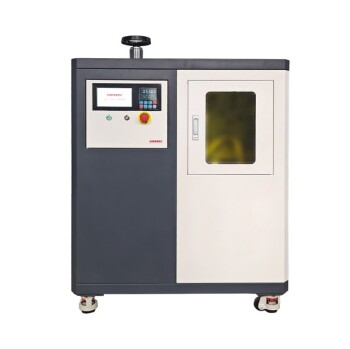
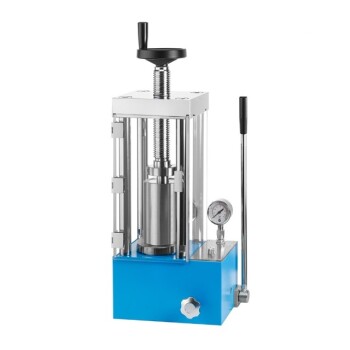
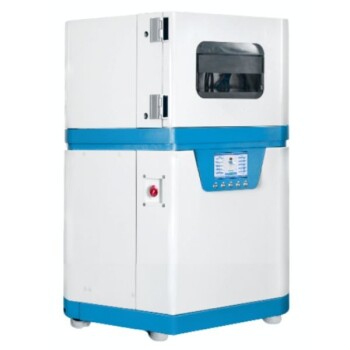
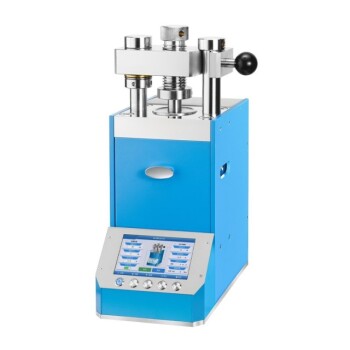
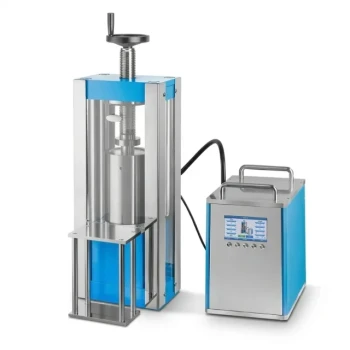
A warm isostatic laminator functions as a critical densification tool that eliminates voids within solid-state battery electrodes. By simultaneously applying high temperatures and uniform (isotropic) pressure in a sealed environment, it physically forces viscous molten electrolytes into the microscopic pores of the electrode material to create a solid, continuous structure.
The primary value of this process is the transformation of a porous, discontinuous electrode into a dense, high-performance component. By driving electrolyte into micropores, it establishes the continuous lithium-ion transport channels necessary for efficient energy storage.
The Mechanism of Porosity Reduction
Leveraging Viscosity and Pressure
The process relies on the distinct physical properties of the electrolyte. Under the high temperatures generated by the laminator, the electrolyte becomes molten and viscous.
Simultaneously, the machine applies high pressure. This mechanical force overcomes the natural surface tension of the viscous fluid, driving it deep into the complex microstructure of the electrode.
The Importance of Isotropic Force
Unlike standard pressing, which applies force from only one direction, isostatic lamination applies pressure equally from all directions.
This ensures that the electrolyte penetration is uniform throughout the composite material. It prevents the formation of density gradients where some areas are well-filled while others remain porous.
Impact on Electrode Architecture
Eliminating Micropores
The primary enemy of solid-state battery performance is "unfilled porosity"—essentially microscopic air gaps within the electrode.
The warm isostatic laminator targets these specific voids. By forcing the molten material into these micropores, the equipment drastically reduces the total volume of unfilled space within the composite.
Creating Continuous Ion Channels
Reducing porosity is not just about density; it is about connectivity.
When the electrolyte fills these voids, it bridges the gaps between active material particles. This establishes continuous pathways for lithium ions to move freely, which is the fundamental requirement for a functioning battery.
Understanding the Trade-offs
Equipment Complexity
While effective, this process requires a sealed environment capable of handling high thermal and pressure loads.
This adds a layer of complexity to the manufacturing line compared to simple mechanical pressing. The equipment must be robust enough to maintain a sealed state under extreme internal stress.
Material Constraints
The process is inherently aggressive. The electrode materials and the current collectors must be able to withstand the combination of high heat and isotropic pressure without degrading.
Manufacturers must ensure that the "viscous molten" state of the electrolyte occurs at a temperature that does not damage the active electrode components.
Making the Right Choice for Your Goal
To maximize the effectiveness of a warm isostatic laminator, align your processing parameters with your specific performance targets.
- If your primary focus is Ion Conductivity: Prioritize temperature settings that optimize the viscosity of the electrolyte for maximum penetration into the smallest micropores.
- If your primary focus is Structural Integrity: Focus on the isotropic pressure application to ensure uniform density without warping the electrode assembly.
By mastering this lamination process, you turn the physical challenge of porosity into the performance advantage of seamless ion transport.
Summary Table:
| Feature | Mechanism | Benefit to Battery Performance |
|---|---|---|
| Isotropic Pressure | Applies force equally from all directions | Eliminates density gradients and ensures uniform filling |
| Thermal Control | Induces a viscous molten state in electrolytes | Allows material to flow into microscopic voids and pores |
| Densification | Physically forces electrolyte into micropores | Creates continuous pathways for efficient lithium-ion transport |
| Structural Integrity | Prevents warping during compression | Maintains electrode architecture and current collector stability |
Elevate Your Battery Research with KINTEK Precision
Unlock the full potential of your solid-state battery development with KINTEK’s advanced laboratory solutions. Reducing porosity and ensuring seamless ion transport requires precision equipment capable of handling extreme thermal and pressure loads.
At KINTEK, we specialize in high-performance laboratory equipment, including:
- Isostatic Presses (Warm & Cold): Perfect for achieving uniform density in composite electrodes.
- Hydraulic Presses: Including pellet, hot, and isostatic systems for material densification.
- High-Temperature Furnaces: Muffle, vacuum, and atmosphere furnaces for precise thermal processing.
- Battery Research Tools: Comprehensive consumables and tools designed for cutting-edge energy storage R&D.
Ready to optimize your electrode architecture? Contact our experts today to find the perfect crushing, milling, and pressing solutions tailored to your laboratory's needs.
Related Products
- Warm Isostatic Press for Solid State Battery Research
- Vacuum Hot Press Furnace Machine for Lamination and Heating
- Electric Heated Hydraulic Vacuum Heat Press for Lab
- Manual Cold Isostatic Pressing Machine CIP Pellet Press
- Touchscreen Automatic Vacuum Heat Press
People Also Ask
- What is the temperature of a warm isostatic press? Achieve Optimal Densification for Your Materials
- What is the function of a Warm Isostatic Press (WIP) in all-solid-state pouch cells? Optimize Battery Density
- Why are Warm Isostatic Presses (WIP) necessary for solid-state batteries? Achieve Atomic-Level Contact
- What advantages does a warm isostatic press offer over a traditional uniaxial press for Li6PS5Cl electrolyte sheets?
- How do warm isostatic presses improve dry electrode performance? Enhance ASSB Conductivity with Heat & Pressure