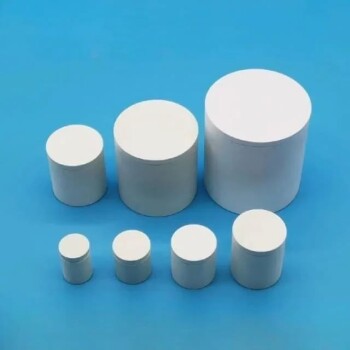
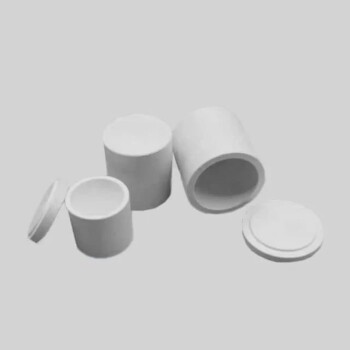
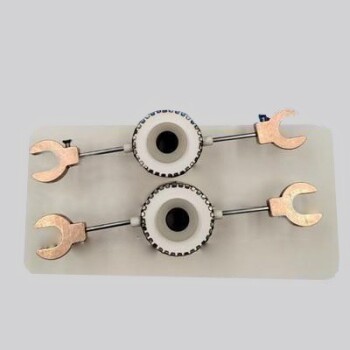
The alumina crucible functions as the essential containment vessel for the raw material mixture during the high-temperature synthesis of Al2.6Cu1.8B105 single crystals. Its primary role is to provide a chemically inert and thermally stable environment that can withstand sintering temperatures of 1500°C without degrading or reacting with the molten metal solvents.
Core Takeaway The success of growing high-quality Al2.6Cu1.8B105 crystals hinges on maintaining an uncontaminated melt environment. The alumina crucible secures this by offering a dual defense: it physically withstands extreme heat while chemically resisting erosion from molten solvents, ensuring the final crystal remains free of leached impurities.
Managing Extreme Thermal Environments
Withstanding 1500°C Sintering
The synthesis of these specific boride crystals requires subjecting the raw materials to intense heat. The alumina crucible is selected specifically for its ability to maintain structural integrity at ultra-high temperatures of 1500°C.
Stability During Phase Changes
During the solution growth method, the raw materials transition from solid to liquid states. The crucible provides exceptional thermal stability, ensuring it acts as a reliable vessel for the mixture throughout the entire heating and cooling cycle.
Ensuring Chemical Purity
Resisting Molten Solvent Erosion
The growth process involves a mixture of aluminum, copper, and boron. When molten, these metals can act as aggressive solvents that attack containment vessels. The alumina crucible provides high chemical inertness, effectively resisting erosion from these molten components.
Preventing Impurity Leaching
The ultimate goal is to produce high-purity single crystals. By resisting physical degradation and chemical attack, the alumina crucible prevents the vessel material itself from breaking down and leaching impurities into the crystal lattice.
Understanding the Stakes of Material Failure
The Cost of Chemical Reactivity
If a crucible with lower chemical inertness were used, the molten metal solvent would dissolve the inner walls of the vessel. This would not only compromise the containment but would introduce foreign elements into the Al2.6Cu1.8B105 structure, ruining the crystal's specific properties.
Thermal Limit Violations
Attempting this synthesis in a vessel not rated for 1500°C would lead to catastrophic failure. The crucible could soften, deform, or crack, resulting in the loss of the expensive raw material mixture and potential damage to the furnace elements.
Making the Right Choice for Your Goal
To ensure the successful growth of complex boride crystals, your equipment selection must align with the harsh realities of the synthesis environment.
- If your primary focus is Crystal Purity: Prioritize a crucible material like alumina that is chemically inert to your specific solvent metals (Al and Cu) to prevent lattice contamination.
- If your primary focus is Process Safety: Ensure the crucible's thermal rating comfortably exceeds your maximum sintering temperature (1500°C) to prevent structural failure during the melt.
By utilizing an alumina crucible, you safeguard the integrity of the melt and ensure the formation of pristine Al2.6Cu1.8B105 single crystals.
Summary Table:
| Feature | Specification/Role | Benefit in Crystal Growth |
|---|---|---|
| Material | High-Purity Alumina (Al2O3) | Provides chemical inertness against molten metal solvents |
| Max Temperature | Up to 1500°C+ | Maintains structural integrity during high-heat sintering |
| Chemical Stability | Resistant to erosion | Prevents impurity leaching into the Al2.6Cu1.8B105 lattice |
| Primary Function | Containment Vessel | Secures the melt environment for successful solution growth |
Elevate Your Materials Research with KINTEK Precision
Achieving the perfect Al2.6Cu1.8B105 single crystal requires more than just the right formula—it demands the highest quality containment. KINTEK specializes in premium laboratory equipment and consumables, offering a wide range of alumina, ceramic, and PTFE crucibles designed to withstand the most aggressive molten solvents and extreme temperatures.
Whether you are performing high-temperature synthesis in our muffle or vacuum furnaces, or preparing samples with our high-pressure reactors and crushing systems, KINTEK provides the reliability your research deserves. Our team of experts is ready to help you select the ideal consumables and equipment to ensure zero contamination and maximum process safety.
Ready to optimize your crystal growth process? Contact us today to find the perfect solution!
References
- Takeo Oku. Direct structure analysis of advanced nanomaterials by high-resolution electron microscopy. DOI: 10.1515/ntrev-2012-0018
This article is also based on technical information from Kintek Solution Knowledge Base .
Related Products
- Arc-Shaped Alumina Ceramic Crucible High Temperature Resistant for Engineering Advanced Fine Ceramics
- Alumina Al2O3 Ceramic Crucible Semicircle Boat with Lid for Engineering Advanced Fine Ceramics
- Engineering Advanced Fine Ceramics Alumina Al2O3 Crucible With Lid Cylindrical Laboratory Crucible
- Engineering Advanced Fine Ceramics Alumina Crucibles (Al2O3) for Thermal Analysis TGA DTA
- Engineering Advanced Fine Alumina Al2O3 Ceramic Crucible for Laboratory Muffle Furnace
People Also Ask
- Why Use Alumina Crucibles & Powder Burial for NaSICON? Ensure Phase Purity and Prevent Elemental Volatilization
- What is the primary purpose of using alumina crucibles for LLTO ceramics? Optimize Your High-Temperature Sintering
- Why are alumina crucibles and mother powder essential for LATP sintering? Optimize Your Solid Electrolyte Performance
- Why are high-purity alumina crucibles used for liquid lead corrosion experiments? Ensure Data Accuracy at 550°C
- Primary considerations for choosing alumina crucibles and quartz tubes in indium intercalation: Ensure Material Purity