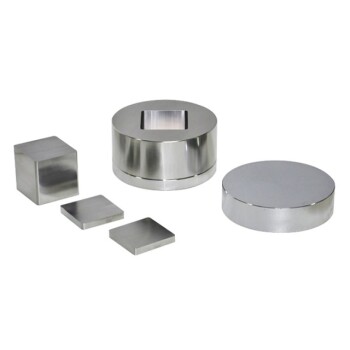
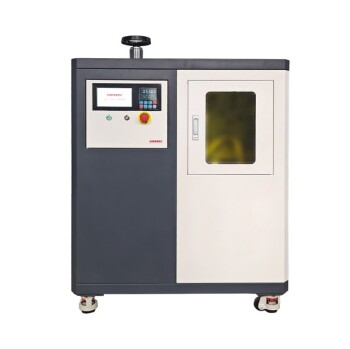
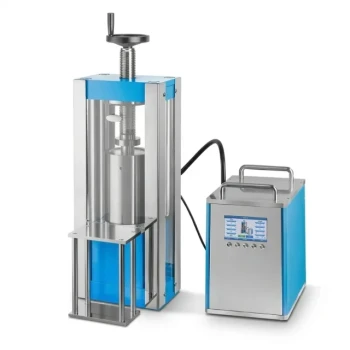
An industrial-grade omnidirectional press acts as the primary driver for structural refinement in VT6 titanium alloys. This machinery facilitates the creation of ultra-fine grained materials by applying multi-axial forging. Through the mechanism of severe plastic deformation (SPD), the press utilizes intense shear forces to physically break down coarse grains and rearrange them into a highly uniform structure.
By orchestrating three-dimensional deformation within a specific temperature window of 800°C to 550°C, the press reduces grain size to approximately 0.25 micrometers, unlocking superior physical and mechanical properties.
The Mechanics of Grain Refinement
Multi-Axial Forging
The defining feature of an omnidirectional press is its ability to apply force from multiple axes simultaneously or sequentially.
Unlike standard unidirectional forging, which flatten grains, this method forces the material to flow in three dimensions.
This ensures that the internal structure is reworked thoroughly, rather than just deformed in a single direction.
Severe Plastic Deformation (SPD)
The press utilizes a process known as Severe Plastic Deformation (SPD).
This technique introduces a high density of defects and dislocations into the crystal lattice of the alloy.
The equipment generates significant shear forces during this process. These forces are responsible for shattering the initial coarse grain structure and prompting the formation of new, smaller grains.
Achieving Uniformity
A common failure point in alloy processing is structural inconsistency between the core and the surface of the material.
The omnidirectional nature of the press ensures high uniformity throughout the entire volume of the titanium alloy.
This results in consistent mechanical properties regardless of where a sample is taken from the forged billet.
Critical Processing Parameters
The Temperature Window
The refinement process is strictly bound by a thermal range of 800°C to 550°C.
Operating within this gradient is essential for balancing material plasticity with grain control.
If the temperature is too high, grains may grow rather than refine; if too low, the material may crack under the immense pressure.
Target Grain Size
The ultimate goal of this machinery is to achieve an specific ultra-fine grain size.
The process targets a grain diameter of approximately 0.25 micrometers.
Reaching this microscopic scale is the direct cause of the enhanced strength and durability observed in the final product.
Understanding the Trade-offs
Process Intensity and Complexity
While the results are superior, using an omnidirectional press is an energy-intensive process.
It requires equipment capable of exerting massive forces with extreme precision.
Thermal Management Challenges
Maintaing the specific 800-550°C window during severe deformation requires rigorous control.
Fluctuations outside this range can compromise the uniformity of the grain structure, negating the benefits of the omnidirectional pressure.
Making the Right Choice for Your Goal
To maximize the utility of ultra-fine grained VT6 titanium, consider your specific engineering requirements:
- If your primary focus is mechanical strength: Rely on this process to achieve the 0.25 micrometer grain size, which significantly enhances the alloy's load-bearing capacity.
- If your primary focus is material reliability: Utilize the omnidirectional capability to ensure structural uniformity, eliminating weak points often found in unidirectionally forged materials.
The industrial-grade omnidirectional press is not just a shaping tool; it is a microstructural engineering instrument essential for high-performance metallurgy.
Summary Table:
| Feature | Specification/Mechanism | Impact on VT6 Alloy |
|---|---|---|
| Processing Method | Multi-Axial Forging (SPD) | Breaks coarse grains via intense shear forces |
| Temperature Window | 800°C to 550°C | Balances plasticity and prevents grain growth |
| Target Grain Size | ~0.25 micrometers | Unlocks ultra-fine grained (UFG) properties |
| Deformation Type | Three-dimensional Flow | Ensures high structural uniformity throughout |
| Key Outcome | Enhanced Grain Refinement | Increases mechanical strength and reliability |
Elevate Your Material Engineering with KINTEK Precision
Unlock the full potential of high-performance metallurgy with KINTEK’s advanced processing solutions. Whether you are developing ultra-fine grained titanium alloys or high-strength composites, our expertise in industrial-grade hydraulic presses (isostatic, pellet, and hot presses), high-temperature furnaces, and crushing systems ensures your lab achieves maximum structural uniformity and precision.
Why choose KINTEK?
- Comprehensive Range: From vacuum and atmosphere furnaces to specialized isostatic presses.
- High-Pressure Excellence: Industry-leading high-temperature high-pressure reactors and autoclaves.
- End-to-End Support: Quality consumables including ceramics, crucibles, and PTFE products.
Contact our specialists today to find the perfect equipment for your research and production needs!
References
- Polina V. Abramova, Андрей Владимирович Коршунов. ВЛИЯНИЕ ДЕФОРМАЦИОННО-ТЕРМИЧЕСКОЙ ОБРАБОТКИ (a+b)-СПЛАВОВ ТИТАНА ВТ6 И ВТ22 НА ИХ КОРРОЗИОННУЮ СТОЙКОСТЬ. DOI: 10.18799/24131830/2023/4/4124
This article is also based on technical information from Kintek Solution Knowledge Base .
Related Products
- Round Bidirectional Press Mold for Lab
- Touchscreen Automatic Vacuum Heat Press
- Single Punch Manual Tablet Press Machine TDP Tablet Punching Machine
- Automatic Laboratory Hydraulic Press for XRF & KBR Pellet Press
- Single Punch Electric Tablet Press Machine TDP Tablet Punching Machine
People Also Ask
- How to use a press mold? Master the Art of Creating Consistent Ceramic Forms
- What is the press mould method? A Guide to Consistent, Detailed Ceramic Forms
- What is the function of press molds during the preparation of SiCf/Ti-43Al-9V composites? Achieve Structural Precision
- What is a press mold used for? Achieve Repeatable Precision and Efficiency
- What is the purpose of specialized pressure devices in sulfide solid-state batteries? Ensure Chemo-Mechanical Stability