Laboratory heating equipment acts as the primary thermal catalyst for the oxidative transformation of activated carbon. It provides the controlled energy required to drive the chemical reaction between the carbon framework and oxidizing agents, such as concentrated nitric acid. This process is essential for grafting oxygen-containing functional groups onto the surface, which fundamentally changes the material's chemical reactivity and hydrophilicity.
Heating equipment serves as the critical interface between raw carbon and functionalized materials, providing the thermal precision necessary to introduce specific chemical groups while maintaining the structural integrity of the carbon framework.
The Mechanics of Thermal Oxidation
Driving the Nitric Acid Reaction
Laboratory heating tools are used to elevate the temperature of mixtures containing activated carbon and concentrated nitric acid. This thermal energy overcomes the activation energy barrier required for the acid to react with the carbon surface. The resulting reaction populates the carbon framework with carboxyl groups, which serve as the primary active sites for further chemical modifications.
Achieving the "Near-Dry" State
A critical phase of the process involves heating the carbon-acid mixture to a near-dry state. This phase ensures maximum contact time and reaction intensity between the remaining oxidant and the carbon surface. Controlled evaporation via heating equipment allows researchers to achieve the desired degree of oxidation without over-processing the material.
Maintaining Constant Reaction Temperatures
For modifications involving basic solutions like sodium hydroxide (NaOH), heating equipment maintains a steady temperature—often around 120 °C. Consistent thermal environments are vital for ensuring that chemical reactions occur uniformly across the entire surface of the carbon or fiber felt. This uniformity is a prerequisite for stable nucleation and the loading of active components in later stages.
Enhancing Surface Chemistry and Structure
Introduction of Functional Groups
The primary role of heating in this context is the introduction of oxygen-containing functional groups, such as hydroxyl and carboxyl groups. These groups alter the surface charge of the activated carbon, making it more receptive to bonding with other molecules. This step is what transforms standard activated carbon into Oxidized Activated Carbon (OAC).
Facilitating Deep Chemical Penetration
When used in conjunction with chemical activators like potassium hydroxide (KOH) or zinc chloride (ZnCl2), heat aids in the impregnation process. While stirring equipment provides mechanical force, controlled heating can assist in allowing these activators to penetrate the fibrous structure of raw materials. This deep penetration is vital for creating a rich microporous structure during high-temperature thermal treatments.
Surface Cleaning and Modification
Heating equipment, particularly when paired with corrosion-resistant vessels, helps "clean" the carbon surface by removing impurities through accelerated chemical reactions. This cleaning process improves the loading stability of active precursors. By altering the surface chemistry, heat ensures that the three-dimensional network of the carbon can hold active components more effectively.
Understanding the Trade-offs
Thermal Degradation vs. Surface Activation
While heat is necessary for modification, excessive temperatures can lead to the structural degradation of the carbon framework. Over-heating during the oxidation phase may destroy the very micropores that give activated carbon its high surface area. Balancing the intensity of the heat with the duration of the reaction is the most common challenge in OAC production.
Safety and Material Compatibility
Working with concentrated acids and bases at high temperatures introduces significant safety risks, including the release of toxic fumes and the risk of vessel failure. Equipment must be precisely calibrated and chemically resistant to prevent contamination of the sample. Inaccurate temperature control can lead to inconsistent functionalization, rendering the OAC ineffective for specific industrial or laboratory applications.
Applying Thermal Control to Your Project
Recommendations for Surface Modification
Achieving high-quality OAC requires matching your heating strategy to your specific functionalization goals.
- If your primary focus is increasing surface acidity: Use heating equipment to maintain a steady boil with nitric acid until a near-dry state is reached to maximize carboxyl group density.
- If your primary focus is improving nucleation uniformity: Utilize constant-temperature heating (approx. 120 °C) with basic solutions to clean the surface and stabilize the surface charge.
- If your primary focus is developing a microporous structure: Ensure heating is used during the impregnation phase to facilitate deep penetration of chemical activators before the final carbonization.
Precision in thermal application is the defining factor in successfully transitioning from raw activated carbon to a highly specialized, functionalized material.
Summary Table:
| Process Phase | Function of Thermal Energy | Key Outcome for OAC |
|---|---|---|
| Nitric Acid Oxidation | Overcomes activation energy barriers | Grafting of carboxyl functional groups |
| Near-Dry State Heating | Maximizes oxidant-surface contact time | Enhanced degree of surface functionalization |
| Constant Temp (120°C) | Maintains uniform chemical environment | Stable nucleation and surface cleaning |
| Activator Impregnation | Facilitates deep chemical penetration | Development of rich microporous structures |
| Thermal Treatment | Drives high-temperature carbonization | Structural stability and active site loading |
Precision is the backbone of material innovation. At KINTEK, we provide the high-performance laboratory equipment required to master the complexities of surface modification. Whether you are producing oxidized activated carbon or developing advanced energy storage materials, our range of muffle furnaces, tube furnaces, and high-temperature high-pressure reactors ensures the thermal precision your research demands.
We offer a comprehensive portfolio including electrolytic cells, ceramics, and corrosion-resistant crucibles tailored for harsh chemical environments. Enhance your lab's efficiency and achieve superior material consistency with our reliable heating and processing solutions. Contact KINTEK today to find the perfect equipment for your specialized applications!
References
- Iloh Emmanuel Onyema. Percentage adsorption of Glipizide (GLI) from deionized water and sPLW using OAC, HAC, and BAC prepared with velvet tamarind shell. DOI: 10.5281/zenodo.7810424
This article is also based on technical information from Kintek Solution Knowledge Base .
Related Products
- Automatic Heated Hydraulic Press Machine with Heated Plates for Laboratory Hot Press
- Laboratory Scientific Electric Heating Blast Drying Oven
- 30T 40T Split Automatic Heated Hydraulic Press Machine with Heated Plates for Laboratory Hot Press
- Cylindrical Lab Electric Heating Press Mold for Laboratory Applications
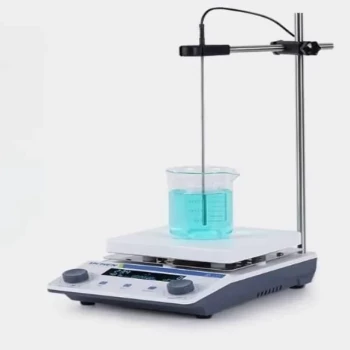
- Laboratory Small Constant Temperature Heated Magnetic Stirrer Heater and Stirrer
People Also Ask
- What are the core advantages of using a laboratory hot press to produce Bi2Se3? Achieve 93% Density & High Conductivity
- How does a laboratory hot press contribute to LATP/polymer composite electrolytes? Achieving Dense, High-Conductivity Films
- How does a three-stage pressure program affect rice husk particleboards? Optimize Bond Strength & Stability
- What is the purpose of a laboratory hot press in the encapsulation stage of solar cell assembly? Ensure Hermetic Seals
- What are the primary advantages of using a laboratory hot press in forming PEO/LLZTO? Unlock Solvent-Free Efficiency