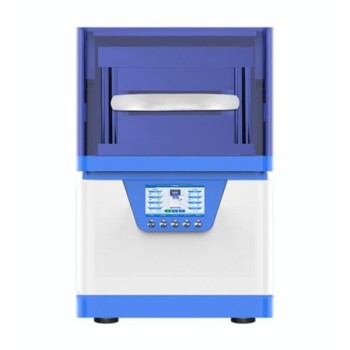
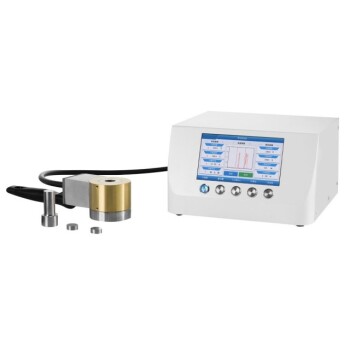
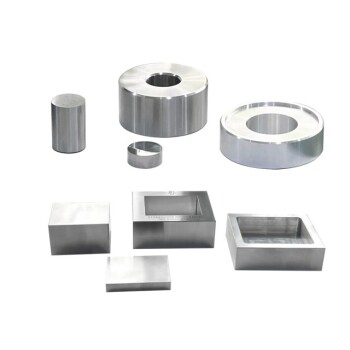
A laboratory hot press functions as the critical densification tool in the preparation of LATP/polymer composite electrolytes by simultaneously applying heat and pressure to the material. This dual action heats the polymer matrix above its softening point, causing it to flow and tightly encapsulate the LATP particles, which eliminates internal pores and creates a structurally continuous, dense membrane.
The core value of hot pressing is not just compaction, but the reduction of interfacial impedance. By transforming a porous coating into a dense film, you maximize the contact area between the ceramic and polymer, which can increase ionic conductivity by nearly an order of magnitude.
The Mechanics of Densification
Promoting Polymer Flow
The primary function of the hot press is to overcome the limitations of solvent casting. By applying heat, the press raises the polymer matrix above its softening point (often around 70°C for specific formulations).
This thermal activation allows the polymer to transition from a rigid state to a viscous flow state. It enables the matrix to move into and fill the microscopic voids that naturally occur during the drying process.
Eliminating Micro-Porosity
Solvent evaporation typically leaves behind a porous structure that hinders performance. The hot press applies significant pressure (e.g., 20 MPa) to physically collapse these voids.
This effectively transforms a loose, porous coated membrane into a dense, non-porous solid. The result is a unified material rather than a collection of loosely bound particles.
Controlled Encapsulation
The simultaneous application of heat and pressure ensures that the ceramic LATP particles are not just trapped but physically bonded to the polymer. The softened polymer is forced to wet the surface of the ceramic particles.
This tight encapsulation prevents particle agglomeration and ensures the ceramic filler is uniformly embedded within the matrix.
Impact on Electrochemical Performance
Reducing Interfacial Impedance
The most significant barrier to ion transport in composite electrolytes is the resistance at the interface between the ceramic and the polymer. Gaps or poor contact at this junction create high impedance.
Hot pressing eliminates these physical gaps, ensuring excellent interface contact. This facilitates smoother ion transfer between the ceramic active material and the polymer host.
Maximizing Ionic Conductivity
Density is directly correlated with conductivity in solid electrolytes. By removing pore defects that block ion pathways, the membrane creates continuous channels for lithium-ion movement.
Data suggests that this densification process can improve the ionic conductivity of the final composite membrane by nearly an order of magnitude compared to non-pressed samples.
Critical Process Parameters and Trade-offs
The Necessity of Uniformity
Achieving a dense membrane is not useful if the geometry is inconsistent. The hydraulic press ensures the film has a uniform thickness, often targeting specific ranges like 25 µm to 50 µm.
Uniformity is essential for accurate comparative testing; without it, variations in impedance could be attributed to thickness inconsistencies rather than material properties.
Precision Control vs. Material Damage
The trade-off in this process lies in the balance of pressure and temperature. While high pressure is needed to fill gaps (densify), excessive or uneven pressure can damage the membrane structure.
You must utilize a precision press capable of maintaining constant parameters (e.g., exactly 20 MPa). This ensures the "gaps" are filled without crushing the ceramic particles or squeezing the polymer out of the composite entirely.
Making the Right Choice for Your Goal
To optimize your LATP/polymer electrolyte preparation, align your pressing parameters with your specific research objectives:
- If your primary focus is maximizing Ionic Conductivity: Prioritize higher pressure settings (around 20 MPa) to ensure total elimination of pore defects and maximum interfacial contact.
- If your primary focus is Mechanical Strength: Focus on the thermal parameters to ensure the polymer flows sufficiently to act as a robust binder for the ceramic particles.
- If your primary focus is Reproducibility: Ensure your press can deliver precise thickness control (e.g., +/- 1 µm) to guarantee that impedance data is comparable across different batches.
Ultimately, the hot press acts as the bridge that turns a theoretical mixture of materials into a functional, high-performance solid-state electrolyte.
Summary Table:
| Parameter | Function in LATP Preparation | Impact on Performance |
|---|---|---|
| Thermal Activation | Heats polymer above softening point to enable viscous flow | Encapsulates ceramic particles & fills voids |
| Pressure Application | Physically collapses micro-pores (e.g., 20 MPa) | Transforms porous coatings into dense solids |
| Thickness Control | Maintains uniform geometry (25–50 µm) | Ensures reproducible impedance data |
| Interfacial Bonding | Forces polymer to wet ceramic surfaces | Dramatically reduces ionic resistance |
Elevate Your Solid-State Battery Research with KINTEK
Precision is the difference between a porous coating and a high-performance electrolyte. KINTEK specializes in advanced laboratory solutions designed for the rigorous demands of material science. Our high-precision hydraulic pellet presses, hot presses, and isostatic presses provide the exact temperature and pressure control needed to eliminate interfacial impedance and maximize ionic conductivity in your LATP/polymer composites.
From crushing and milling your raw materials to densifying your final membranes, KINTEK offers a comprehensive range of:
- Laboratory Hot Presses for perfect film densification.
- High-Temperature Furnaces (Muffle, Vacuum, CVD) for material synthesis.
- Ceramic Crucibles & Consumables for high-purity processing.
Ready to achieve superior membrane density and reproducibility? Contact our technical experts today to find the perfect equipment for your lab's specific needs.
Related Products
- 30T 40T Split Automatic Heated Hydraulic Press Machine with Heated Plates for Laboratory Hot Press
- Automatic Heated Hydraulic Press Machine with Heated Plates for Laboratory Hot Press
- Heated Hydraulic Press Machine with Heated Plates Split Manual Laboratory Hot Press
- Automatic Laboratory Heat Press Machine
- 24T 30T 60T Heated Hydraulic Press Machine with Heated Plates for Laboratory Hot Press
People Also Ask
- What are the advantages of using a laboratory hydraulic press for hot pressing? Achieve Peak Nano-Composite Density
- What are the core advantages of using a laboratory hot press to produce Bi2Se3? Achieve 93% Density & High Conductivity
- Why is a laboratory hydraulic hot press essential for high-density, additive-free Silicon Carbide? Unlock Pure SiC.
- How does a laboratory hydraulic hot press ensure the quality of PHBV/natural fiber composites? Expert Guide
- What is the function of a laboratory hydraulic hot press in the assembly of solid-state photoelectrochemical cells?