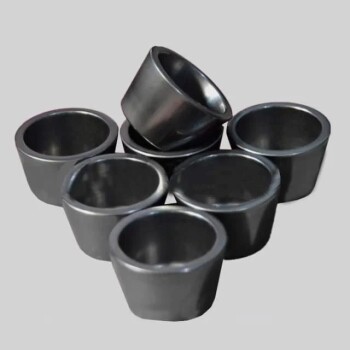
High-strength graphite dies and graphite paper serve as the critical processing infrastructure during the Spark Plasma Sintering (SPS) of Boron Carbide (B4C) composites. The dies function as conductive, pressure-bearing vessels capable of withstanding axial loads up to 40 MPa, while the graphite paper acts as a vital interface layer that optimizes conductivity and ensures the sample can be extracted without destroying the tooling.
Core Takeaway Reliable densification of B4C composites requires the graphite die to act simultaneously as a shaping container, a heating element, and a pressure vessel. Graphite paper is equally essential, serving as a conductive interface that ensures uniform heat distribution while acting as a sacrificial barrier to preserve the expensive die assembly.
The Multifaceted Role of the Graphite Die
Acting as the Forming Container
The primary function of the high-strength graphite die is to define the shape and size of the B4C sample. It serves as a robust container that holds the loose powder in the desired geometry. This containment is critical as it must maintain structural integrity within a vacuum environment throughout the process.
Enabling Resistive Heating
Unlike conventional sintering where heat is applied externally, the graphite die plays an active role in thermal generation. It functions as an electrical conductor, converting the pulsed current of the SPS process directly into thermal energy. This allows for the rapid heating rates characteristic of SPS, essential for consolidating difficult-to-sinter materials like Boron Carbide.
Transmission of Axial Pressure
The die acts as the medium for pressure transmission, allowing for the application of significant mechanical force. It is designed to withstand and transmit uniaxial pressures up to 40 MPa. This pressure is necessary to facilitate plastic flow and diffusion in the ceramic powder, driving the densification process.
The Critical Function of Graphite Paper
Optimizing Interfacial Conductivity
Graphite paper is placed strategically between the punches and the B4C powder. Its presence significantly enhances both electrical and thermal conductivity at this interface. By improving contact, it ensures that the pulsed current flows efficiently into the sample, promoting consistent heating.
Improving Heat Distribution
By smoothing out the interface between the punch and the powder, graphite paper mitigates hot spots. It ensures that the thermal energy generated is distributed more uniformly across the sample surface. This homogeneity is vital for avoiding thermal stress or uneven sintering in the final B4C composite.
Die Protection and Sample Removal
The graphite paper serves as a physical barrier that facilitates the easy removal of the sintered sample. Without this layer, the ceramic composite could fuse or adhere to the punches. The paper protects the graphite die from damage during ejection, extending the lifespan of the tooling and preserving the sample's surface finish.
Understanding the Trade-offs
Mechanical Limitations
While high-strength graphite is robust, it is not invincible. Pushing pressures beyond the rated capacity (e.g., exceeding 40-50 MPa) to achieve higher density carries the risk of fracturing the die. This can lead to catastrophic failure of the mold during the sintering cycle.
Consumable Nature
Graphite paper is strictly a single-use consumable. It degrades during the process and creates a trade-off between operational cost and process security. Attempting to reuse paper to save costs will degrade conductivity and increase the risk of the sample sticking to the punch.
Making the Right Choice for Your Project
To maximize the quality of your Boron Carbide composites, consider the following regarding your tooling setup:
- If your primary focus is Densification: Ensure your graphite die is rated to handle the maximum required pressure (typically 40 MPa) to maximize plastic flow without risking structural failure.
- If your primary focus is Process Repeatability: rigorously utilize fresh graphite paper for every cycle to guarantee consistent contact resistance and thermal distribution.
- If your primary focus is Equipment Longevity: Rely on the graphite paper as a sacrificial layer to prevent chemical interaction between the B4C and the punches, thereby protecting your reusable die components.
The correct utilization of these graphite components transforms the SPS apparatus from a simple press into a precision thermal-electric reactor.
Summary Table:
| Component | Primary Function | Key Performance Role |
|---|---|---|
| High-Strength Graphite Die | Containment & Shaping | Withstands axial loads up to 40 MPa; acts as a heating element |
| Graphite Paper | Interface Optimization | Improves electrical/thermal conductivity; prevents sample sticking |
| SPS Process | Rapid Consolidation | Uses pulsed current for fast densification of B4C powders |
| Vacuum Environment | Process Integrity | Prevents oxidation and maintains material purity during heating |
Elevate Your Material Research with KINTEK
Precision in Spark Plasma Sintering (SPS) demands more than just a process—it requires high-performance infrastructure. KINTEK specializes in providing the laboratory equipment and consumables essential for advanced materials science. Whether you are consolidating Boron Carbide composites or developing next-generation ceramics, our portfolio offers the reliability you need.
From high-temperature furnaces (muffle, vacuum, and CVD) to robust hydraulic presses and essential consumables like high-strength graphite tooling, ceramics, and crucibles, KINTEK is your partner in achieving superior densification and process repeatability.
Ready to optimize your lab's efficiency? Contact us today to explore our full range of sintering solutions!
References
- Alberto Daniel Rico-Cano, Gültekin Göller. Corrosion Behavior and Microhardness of a New B4C Ceramic Doped with 3% Volume High-Entropy Alloy in an Aggressive Environment. DOI: 10.3390/met15010079
This article is also based on technical information from Kintek Solution Knowledge Base .
Related Products
- Spark Plasma Sintering Furnace SPS Furnace
- 2200 ℃ Graphite Vacuum Heat Treat Furnace
- Ultra-High Temperature Graphite Vacuum Graphitization Furnace
- High Purity Pure Graphite Crucible for Electron Beam Evaporation
- High Purity Pure Graphite Crucible for Evaporation
People Also Ask
- What is SPS sintering method? A Guide to High-Speed, High-Performance Material Fabrication
- Why are Spark Plasma Sintering (SPS) furnaces or hot presses utilized in the preparation of Li3PS4 solid electrolytes?
- What is the difference between spark plasma sintering and flash sintering? A Guide to Advanced Sintering Methods
- What technical advantages does a Spark Plasma Sintering (SPS) furnace offer for LZP ceramics? Enhance Ionic Conductivity
- What is the theory of spark plasma sintering? A Guide to Rapid, Low-Temperature Densification