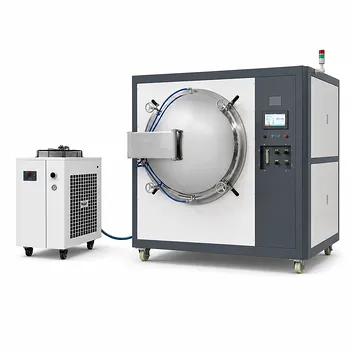
A vacuum hot pressing sintering furnace provides a critical technical advantage by simultaneously applying uniaxial mechanical pressure and high temperature within a protective vacuum environment. This combination forces the softer copper matrix to plastically deform and fill the microscopic voids created by the rigid diamond particles, while preventing the oxidation of copper and the degradation of diamond, ultimately achieving densities as high as 98.8%.
The Core Takeaway While heat alone is insufficient to fully densify diamond/copper composites due to the rigid structure of diamond particles, the addition of mechanical pressure physically overcomes this resistance. The furnace effectively forces the metal matrix into interstitial gaps that would remain empty in pressureless sintering.
Mechanisms of Densification
Overcoming the "Rigid Skeleton" Effect
Diamond particles are extremely hard and rigid. When packed together, they form a "skeleton" that creates bridges and gaps which a copper matrix cannot fill through simple melting or gravity alone.
Inducing Plastic Flow
The furnace applies significant mechanical pressure (typically around 28 MPa, though it can reach 40 MPa). This pressure forces the copper matrix—which has been softened by heat—to undergo plastic flow.
This mechanical force pushes the copper into the tiny micropores and gaps between the diamond rods or particles. This action is essential for achieving near-full densification, as it overcomes the frictional resistance between particles that hinders traditional sintering.
Lowering Sintering Temperatures
By introducing external pressure, the energy required for densification is reduced. This allows the composite to reach high density at lower sintering temperatures compared to pressureless methods. This is beneficial for preserving the structural integrity of the diamond.
The Critical Role of the Vacuum Environment
Prevention of Oxidation
Copper is highly susceptible to oxidation at sintering temperatures. The vacuum environment (maintained between 10⁻³ and 10⁻² Pa) eliminates oxygen from the chamber.
This ensures the copper matrix remains pure, as oxide layers acts as thermal barriers and weaken the structural integrity of the composite.
Prevention of Diamond Graphitization
At high temperatures, diamond is prone to graphitization (turning into graphite) and oxidation. The vacuum environment protects the diamond particles, preserving their thermal and mechanical properties.
Degassing Micro-Pores
The high-vacuum environment actively removes gases trapped within the internal micropores of the powder mixture.
Effective degassing is vital because trapped gas pockets prevent complete densification and can lead to structural defects or blistering in the final product.
Optimizing Interfacial Bonding
Enhancing Physical Contact
The axial pressure applied by the furnace maximizes the contact area between the copper matrix and the diamond particles.
By forcing the materials together, the furnace promotes atomic diffusion, which is the movement of atoms across the boundary to create a solid bond.
Facilitating Metallurgical Reactions
When active elements (such as Zirconium or Titanium) are added to the matrix, the furnace provides the necessary thermodynamic conditions for chemical reactions.
The combination of heat and pressure drives the diffusion of these elements to the interface, where they can form carbide layers (like ZrC or TiC). This transitions the bond from a weak mechanical lock to a strong metallurgical bond.
Understanding the Trade-offs
Geometry Limitations
While vacuum hot pressing is superior for density, it relies on uniaxial pressure (pressure from one direction). This generally limits the production of parts to simple shapes, such as discs or flat plates. Complex geometries may require additional machining after sintering.
Production Efficiency
This process is typically a batch operation. It requires time to pump down the vacuum, heat the mass, apply pressure, and cool down. It is generally slower and more capital-intensive than continuous sintering methods used for lower-performance materials.
Making the Right Choice for Your Goal
When evaluating sintering technologies for Diamond/Copper composites, consider your specific performance metrics:
- If your primary focus is Thermal Conductivity: The vacuum hot press is essential to prevent oxide layers (which insulate heat) and ensure the copper fully eliminates air gaps (which block heat transfer).
- If your primary focus is Mechanical Strength: The application of pressure is non-negotiable to achieve the high density (98%+) and strong interfacial bonding required to prevent material failure under stress.
By integrating vacuum protection with mechanical force, this furnace technology solves the fundamental conflict of combining a hard ceramic (diamond) with a soft metal (copper).
Summary Table:
| Technical Feature | Mechanism of Action | Benefit for Diamond/Copper Composites |
|---|---|---|
| Uniaxial Pressure | Induces plastic flow in copper matrix | Fills micropores; overcomes rigid diamond skeleton |
| High Vacuum | Eliminates oxygen (10⁻³ to 10⁻² Pa) | Prevents copper oxidation and diamond graphitization |
| Mechanical Force | Increases atomic contact area | Promotes strong metallurgical bonding and diffusion |
| Integrated Heat | Lowers required sintering energy | Preserves diamond integrity while softening the matrix |
| Degassing | Removes trapped internal gases | Eliminates structural defects and prevents blistering |
Elevate Your Material Performance with KINTEK Precision
Unlock the full potential of your high-performance composites with KINTEK’s industry-leading thermal processing solutions. Whether you are developing Diamond/Copper heat sinks, advanced battery materials, or aerospace components, our specialized equipment ensures 98.8%+ densification and oxide-free results.
Our value to your laboratory includes:
- Comprehensive Furnace Range: High-vacuum hot presses, muffle, tube, and CVD/PECVD systems tailored for precision metallurgy.
- Total Sample Prep: From crushing and milling systems to hydraulic pellet presses and isostatic systems.
- Specialized Labware: High-temperature reactors, autoclaves, ceramics, and PTFE consumables for rigorous research environments.
Don't let voids and oxidation compromise your thermal conductivity. Contact KINTEK today to discuss your project and get a custom quote.
Related Products
- 600T Vacuum Induction Hot Press Furnace for Heat Treat and Sintering
- Vacuum Heat Treat and Sintering Furnace with 9MPa Air Pressure
- Vacuum Heat Treat and Pressure Sintering Furnace for High Temperature Applications
- 2200 ℃ Tungsten Vacuum Heat Treat and Sintering Furnace
- Vacuum Hot Press Furnace Heated Vacuum Press Machine Tube Furnace
People Also Ask
- What role does an induction vacuum hot pressing furnace play in sintering? Achieve 98% Density in Carbide Blocks
- What advantages does a vacuum hot press furnace provide for LSLBO ceramic electrolytes? Achieve 94% Relative Density
- What role does a Vacuum Hot Press (VHP) furnace play in the densification of austenitic stainless steel 316 composites?
- What are the advantages of a vacuum hot press furnace for W-50%Cu? Achieve 99.6% Density at Lower Temperatures
- What role does mechanical pressure play during the vacuum diffusion bonding of tungsten and copper? Keys to Solid Bonding