Knowledge What temperature can tungsten withstand? Unlocking Its Extreme Heat Resistance & Limits
Author avatar

Tech Team · Kintek Solution

Updated 1 week ago

What temperature can tungsten withstand? Unlocking Its Extreme Heat Resistance & Limits


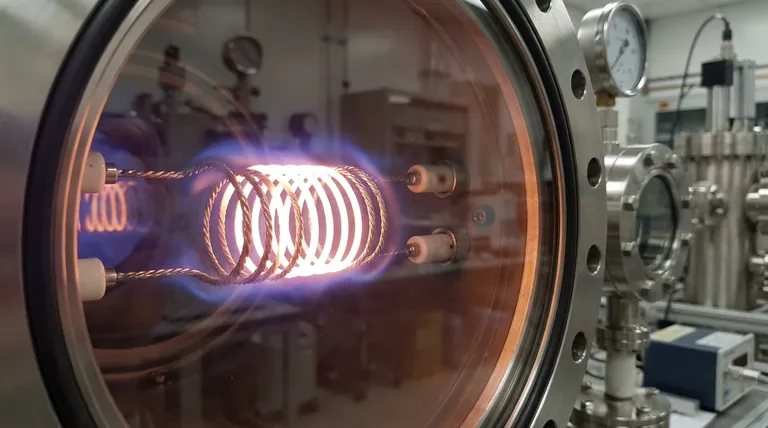
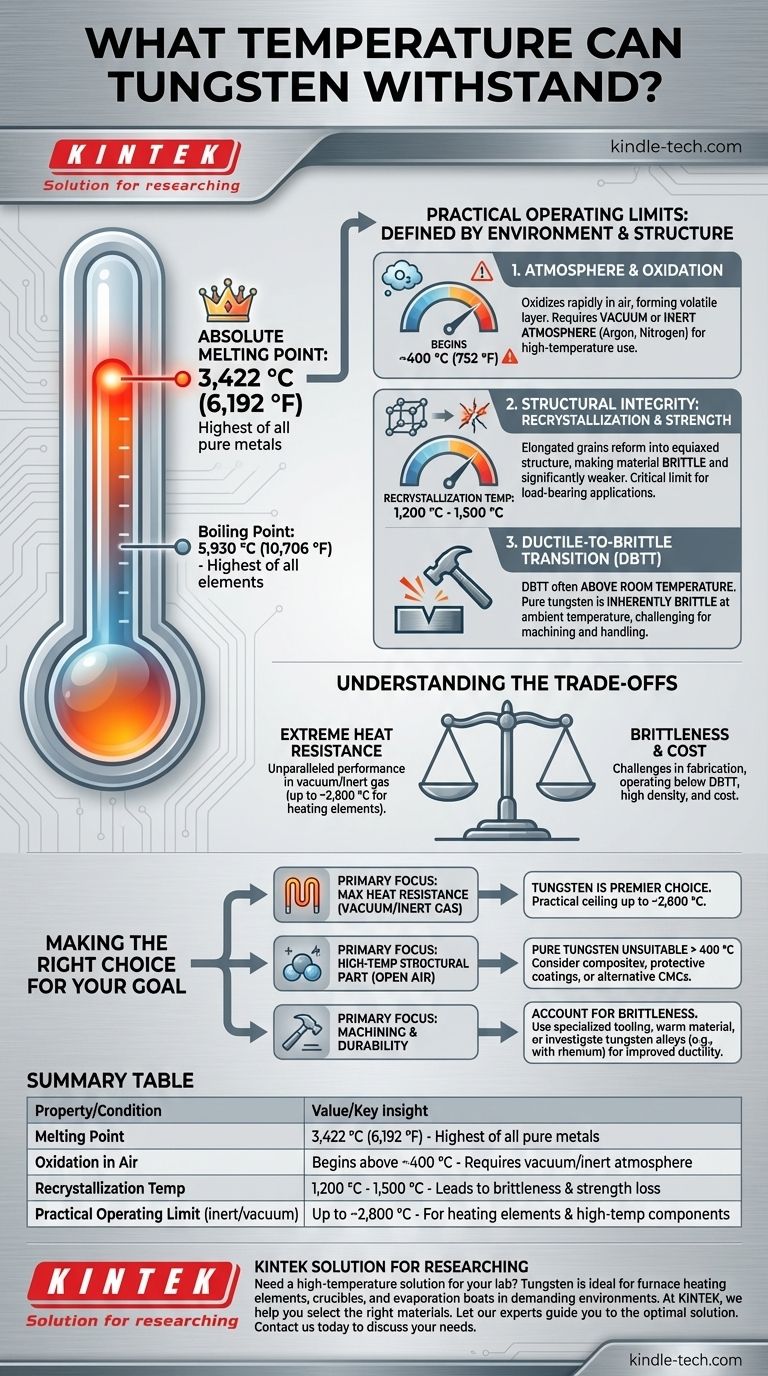
Of all pure metals, tungsten possesses the highest melting point. It can withstand temperatures up to its melting point of 3,422 °C (6,192 °F). This remarkable property is matched only by its boiling point of 5,930 °C (10,706 °F), which is the highest of all known elements.

While its melting point defines the absolute physical limit, the practical temperature tungsten can withstand is almost always lower. This operational ceiling is dictated by the surrounding atmosphere and the structural demands placed upon the material.
What temperature can tungsten withstand? Unlocking Its Extreme Heat Resistance & Limits

Beyond the Melting Point: Practical Operating Limits

To use tungsten effectively, you must understand the factors that constrain its performance well below its melting point. The theoretical maximum temperature is rarely achievable in a real-world application.

The Critical Role of the Atmosphere: Oxidation

Tungsten's primary vulnerability at high temperatures is oxygen. In air, it begins to oxidize rapidly at temperatures above approximately 400 °C (752 °F).

This process forms a volatile oxide layer (tungsten trioxide) that quickly sublimates, or "burns away," causing the material to degrade and fail. For this reason, high-temperature tungsten applications must operate in a vacuum or a protective, inert atmosphere like argon or nitrogen.

Structural Integrity: Recrystallization and Strength

Tungsten's strength is highly dependent on its internal grain structure. When it is manufactured into forms like wire or sheet, the grains are elongated, which imparts strength and ductility.

If heated above its recrystallization temperature (typically 1,200 °C to 1,500 °C), these elongated grains reform into a more uniform, equiaxed structure. This change makes the material significantly more brittle and weaker, even after it cools down. For any application where tungsten must bear a load, the recrystallization temperature is a more critical limit than the melting point.

The Ductile-to-Brittle Transition

A key characteristic of tungsten is its high Ductile-to-Brittle Transition Temperature (DBTT), which is often above room temperature.

This means that at ambient temperatures, pure tungsten is inherently brittle and can fracture easily, much like glass. This makes it challenging to machine and handle without specialized techniques and equipment.

Understanding the Trade-offs

Choosing tungsten for an application involves accepting a distinct set of advantages and disadvantages. Its extreme properties are a double-edged sword.

Extreme Heat Resistance vs. Brittleness

This is the central trade-off of tungsten. You gain unparalleled performance at extreme temperatures, but you must manage its brittleness during fabrication and at any point it operates below its DBTT. Alloying tungsten with elements like rhenium can improve ductility but adds complexity and cost.

High Density and Hardness

Tungsten is one of the densest metals, nearly identical in density to gold. This can be an advantage for applications like radiation shielding or counterweights but is a significant drawback for aerospace applications where weight is a primary concern. Its extreme hardness contributes to its wear resistance but also to the difficulty and expense of machining it.

Cost and Machinability

Due to its hardness and high melting point, tungsten is difficult and costly to extract, refine, and shape into final components. This positions it as a specialty material for applications where no other metal can perform.

Making the Right Choice for Your Goal

To select and implement tungsten successfully, you must align its properties with your specific operating environment and performance requirements.

  • If your primary focus is maximum heat resistance in a vacuum or inert gas: Tungsten is the premier choice, with a practical operating ceiling for heating elements often reaching 2,800 °C, far beyond other metals.
  • If your primary focus is a high-temperature structural part in open air: Pure tungsten is unsuitable above 400°C. You must consider tungsten composites with protective matrices, specialized coatings (like silicides), or alternative materials like ceramic matrix composites (CMCs).
  • If your primary focus is an application requiring machining and durability: You must account for tungsten's brittleness. Plan for diamond or carbide tooling, consider warming the material for machining, or investigate tungsten alloys designed for improved ductility.

Understanding these environmental and structural limits is the key to successfully harnessing tungsten's unparalleled thermal capabilities.

Summary Table:

Property Value / Condition Key Insight
Melting Point 3,422 °C (6,192 °F) Highest of all pure metals
Oxidation in Air Begins above ~400 °C Requires vacuum/inert atmosphere for high-temp use
Recrystallization Temp 1,200 °C - 1,500 °C Leads to brittleness and strength loss
Practical Operating Limit (inert/vacuum) Up to ~2,800 °C For heating elements and high-temp components

Need a high-temperature solution for your lab? Tungsten's extreme heat resistance makes it ideal for furnace heating elements, crucibles, and evaporation boats in demanding environments. At KINTEK, we specialize in high-performance lab equipment and consumables, helping you select the right materials for your specific thermal and atmospheric conditions.

Let our experts guide you to the optimal solution. Contact us today to discuss how our tungsten-based products can enhance your laboratory's capabilities and reliability.

Visual Guide
What temperature can tungsten withstand? Unlocking Its Extreme Heat Resistance & Limits Visual Guide

Related Products

People Also Ask

Related Products

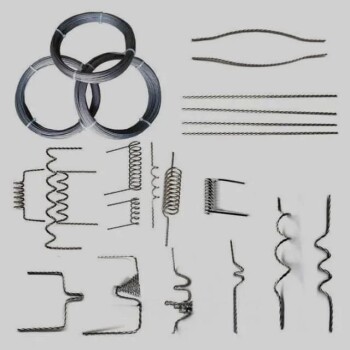
Thermally Evaporated Tungsten Wire for High Temperature Applications

Thermally Evaporated Tungsten Wire for High Temperature Applications

It has a high melting point, thermal and electrical conductivity, and corrosion resistance. It is a valuable material for high temperature, vacuum and other industries.

High Purity Gold Platinum Copper Iron Metal Sheets

High Purity Gold Platinum Copper Iron Metal Sheets

Elevate your experiments with our high-purity sheet metal. Gold, platinum, copper, iron, and more. Perfect for electrochemistry and other fields.

Custom PTFE Teflon Parts Manufacturer for PTFE Mesh F4 Sieve

Custom PTFE Teflon Parts Manufacturer for PTFE Mesh F4 Sieve

PTFE mesh sieve is a specialized test sieve designed for particle analysis in various industries, featuring a non-metallic mesh woven from PTFE filament. This synthetic mesh is ideal for applications where metal contamination is a concern . PTFE sieves are crucial for maintaining the integrity of samples in sensitive environments, ensuring accurate and reliable results in particle size distribution analysis.

Custom PTFE Teflon Parts Manufacturer Adjustable Height Flower Basket

Custom PTFE Teflon Parts Manufacturer Adjustable Height Flower Basket

The flower basket is made of PTFE, which is a chemically inert material. This makes it resistant to most acids and bases, and it can be used in a wide variety of applications.

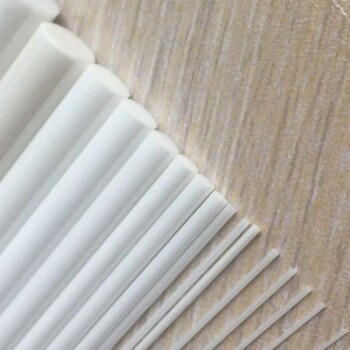
Engineering Advanced Fine Alumina Al2O3 Ceramic Rod Insulated for Industrial Applications

Engineering Advanced Fine Alumina Al2O3 Ceramic Rod Insulated for Industrial Applications

Insulated alumina rod is a fine ceramic material. Alumina rods have excellent electrical insulating properties, high chemical resistance and low thermal expansion.

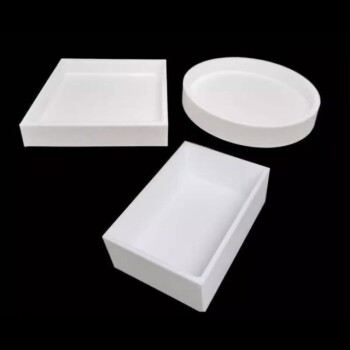
Custom PTFE Teflon Parts Manufacturer for Culture Dish and Evaporation Dish

Custom PTFE Teflon Parts Manufacturer for Culture Dish and Evaporation Dish

The PTFE culture dish evaporating dish is a versatile laboratory tool known for its chemical resistance and high-temperature stability. PTFE, a fluoropolymer, offers exceptional non-stick properties and durability, making it ideal for various applications in research and industry, including filtration, pyrolysis, and membrane technology.

Custom PTFE Teflon Parts Manufacturer for Reagent Wide Mouth Fine Mouth Sample High Temperature Bottles

Custom PTFE Teflon Parts Manufacturer for Reagent Wide Mouth Fine Mouth Sample High Temperature Bottles

The PTFE Reagent Bottle, also known as PTFE Chemical Bottles or Teflon Reagent Bottle, is a robust alternative to traditional glass reagent bottles. These bottles are highly resistant to both acids and alkalis, featuring a leak-proof screw cap. Ideal for laboratory use, they offer excellent chemical resistance, high temperature capabilities up to 260°C, and superior durability.

Custom PTFE Teflon Parts Manufacturer Corrosion Resistant Cleaning Rack Flower Basket

Custom PTFE Teflon Parts Manufacturer Corrosion Resistant Cleaning Rack Flower Basket

The PTFE cleaning rack, also known as the PTFE flower basket cleaning flower basket, is a specialized laboratory tool designed for the efficient cleaning of PTFE materials. This cleaning rack ensures thorough and safe cleaning of PTFE items, maintaining their integrity and performance in laboratory settings.

High Temperature Wear-Resistant Alumina Al2O3 Plate for Engineering Advanced Fine Ceramics

High Temperature Wear-Resistant Alumina Al2O3 Plate for Engineering Advanced Fine Ceramics

High temperature wear-resistant insulating alumina plate has excellent insulation performance and high temperature resistance.

Silicon Carbide (SIC) Ceramic Sheet Wear-Resistant Engineering Advanced Fine Ceramics

Silicon Carbide (SIC) Ceramic Sheet Wear-Resistant Engineering Advanced Fine Ceramics

Silicon carbide (sic) ceramic sheet is composed of high-purity silicon carbide and ultra-fine powder, which is formed by vibration molding and high-temperature sintering.

Cold Isostatic Pressing Machine CIP for Small Workpiece Production 400Mpa

Cold Isostatic Pressing Machine CIP for Small Workpiece Production 400Mpa

Produce uniformly high-density materials with our Cold Isostatic Press. Ideal for compacting small workpieces in production settings. Widely used in powder metallurgy, ceramics, and biopharmaceutical fields for high-pressure sterilization and protein activation.

Precision Machined Silicon Nitride (SiN) Ceramic Sheet for Engineering Advanced Fine Ceramics

Precision Machined Silicon Nitride (SiN) Ceramic Sheet for Engineering Advanced Fine Ceramics

Silicon nitride plate is a commonly used ceramic material in the metallurgical industry due to its uniform performance at high temperatures.

Platinum Auxiliary Electrode for Laboratory Use

Platinum Auxiliary Electrode for Laboratory Use

Optimize your electrochemical experiments with our Platinum Auxiliary Electrode. Our high-quality, customizable models are safe and durable. Upgrade today!

Rubber Vulcanizer Vulcanizing Machine Plate Vulcanizing Press for Lab

Rubber Vulcanizer Vulcanizing Machine Plate Vulcanizing Press for Lab

The Plate vulcanizing press is a kind of equipment used in the production of rubber products, mainly used for the vulcanization of rubber products. Vulcanization is a key step in rubber processing.

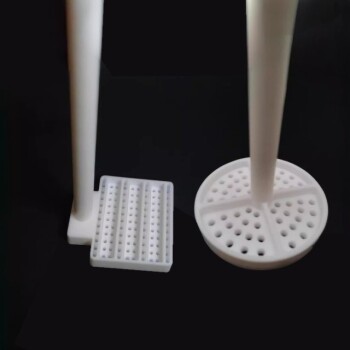
Custom PTFE Teflon Parts Manufacturer for Hollow Etching Flower Basket ITO FTO Developing Glue Removal

Custom PTFE Teflon Parts Manufacturer for Hollow Etching Flower Basket ITO FTO Developing Glue Removal

PTFE adjustable height flower basket (Teflon flower baskets) are made of high-purity experimental grade PTFE, with excellent chemical stability, corrosion resistance, sealing and high and low temperature resistance.

Advanced Engineering Fine Ceramics Aluminum Nitride (AlN) Ceramic Sheet

Advanced Engineering Fine Ceramics Aluminum Nitride (AlN) Ceramic Sheet

Aluminum nitride (AlN) has the characteristics of good compatibility with silicon. It is not only used as a sintering aid or reinforcing phase for structural ceramics, but its performance far exceeds that of alumina.

Zirconia Ceramic Gasket Insulating Engineering Advanced Fine Ceramics

Zirconia Ceramic Gasket Insulating Engineering Advanced Fine Ceramics

Zirconia insulating ceramic gasket has high melting point, high resistivity, low thermal expansion coefficient and other properties, making it an important high temperature resistant material, ceramic insulating material and ceramic sunscreen material.

Custom-Made Alumina Zirconia Special-Shaped Ceramic Plates for Engineering Advanced Fine Ceramics Processing

Custom-Made Alumina Zirconia Special-Shaped Ceramic Plates for Engineering Advanced Fine Ceramics Processing

Alumina ceramics have good electrical conductivity, mechanical strength and high temperature resistance, while zirconia ceramics are known for their high strength and high toughness and are widely used.

Metallographic Specimen Mounting Machine for Laboratory Materials and Analysis

Metallographic Specimen Mounting Machine for Laboratory Materials and Analysis

Precision metallographic mounting machines for labs—automated, versatile, and efficient. Ideal for sample prep in research and quality control. Contact KINTEK today!

Precision Machined Zirconia Ceramic Ball for Engineering Advanced Fine Ceramics

Precision Machined Zirconia Ceramic Ball for Engineering Advanced Fine Ceramics

zirconia ceramic ball have the characteristics of high strength, high hardness, PPM wear level, high fracture toughness, good wear resistance, and high specific gravity.


Leave Your Message