Knowledge Vacuum Furnace What temperature is annealing cooled? Mastering the Crucial Role of Cooling Rate
Author avatar

Tech Team · Kintek Solution

Updated 2 months ago

What temperature is annealing cooled? Mastering the Crucial Role of Cooling Rate


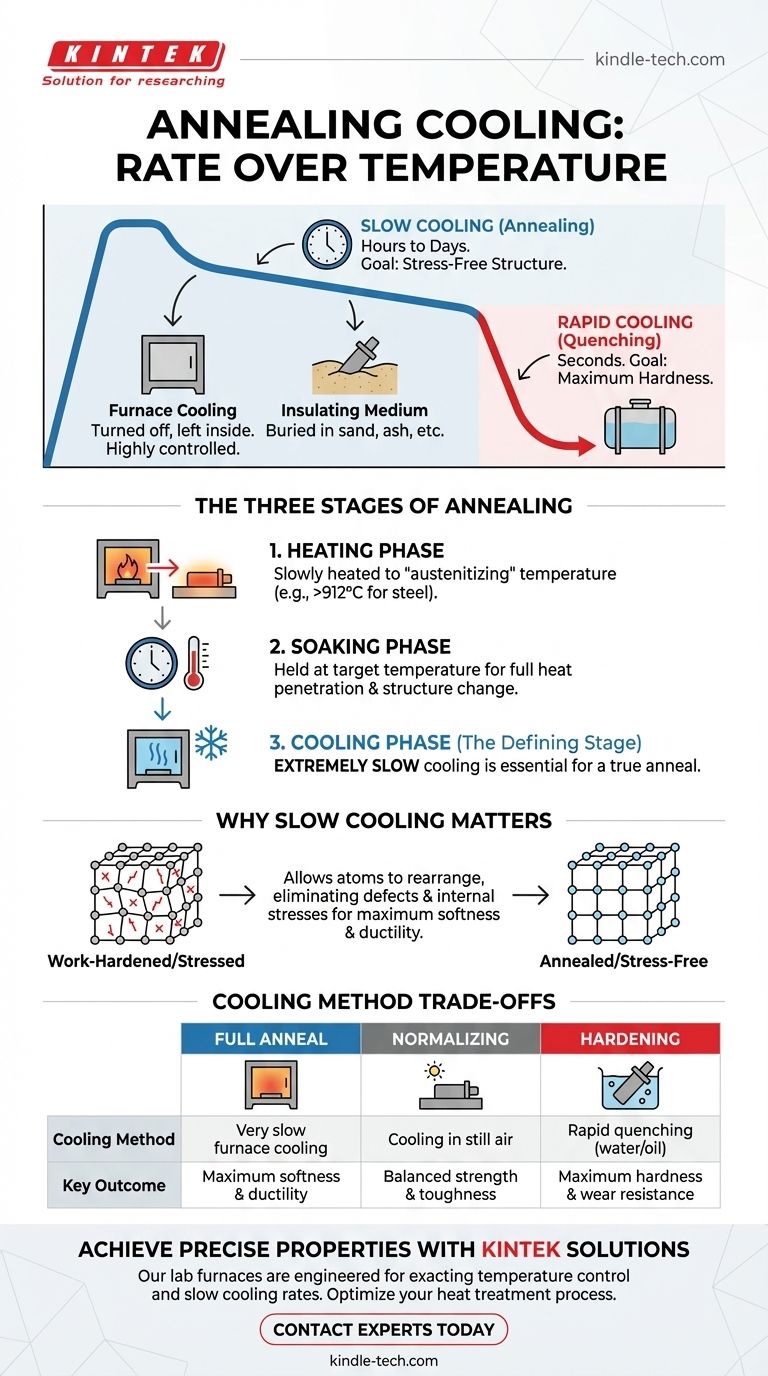
Crucially, annealing is not defined by cooling to a specific temperature, but by the controlled rate of cooling. For a full anneal, the material is cooled as slowly as possible, typically by leaving it in the furnace after it has been turned off and allowing it to cool to ambient temperature over many hours. The goal is to let the material's internal structure fully relax and re-form.

The single most important factor in annealing is not a target temperature, but the extremely slow cooling rate. This deliberate process is what allows the material's microstructure to reset, eliminating internal stresses and maximizing its softness and ductility.
What temperature is annealing cooled? Mastering the Crucial Role of Cooling Rate

The Three Stages of Annealing

To understand the cooling process, you must first understand its place within the overall annealing cycle. Annealing is a three-part process designed to alter the physical and sometimes chemical properties of a material.

Stage 1: The Heating Phase

First, the material is slowly and uniformly heated to a specific "austenitizing" temperature. This temperature is critical and varies by material, but for steel, it's typically above its upper critical temperature (around 912 °C or 1674 °F) where its crystal structure changes.

Stage 2: The Soaking Phase

Once at the target temperature, the material is "soaked"—held at that temperature for a specific duration. This allows the heat to fully penetrate the entire workpiece, ensuring a complete and uniform change in its internal crystal structure.

Stage 3: The Cooling Phase

This is the defining stage. After soaking, the material must be cooled in a highly controlled manner. For a true or "full" anneal, this cooling must be extremely slow.

Why Slow Cooling is the Defining Factor

The rate of cooling directly manipulates the final microstructure of the material, which in turn dictates its mechanical properties like hardness and ductility.

The Goal: A Stress-Free Structure

Work-hardening a metal through processes like bending or hammering creates a large number of defects (dislocations) in its crystal lattice, making it hard and brittle. Slow cooling allows the atoms to migrate and rearrange themselves into a near-perfect, low-stress crystal structure, effectively erasing the effects of work hardening.

How "Slow" is Achieved in Practice

The term "slow" almost always means furnace cooling. The heating elements of the furnace are turned off, and the part is left inside. The furnace's own thermal mass and insulation prevent rapid heat loss, forcing a gradual temperature drop over 8 to 20+ hours, until it reaches room temperature.

For some applications or materials, the part might be removed from the furnace and immediately buried in an insulating medium like sand, ash, or vermiculite. This also slows heat loss significantly compared to cooling in open air.

Understanding the Trade-offs: Annealing vs. Other Treatments

The cooling rate is the primary variable that distinguishes annealing from other common heat treatments.

Annealing vs. Normalizing

Normalizing also involves heating to a similar temperature, but the cooling is done by removing the part from the furnace and letting it cool in still air. This is faster than furnace cooling but slower than quenching. The result is a material that is stronger and harder than an annealed part but more ductile than a hardened one.

Annealing vs. Hardening (Quenching)

Hardening seeks the opposite effect of annealing. After soaking, the material is cooled as rapidly as possible by quenching it in a medium like water, oil, or brine. This rapid cooling traps the crystal structure in a hard, brittle state (martensite in steels). This maximizes hardness at the expense of ductility.

The Cost of an Anneal

The main trade-off of a full anneal is time and cost. Occupying a furnace for many hours during a slow cool-down cycle is energy-intensive and reduces production throughput. For this reason, normalizing is often chosen when maximum softness is not strictly required.

Making the Right Choice for Your Goal

Your choice of cooling method should be dictated entirely by the final properties you need from the material.

  • If your primary focus is maximum softness, ductility, and machinability: A full anneal with a slow furnace cool is the correct process.
  • If your primary focus is refining grain structure and achieving a good balance of strength and toughness: Normalizing by cooling in still air is a more efficient choice.
  • If your primary focus is achieving maximum hardness and wear resistance: You must use a rapid cooling method like quenching, followed by a secondary tempering process to reduce brittleness.

Ultimately, understanding that the cooling rate directly controls the material's final properties is the key to mastering any heat treatment process.

Summary Table:

Heat Treatment Cooling Method Key Outcome
Full Anneal Very slow furnace cooling Maximum softness & ductility
Normalizing Cooling in still air Balanced strength & toughness
Hardening Rapid quenching (water/oil) Maximum hardness & wear resistance

Achieve precise material properties with KINTEK's annealing solutions.

Our lab furnaces are engineered for the exacting temperature control and slow cooling rates required for successful annealing processes. Whether you're working to maximize softness for machining or need to refine grain structure, KINTEK provides the reliable equipment and expert support to meet your laboratory's specific material science goals.

Ready to optimize your heat treatment process? Contact our experts today to discuss how KINTEK's specialized lab equipment can enhance your research and development.

Visual Guide
What temperature is annealing cooled? Mastering the Crucial Role of Cooling Rate Visual Guide

Related Products

People Also Ask

Related Products

Controlled Nitrogen Inert Hydrogen Atmosphere Furnace

Controlled Nitrogen Inert Hydrogen Atmosphere Furnace

KT-AH Hydrogen atmosphere furnace - induction gas furnace for sintering/annealing with built-in safety features, dual housing design, and energy-saving efficiency. Ideal for lab and industrial use.

Vacuum Heat Treat Furnace with Ceramic Fiber Liner

Vacuum Heat Treat Furnace with Ceramic Fiber Liner

Vacuum furnace with polycrystalline ceramic fiber insulation liner for excellent heat insulation and uniform temperature field. Choose from 1200℃ or 1700℃ max. working temperature with high vacuum performance and precise temperature control.

High Temperature Muffle Oven Furnace for Laboratory Debinding and Pre Sintering

High Temperature Muffle Oven Furnace for Laboratory Debinding and Pre Sintering

KT-MD High temperature debinding and pre-sintering furnace for ceramic materials with various molding processes. Ideal for electronic components such as MLCC and NFC.

Laboratory Muffle Oven Furnace Bottom Lifting Muffle Furnace

Laboratory Muffle Oven Furnace Bottom Lifting Muffle Furnace

Efficiently produce batches with excellent temperature uniformity using our Bottom Lifting Furnace. Features two electric lifting stages and advanced temperature control up to 1600℃.

Graphite Vacuum Furnace High Thermal Conductivity Film Graphitization Furnace

Graphite Vacuum Furnace High Thermal Conductivity Film Graphitization Furnace

The high thermal conductivity film graphitization furnace has uniform temperature, low energy consumption and can operate continuously.

Non Consumable Vacuum Arc Induction Melting Furnace

Non Consumable Vacuum Arc Induction Melting Furnace

Explore the benefits of Non-Consumable Vacuum Arc Furnace with high melting point electrodes. Small, easy to operate & eco-friendly. Ideal for laboratory research on refractory metals & carbides.

Vertical High Temperature Graphite Vacuum Graphitization Furnace

Vertical High Temperature Graphite Vacuum Graphitization Furnace

Vertical high temperature graphitization furnace for carbonization and graphitization of carbon materials up to 3100℃.Suitable for shaped graphitization of carbon fiber filaments and other materials sintered in a carbon environment.Applications in metallurgy, electronics, and aerospace for producing high-quality graphite products like electrodes and crucibles.

1200℃ Controlled Atmosphere Furnace Nitrogen Inert Atmosphere Furnace

1200℃ Controlled Atmosphere Furnace Nitrogen Inert Atmosphere Furnace

Discover our KT-12A Pro Controlled atmosphere furnace - high precision, heavy duty vacuum chamber, versatile smart touch screen controller, and excellent temperature uniformity up to 1200C. Ideal for both laboratory and industrial application.

Horizontal High Temperature Graphite Vacuum Graphitization Furnace

Horizontal High Temperature Graphite Vacuum Graphitization Furnace

Horizontal Graphitization Furnace: This type of furnace is designed with the heating elements placed horizontally, allowing for uniform heating of the sample. It's well-suited for graphitizing large or bulky samples that require precise temperature control and uniformity.

1700℃ Controlled Atmosphere Furnace Nitrogen Inert Atmosphere Furnace

1700℃ Controlled Atmosphere Furnace Nitrogen Inert Atmosphere Furnace

KT-17A Controlled atmosphere furnace: 1700℃ heating, vacuum sealing technology, PID temperature control, and versatile TFT smart touch screen controller for laboratory and industrial use.

Dental Porcelain Zirconia Sintering Ceramic Furnace Chairside with Transformer

Dental Porcelain Zirconia Sintering Ceramic Furnace Chairside with Transformer

Experience top-notch sintering with Chairside Sintering Furnace with Transformer. Easy to operate, noise-free pallet, and automatic temperature calibration. Order now!

Ultra-High Temperature Graphite Vacuum Graphitization Furnace

Ultra-High Temperature Graphite Vacuum Graphitization Furnace

The ultra-high temperature graphitization furnace utilizes medium frequency induction heating in a vacuum or inert gas environment. The induction coil generates an alternating magnetic field, inducing eddy currents in the graphite crucible, which heats up and radiates heat to the workpiece, bringing it to the desired temperature. This furnace is primarily used for graphitization and sintering of carbon materials, carbon fiber materials, and other composite materials.

Mesh belt controlled atmosphere furnace

Mesh belt controlled atmosphere furnace

Discover our KT-MB mesh belt sintering furnace - perfect for high-temperature sintering of electronic components & glass insulators. Available for open air or controlled atmosphere environments.

1400℃ Controlled Atmosphere Furnace with Nitrogen and Inert Atmosphere

1400℃ Controlled Atmosphere Furnace with Nitrogen and Inert Atmosphere

Achieve precise heat treatment with KT-14A controlled atmosphere furnace. Vacuum sealed with a smart controller, it's ideal for lab and industrial use up to 1400℃.

Vacuum Heat Treat and Pressure Sintering Furnace for High Temperature Applications

Vacuum Heat Treat and Pressure Sintering Furnace for High Temperature Applications

Vacuum pressure sintering furnaces are designed for high temperature hot pressing applications in metal and ceramic sintering. Its advanced features ensure precise temperature control, reliable pressure maintenance, and a robust design for seamless operation.

Graphite Vacuum Furnace Bottom Discharge Graphitization Furnace for Carbon Materials

Graphite Vacuum Furnace Bottom Discharge Graphitization Furnace for Carbon Materials

Bottom-out graphitization furnace for carbon materials, ultra-high temperature furnace up to 3100°C, suitable for graphitization and sintering of carbon rods and carbon blocks. Vertical design, bottom discharging, convenient feeding and discharging, high temperature uniformity, low energy consumption, good stability, hydraulic lifting system, convenient loading and unloading.

Large Vertical Graphite Vacuum Graphitization Furnace

Large Vertical Graphite Vacuum Graphitization Furnace

A large vertical high-temperature graphitization furnace is a type of industrial furnace used for the graphitization of carbon materials, such as carbon fiber and carbon black. It is a high-temperature furnace that can reach temperatures of up to 3100°C.

Graphite Vacuum Continuous Graphitization Furnace

Graphite Vacuum Continuous Graphitization Furnace

High-temperature graphitization furnace is a professional equipment for graphitization treatment of carbon materials. It is a key equipment for the production of high-quality graphite products. It has high temperature, high efficiency and uniform heating. It is suitable for various high-temperature treatments and graphitization treatments. It is widely used in metallurgy, electronics, aerospace, etc. industry.

Vacuum Arc Induction Melting Furnace

Vacuum Arc Induction Melting Furnace

Discover the power of Vacuum Arc Furnace for melting active & refractory metals. High-speed, remarkable degassing effect, and free of contamination. Learn more now!

Vertical Laboratory Tube Furnace

Vertical Laboratory Tube Furnace

Elevate your experiments with our Vertical Tube Furnace. Versatile design allows for operation under various environments and heat treatment applications. Order now for precise results!


Leave Your Message



















