Knowledge Vacuum Furnace What temperature is ceramic sintering? Master the Heat for Strong, Dense Ceramics
Author avatar

Tech Team · Kintek Solution

Updated 3 months ago

What temperature is ceramic sintering? Master the Heat for Strong, Dense Ceramics


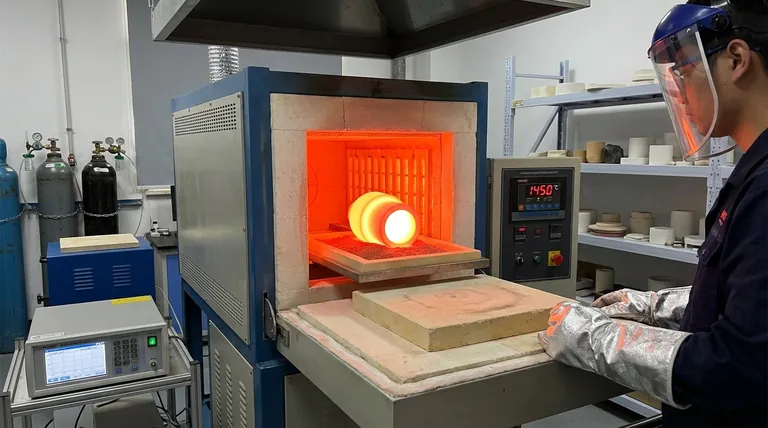
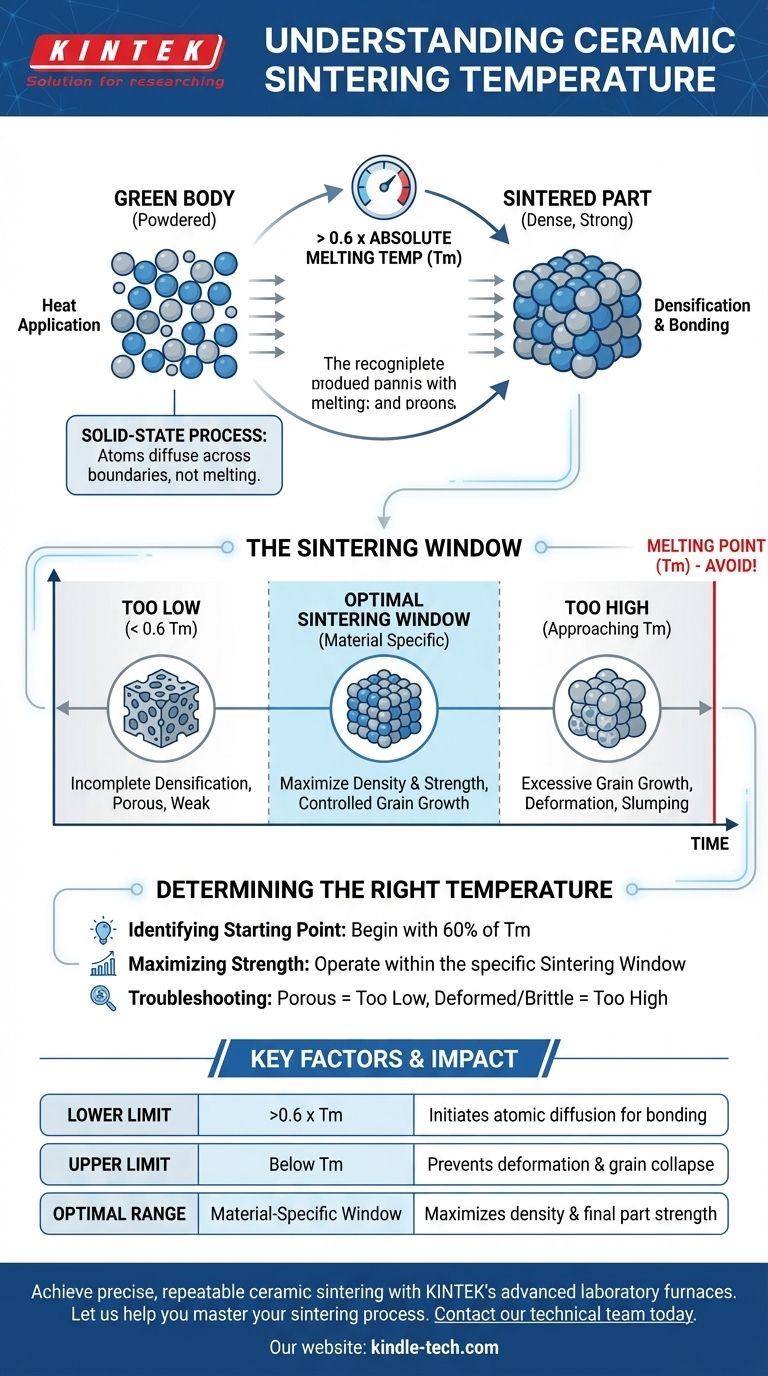
As a general rule, ceramic sintering occurs at temperatures greater than 0.6 times the material's absolute melting temperature (Tm). This high temperature is not intended to melt the ceramic but to provide enough energy for solid-state diffusion, a process where atoms migrate across particle boundaries to fuse the material into a dense, solid mass.

The critical takeaway is that sintering temperature is not a single value but a carefully controlled range specific to each material. The goal is to make the material hot enough for atoms to bond without reaching the melting point, which would cause the structure to liquefy and collapse.
What temperature is ceramic sintering? Master the Heat for Strong, Dense Ceramics

Why Temperature is the Critical Factor

Sintering is fundamentally a heat-driven process. The precise application of temperature is what transforms a loosely packed "green body" of ceramic powder into a strong, coherent part.

Activating Atomic Diffusion

Heat provides the kinetic energy necessary for atoms to move. During sintering, this energy allows atoms on the surface of individual ceramic particles to diffuse across the boundaries and bond with neighboring particles.

This process reduces the overall surface area and closes the pores between particles, leading to densification and a significant increase in the material's strength and stability.

A Solid-State Process

Crucially, sintering is a solid-state mechanism. The temperature must remain below the material's melting point.

If the ceramic were to melt, its formed shape would be lost. The objective is to fuse the particles together while they remain solid, preserving the component's geometry.

Understanding the Sintering Window

Every ceramic material has an optimal "sintering window"—a specific temperature range where effective densification occurs without causing structural damage.

The Lower Boundary

The process requires a minimum temperature to initiate significant atomic diffusion. This is where the rule of thumb—greater than 0.6 Tm—serves as a useful starting point.

Below this general threshold, the rate of diffusion is too slow to achieve full density in a practical amount of time.

The Upper Boundary

The absolute upper limit for sintering is the material's melting point. Approaching this temperature risks deformation, slumping, or complete liquefaction of the part.

Sintering in Context

The sintering stage comes at the end of a multi-step process. A molded "green body" is first heated at a lower temperature to burn off binders before being brought up to the high sintering temperature to fuse the ceramic particles.

The Trade-offs of Temperature Control

Achieving the correct temperature is a balancing act. Deviating from the optimal sintering window, even slightly, can have significant consequences for the final product.

Too Low: Incomplete Densification

If the temperature is too low, diffusion will be insufficient. The resulting part will be porous, mechanically weak, and may not meet the required performance specifications.

Too High: Grain Growth and Deformation

If the temperature is too high, even if it's below the melting point, it can cause other problems. The primary issue is excessive grain growth, where smaller grains merge into larger ones, which can often reduce the material's strength and fracture toughness.

Determining the Right Temperature for Your Goal

The correct sintering temperature is entirely dependent on the specific material and the desired properties of the final component.

  • If your primary focus is identifying a starting point: Begin by finding the material's absolute melting temperature (Tm) and calculate 60% of that value.
  • If your primary focus is achieving maximum strength: You must operate within the material's specific sintering window, balancing temperature to maximize density while preventing excessive grain growth.
  • If your primary focus is process troubleshooting: A porous, weak part suggests the temperature may be too low, while a deformed or brittle part could indicate the temperature was too high.

Ultimately, precise temperature control is the essential tool for transforming powdered ceramic into a high-performance technical component.

Summary Table:

Key Factor Description Impact on Sintering
Lower Limit >0.6 x Melting Temp (Tm) Initiates atomic diffusion for bonding
Upper Limit Below Melting Point (Tm) Prevents deformation and grain collapse
Optimal Range Material-specific 'Sintering Window' Maximizes density and final part strength

Achieve precise, repeatable ceramic sintering with KINTEK's advanced laboratory furnaces.

Whether you are developing new materials or troubleshooting production issues, precise temperature control is non-negotiable. KINTEK specializes in the lab equipment and consumables that researchers and engineers rely on for consistent, high-quality results.

Let us help you master your sintering process. Our experts can guide you to the right equipment for your specific ceramic materials and application goals.

Contact our technical team today to discuss your sintering requirements and discover how KINTEK solutions can enhance your lab's capabilities.

Visual Guide
What temperature is ceramic sintering? Master the Heat for Strong, Dense Ceramics Visual Guide

Related Products

People Also Ask

Related Products

Dental Porcelain Zirconia Sintering Ceramic Furnace Chairside with Transformer

Dental Porcelain Zirconia Sintering Ceramic Furnace Chairside with Transformer

Experience top-notch sintering with Chairside Sintering Furnace with Transformer. Easy to operate, noise-free pallet, and automatic temperature calibration. Order now!

Dental Porcelain Zirconia Sintering Ceramic Vacuum Press Furnace

Dental Porcelain Zirconia Sintering Ceramic Vacuum Press Furnace

Get precise dental results with Dental Vacuum Press Furnace. Automatic temperature calibration, low noise tray, and touch screen operation. Order now!

Vacuum Dental Porcelain Sintering Furnace

Vacuum Dental Porcelain Sintering Furnace

Get precise and reliable results with KinTek's Vacuum Porcelain Furnace. Suitable for all porcelain powders, it features hyperbolic ceramic furnace function, voice prompt, and automatic temperature calibration.

Vacuum Heat Treat Furnace with Ceramic Fiber Liner

Vacuum Heat Treat Furnace with Ceramic Fiber Liner

Vacuum furnace with polycrystalline ceramic fiber insulation liner for excellent heat insulation and uniform temperature field. Choose from 1200℃ or 1700℃ max. working temperature with high vacuum performance and precise temperature control.

High Temperature Muffle Oven Furnace for Laboratory Debinding and Pre Sintering

High Temperature Muffle Oven Furnace for Laboratory Debinding and Pre Sintering

KT-MD High temperature debinding and pre-sintering furnace for ceramic materials with various molding processes. Ideal for electronic components such as MLCC and NFC.

Spark Plasma Sintering Furnace SPS Furnace

Spark Plasma Sintering Furnace SPS Furnace

Discover the benefits of Spark Plasma Sintering Furnaces for rapid, low-temperature material preparation. Uniform heating, low cost & eco-friendly.

Vacuum Heat Treat and Sintering Furnace with 9MPa Air Pressure

Vacuum Heat Treat and Sintering Furnace with 9MPa Air Pressure

The air pressure sintering furnace is a high-tech equipment commonly used for the sintering of advanced ceramic materials. It combines vacuum sintering and pressure sintering techniques to achieve high-density and high-strength ceramics.

Vacuum Heat Treat and Molybdenum Wire Sintering Furnace for Vacuum Sintering

Vacuum Heat Treat and Molybdenum Wire Sintering Furnace for Vacuum Sintering

A vacuum molybdenum wire sintering furnace is a vertical or bedroom structure, which is suitable for withdrawal, brazing, sintering and degassing of metal materials under high vacuum and high temperature conditions. It is also suitable for dehydroxylation treatment of quartz materials.

Vacuum Heat Treat and Pressure Sintering Furnace for High Temperature Applications

Vacuum Heat Treat and Pressure Sintering Furnace for High Temperature Applications

Vacuum pressure sintering furnaces are designed for high temperature hot pressing applications in metal and ceramic sintering. Its advanced features ensure precise temperature control, reliable pressure maintenance, and a robust design for seamless operation.

Mesh belt controlled atmosphere furnace

Mesh belt controlled atmosphere furnace

Discover our KT-MB mesh belt sintering furnace - perfect for high-temperature sintering of electronic components & glass insulators. Available for open air or controlled atmosphere environments.

600T Vacuum Induction Hot Press Furnace for Heat Treat and Sintering

600T Vacuum Induction Hot Press Furnace for Heat Treat and Sintering

Discover the 600T Vacuum Induction Hot Press Furnace, designed for high-temperature sintering experiments in vacuum or protected atmospheres. Its precise temperature and pressure control, adjustable working pressure, and advanced safety features make it ideal for nonmetal materials, carbon composites, ceramics, and metal powders.

Ultra-High Temperature Graphite Vacuum Graphitization Furnace

Ultra-High Temperature Graphite Vacuum Graphitization Furnace

The ultra-high temperature graphitization furnace utilizes medium frequency induction heating in a vacuum or inert gas environment. The induction coil generates an alternating magnetic field, inducing eddy currents in the graphite crucible, which heats up and radiates heat to the workpiece, bringing it to the desired temperature. This furnace is primarily used for graphitization and sintering of carbon materials, carbon fiber materials, and other composite materials.

Small Vacuum Heat Treat and Tungsten Wire Sintering Furnace

Small Vacuum Heat Treat and Tungsten Wire Sintering Furnace

The small vacuum tungsten wire sintering furnace is a compact experimental vacuum furnace specially designed for universities and scientific research institutes. The furnace features a CNC welded shell and vacuum piping to ensure leak-free operation. Quick-connect electrical connections facilitate relocation and debugging, and the standard electrical control cabinet is safe and convenient to operate.

2200 ℃ Graphite Vacuum Heat Treat Furnace

2200 ℃ Graphite Vacuum Heat Treat Furnace

Discover the power of the KT-VG Graphite Vacuum Furnace - with a maximum working temperature of 2200℃, it's perfect for vacuum sintering of various materials. Learn more now.

Boron Nitride (BN) Crucible for Phosphorous Powder Sintered

Boron Nitride (BN) Crucible for Phosphorous Powder Sintered

Phosphorus powder sintered boron nitride (BN) crucible has a smooth surface, dense, pollution-free and long service life.

2200 ℃ Tungsten Vacuum Heat Treat and Sintering Furnace

2200 ℃ Tungsten Vacuum Heat Treat and Sintering Furnace

Experience the ultimate refractory metal furnace with our Tungsten vacuum furnace. Capable of reaching 2200℃, perfect for sintering advanced ceramics and refractory metals. Order now for high-quality results.

Controlled Nitrogen Inert Hydrogen Atmosphere Furnace

Controlled Nitrogen Inert Hydrogen Atmosphere Furnace

KT-AH Hydrogen atmosphere furnace - induction gas furnace for sintering/annealing with built-in safety features, dual housing design, and energy-saving efficiency. Ideal for lab and industrial use.

Vertical High Temperature Graphite Vacuum Graphitization Furnace

Vertical High Temperature Graphite Vacuum Graphitization Furnace

Vertical high temperature graphitization furnace for carbonization and graphitization of carbon materials up to 3100℃.Suitable for shaped graphitization of carbon fiber filaments and other materials sintered in a carbon environment.Applications in metallurgy, electronics, and aerospace for producing high-quality graphite products like electrodes and crucibles.

Graphite Vacuum Furnace High Thermal Conductivity Film Graphitization Furnace

Graphite Vacuum Furnace High Thermal Conductivity Film Graphitization Furnace

The high thermal conductivity film graphitization furnace has uniform temperature, low energy consumption and can operate continuously.

Vacuum Arc Induction Melting Furnace

Vacuum Arc Induction Melting Furnace

Discover the power of Vacuum Arc Furnace for melting active & refractory metals. High-speed, remarkable degassing effect, and free of contamination. Learn more now!


Leave Your Message