Knowledge Resources Why is the annealing process required? To Reverse Work Hardening and Internal Stress in Metals
Author avatar

Tech Team · Kintek Solution

Updated 2 months ago

Why is the annealing process required? To Reverse Work Hardening and Internal Stress in Metals


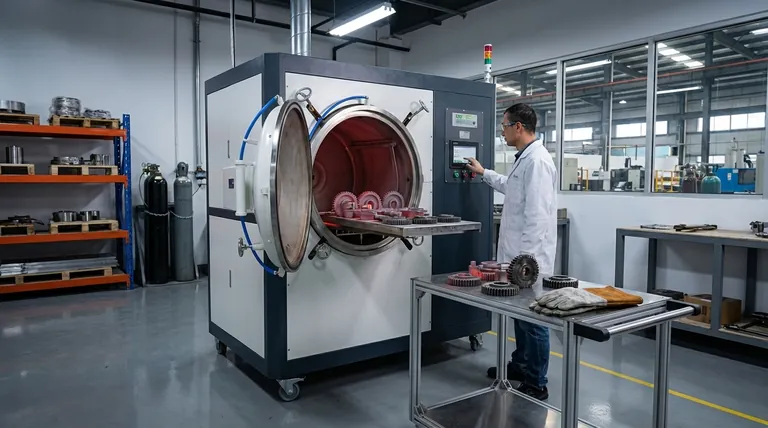
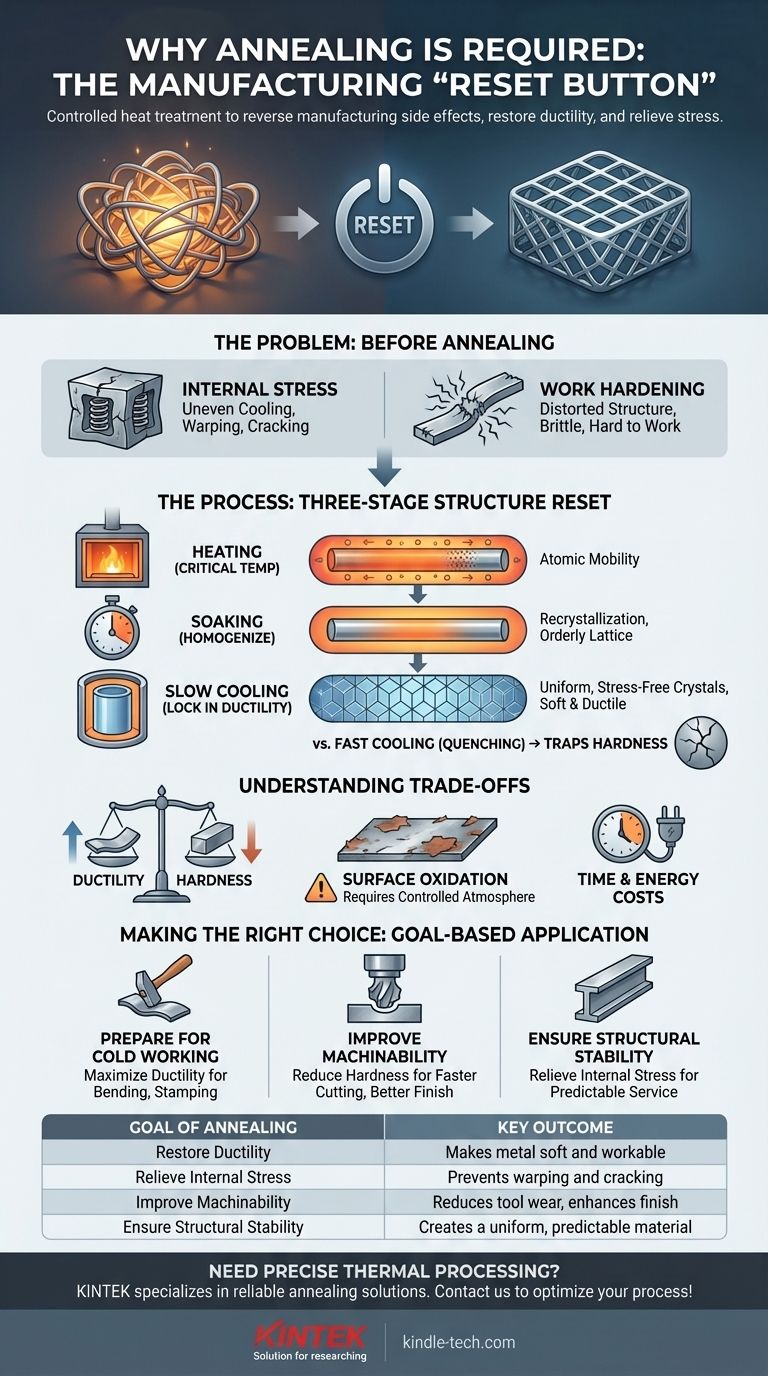
At its core, the annealing process is required to reverse the negative side effects of manufacturing. Processes like casting, forging, or cold working can leave a metal hard, brittle, and full of internal stress. Annealing is a controlled heat treatment that systematically removes these issues, reducing hardness, relieving stress, and restoring ductility to make the material more workable and stable.

Annealing should be understood not as a strengthening process, but as a critical "reset button." It sacrifices hardness to gain ductility and relieve internal stresses, transforming a brittle, unpredictable material into a uniform and workable one.
Why is the annealing process required? To Reverse Work Hardening and Internal Stress in Metals

The Problem: Why Metals Need to Be Annealed

Before a metal is annealed, it often exists in a state that is difficult or risky to work with. This is a direct consequence of previous manufacturing steps.

The Impact of Internal Stress

Processes like casting, welding, or forging cool unevenly, creating microscopic tension and compression zones within the material. These internal stresses are like tightly coiled springs hidden inside the metal, which can lead to warping or spontaneous cracking over time or during subsequent machining.

The Challenge of Work Hardening

When a metal is bent, stretched, or shaped at room temperature (a process called cold working), its internal crystal structure becomes distorted and tangled. This makes the metal harder and stronger, but also significantly more brittle and prone to fracture if further work is attempted.

The Goal: Restoring Workability

The primary driver for annealing is to make the material suitable for the next stage of production. A hard, brittle material is difficult to machine, impossible to form, and unreliable in service. Annealing restores its ductility (the ability to deform without breaking) and machinability.

How Annealing Resets the Material's Structure

Annealing is a precise, three-stage process designed to systematically rearrange the metal's internal crystal lattice, effectively repairing the damage from previous work.

Step 1: Heating to a Critical Temperature

The metal is heated in a furnace to a specific temperature, which is always below its melting point. This heat provides the atomic energy necessary for the crystal structure to become mobile and begin correcting itself. Different alloys have different optimal annealing temperatures.

Step 2: Soaking to Homogenize the Structure

The material is held at this high temperature for a set period. During this "soaking" phase, the atoms migrate into a more orderly and stable lattice. This process, known as recrystallization, eliminates the majority of the crystal defects (dislocations) that cause hardness and brittleness.

Step 3: Slow Cooling to Lock in Ductility

This is the most critical step for achieving softness and ductility. The material is cooled very slowly, often by leaving it in the insulated furnace to cool over many hours. This slow rate allows large, uniform, and stress-free crystals to form, resulting in a soft and highly ductile final state. Fast cooling (quenching), by contrast, would trap a hard, brittle structure.

Understanding the Practical Trade-offs

While essential, annealing is not without its compromises. Understanding these trade-offs is key to using the process effectively.

The Primary Trade-off: Hardness for Ductility

Annealing fundamentally reduces the hardness and tensile strength of a material. You are intentionally making the metal softer. If the final application requires high strength, another heat treatment (like hardening and tempering) may be necessary after the forming and machining operations are complete.

The Risk of Surface Oxidation

Heating metals to high temperatures in the presence of oxygen will cause a layer of scale or oxide to form on the surface. To prevent this, annealing is often performed in a furnace with a controlled, protective atmosphere (such as nitrogen or argon) that is chemically inert.

Time and Energy Costs

Annealing is an energy-intensive process that can take many hours from start to finish. The heating and slow cooling cycles tie up furnace capacity and consume significant power, adding to the overall cost of manufacturing a component.

Making the Right Choice for Your Goal

Annealing is not a single solution but a tool to achieve a specific outcome. You should apply it based on what you need to do next with the material.

  • If your primary focus is preparing for cold working: Anneal to maximize ductility, allowing the metal to be bent, stamped, or drawn into complex shapes without fracturing.
  • If your primary focus is improving machinability: Anneal to reduce hardness, which results in less tool wear, faster cutting speeds, and a better surface finish.
  • If your primary focus is ensuring structural stability: Anneal to relieve internal stresses from casting or welding, preventing dimensional changes or failure in service.

Ultimately, annealing provides the control to transform a stressed, brittle material into a predictable and reliable foundation for your final product.

Summary Table:

Goal of Annealing Key Outcome Common Applications
Restore Ductility Makes metal soft and workable Cold working, forming, bending
Relieve Internal Stress Prevents warping and cracking After casting, welding, or machining
Improve Machinability Reduces tool wear, enhances finish Pre-machining preparation
Ensure Structural Stability Creates a uniform, predictable material Critical components for service

Need precise thermal processing for your materials? KINTEK specializes in lab equipment and consumables, providing reliable solutions for all your annealing and heat treatment requirements. Our expertise ensures your materials achieve the perfect balance of ductility and stability. Contact us today to optimize your manufacturing process!

Visual Guide
Why is the annealing process required? To Reverse Work Hardening and Internal Stress in Metals Visual Guide

Related Products

People Also Ask

Related Products

Controlled Nitrogen Inert Hydrogen Atmosphere Furnace

Controlled Nitrogen Inert Hydrogen Atmosphere Furnace

KT-AH Hydrogen atmosphere furnace - induction gas furnace for sintering/annealing with built-in safety features, dual housing design, and energy-saving efficiency. Ideal for lab and industrial use.

Vacuum Heat Treat Furnace with Ceramic Fiber Liner

Vacuum Heat Treat Furnace with Ceramic Fiber Liner

Vacuum furnace with polycrystalline ceramic fiber insulation liner for excellent heat insulation and uniform temperature field. Choose from 1200℃ or 1700℃ max. working temperature with high vacuum performance and precise temperature control.

High Temperature Muffle Oven Furnace for Laboratory Debinding and Pre Sintering

High Temperature Muffle Oven Furnace for Laboratory Debinding and Pre Sintering

KT-MD High temperature debinding and pre-sintering furnace for ceramic materials with various molding processes. Ideal for electronic components such as MLCC and NFC.

Laboratory Muffle Oven Furnace Bottom Lifting Muffle Furnace

Laboratory Muffle Oven Furnace Bottom Lifting Muffle Furnace

Efficiently produce batches with excellent temperature uniformity using our Bottom Lifting Furnace. Features two electric lifting stages and advanced temperature control up to 1600℃.

Graphite Vacuum Furnace High Thermal Conductivity Film Graphitization Furnace

Graphite Vacuum Furnace High Thermal Conductivity Film Graphitization Furnace

The high thermal conductivity film graphitization furnace has uniform temperature, low energy consumption and can operate continuously.

Non Consumable Vacuum Arc Induction Melting Furnace

Non Consumable Vacuum Arc Induction Melting Furnace

Explore the benefits of Non-Consumable Vacuum Arc Furnace with high melting point electrodes. Small, easy to operate & eco-friendly. Ideal for laboratory research on refractory metals & carbides.

Vertical High Temperature Graphite Vacuum Graphitization Furnace

Vertical High Temperature Graphite Vacuum Graphitization Furnace

Vertical high temperature graphitization furnace for carbonization and graphitization of carbon materials up to 3100℃.Suitable for shaped graphitization of carbon fiber filaments and other materials sintered in a carbon environment.Applications in metallurgy, electronics, and aerospace for producing high-quality graphite products like electrodes and crucibles.

1200℃ Controlled Atmosphere Furnace Nitrogen Inert Atmosphere Furnace

1200℃ Controlled Atmosphere Furnace Nitrogen Inert Atmosphere Furnace

Discover our KT-12A Pro Controlled atmosphere furnace - high precision, heavy duty vacuum chamber, versatile smart touch screen controller, and excellent temperature uniformity up to 1200C. Ideal for both laboratory and industrial application.

Horizontal High Temperature Graphite Vacuum Graphitization Furnace

Horizontal High Temperature Graphite Vacuum Graphitization Furnace

Horizontal Graphitization Furnace: This type of furnace is designed with the heating elements placed horizontally, allowing for uniform heating of the sample. It's well-suited for graphitizing large or bulky samples that require precise temperature control and uniformity.

1700℃ Controlled Atmosphere Furnace Nitrogen Inert Atmosphere Furnace

1700℃ Controlled Atmosphere Furnace Nitrogen Inert Atmosphere Furnace

KT-17A Controlled atmosphere furnace: 1700℃ heating, vacuum sealing technology, PID temperature control, and versatile TFT smart touch screen controller for laboratory and industrial use.

Dental Porcelain Zirconia Sintering Ceramic Furnace Chairside with Transformer

Dental Porcelain Zirconia Sintering Ceramic Furnace Chairside with Transformer

Experience top-notch sintering with Chairside Sintering Furnace with Transformer. Easy to operate, noise-free pallet, and automatic temperature calibration. Order now!

Ultra-High Temperature Graphite Vacuum Graphitization Furnace

Ultra-High Temperature Graphite Vacuum Graphitization Furnace

The ultra-high temperature graphitization furnace utilizes medium frequency induction heating in a vacuum or inert gas environment. The induction coil generates an alternating magnetic field, inducing eddy currents in the graphite crucible, which heats up and radiates heat to the workpiece, bringing it to the desired temperature. This furnace is primarily used for graphitization and sintering of carbon materials, carbon fiber materials, and other composite materials.

Mesh belt controlled atmosphere furnace

Mesh belt controlled atmosphere furnace

Discover our KT-MB mesh belt sintering furnace - perfect for high-temperature sintering of electronic components & glass insulators. Available for open air or controlled atmosphere environments.

1400℃ Controlled Atmosphere Furnace with Nitrogen and Inert Atmosphere

1400℃ Controlled Atmosphere Furnace with Nitrogen and Inert Atmosphere

Achieve precise heat treatment with KT-14A controlled atmosphere furnace. Vacuum sealed with a smart controller, it's ideal for lab and industrial use up to 1400℃.

Vacuum Heat Treat and Pressure Sintering Furnace for High Temperature Applications

Vacuum Heat Treat and Pressure Sintering Furnace for High Temperature Applications

Vacuum pressure sintering furnaces are designed for high temperature hot pressing applications in metal and ceramic sintering. Its advanced features ensure precise temperature control, reliable pressure maintenance, and a robust design for seamless operation.

Graphite Vacuum Furnace Bottom Discharge Graphitization Furnace for Carbon Materials

Graphite Vacuum Furnace Bottom Discharge Graphitization Furnace for Carbon Materials

Bottom-out graphitization furnace for carbon materials, ultra-high temperature furnace up to 3100°C, suitable for graphitization and sintering of carbon rods and carbon blocks. Vertical design, bottom discharging, convenient feeding and discharging, high temperature uniformity, low energy consumption, good stability, hydraulic lifting system, convenient loading and unloading.

Large Vertical Graphite Vacuum Graphitization Furnace

Large Vertical Graphite Vacuum Graphitization Furnace

A large vertical high-temperature graphitization furnace is a type of industrial furnace used for the graphitization of carbon materials, such as carbon fiber and carbon black. It is a high-temperature furnace that can reach temperatures of up to 3100°C.

Graphite Vacuum Continuous Graphitization Furnace

Graphite Vacuum Continuous Graphitization Furnace

High-temperature graphitization furnace is a professional equipment for graphitization treatment of carbon materials. It is a key equipment for the production of high-quality graphite products. It has high temperature, high efficiency and uniform heating. It is suitable for various high-temperature treatments and graphitization treatments. It is widely used in metallurgy, electronics, aerospace, etc. industry.

Vacuum Arc Induction Melting Furnace

Vacuum Arc Induction Melting Furnace

Discover the power of Vacuum Arc Furnace for melting active & refractory metals. High-speed, remarkable degassing effect, and free of contamination. Learn more now!

Vertical Laboratory Tube Furnace

Vertical Laboratory Tube Furnace

Elevate your experiments with our Vertical Tube Furnace. Versatile design allows for operation under various environments and heat treatment applications. Order now for precise results!


Leave Your Message



















