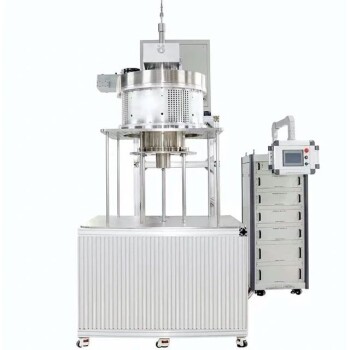
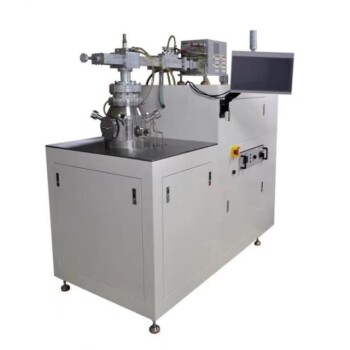
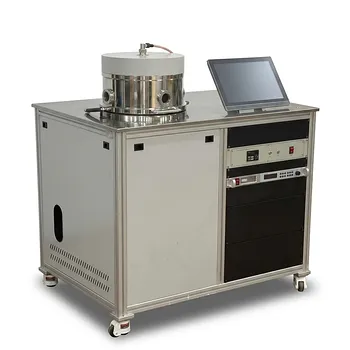
Chemical Vapor Deposition (CVD) and Molecular Layer Deposition (MLD) systems are utilized to evaluate the permeability of capping layers by employing precursors of varying molecular sizes. By attempting to deposit materials like PEDOT or SiOC-H, engineers can verify whether a capping layer (such as Tungsten) effectively seals an air gap or if it allows specific molecules to diffuse through its grain boundaries.
Core Takeaway These systems serve as a diagnostic control to distinguish between surface adhesion and internal infiltration. They demonstrate that the preservation of air gaps depends critically on preventing the specific diffusion of small-molecule precursors through the grain boundaries of the capping thin film.
The Mechanics of Penetration Testing
Utilizing Molecular Size as a Probe
The primary reason for selecting PEDOT (via CVD) or SiOC-H (via MLD) is the molecular size of their precursors. These processes typically utilize larger polymer or hybrid material precursors.
By comparing these against other materials, researchers can test the "sieving" capability of the capping layer.
The Role of the Capping Layer
In air gap integration, a capping layer (such as Tungsten) is deposited to seal the structure. The integrity of this seal is paramount.
The test determines if the capping layer forms a continuous barrier or if it contains pathways that allow materials to enter the air gap.
Surface Deposition vs. Infiltration
When larger precursors like those used for PEDOT or SiOC-H are introduced, they often fail to penetrate the capping layer.
Instead of filling the air gap, these materials deposit only on the surface. This result confirms that the capping layer effectively blocks large molecules.
Diagnosing Air Gap Integrity
Identifying Diffusion Pathways
While large molecules are blocked, the testing reveals that failure modes often involve small-molecule halide precursors.
These smaller units can diffuse through specific weak points in the film, compromising the air gap.
The Significance of Grain Boundaries
The experiments highlight that the capping film is not always a perfect shield. The diffusion of small molecules occurs primarily through grain boundaries.
Therefore, the stability of the air gap is defined by the film's ability to block diffusion through these specific microstructural gaps.
Understanding the Trade-offs
Contextual Validity
This testing method provides a relative measure of stability based on molecular size. It proves that a cap might be "sealed" against a polymer but "leaky" against a small halide.
Interpretation of Results
It is critical not to assume a capping layer is perfect simply because large-molecule precursors do not penetrate it.
Success with PEDOT or SiOC-H indicates resistance to large molecules, but it does not guarantee protection against smaller, highly diffusive chemical species.
Making the Right Choice for Your Goal
To ensure the reliability of your air gap structures, apply these findings as follows:
- If your primary focus is validating the mechanical seal: Look for deposition strictly on the surface of the capping layer, confirming that large precursors cannot enter.
- If your primary focus is identifying chemical vulnerability: Analyze the grain boundaries of your Tungsten cap, as this is the diffusion path for small-molecule halide precursors.
By utilizing materials with different precursor sizes, you transform a standard deposition process into a precise leak-detection mechanism.
Summary Table:
| Feature | CVD/MLD Testing Utility |
|---|---|
| Primary Goal | Assess capping layer (e.g., Tungsten) permeability |
| Materials Used | PEDOT (CVD) or SiOC-H (MLD) |
| Mechanism | Molecular size-based "sieving" at grain boundaries |
| Success Metric | Surface-only deposition (indicates a successful seal) |
| Failure Mode | Diffusion of small-molecule halide precursors |
| Key Focus | Evaluating grain boundary integrity and film density |
Secure Your Semiconductor Processes with KINTEK Precision
Precise control over material deposition and film integrity is critical for the next generation of air gap integration. KINTEK specializes in high-performance laboratory equipment designed for the most demanding research and production environments. Whether you are optimizing CVD or PECVD processes, exploring thin-film stability, or requiring advanced high-temperature furnaces and vacuum systems, our solutions deliver the accuracy you need.
From high-pressure reactors for material synthesis to specialized crushing, milling, and hydraulic press systems for sample preparation, KINTEK provides a comprehensive range of tools and consumables tailored for semiconductor and materials science researchers.
Ready to enhance your lab's diagnostic capabilities? Contact us today to discover how KINTEK’s expert equipment can validate your structural designs and streamline your manufacturing workflow.
References
- Hannah R. M. Margavio, Gregory N. Parsons. Controlled Air Gap Formation between W and TiO <sub>2</sub> Films via Sub‐Surface TiO <sub>2</sub> Atomic Layer Etching. DOI: 10.1002/admt.202501155
This article is also based on technical information from Kintek Solution Knowledge Base .
Related Products
- Chemical Vapor Deposition CVD Equipment System Chamber Slide PECVD Tube Furnace with Liquid Gasifier PECVD Machine
- Customer Made Versatile CVD Tube Furnace Chemical Vapor Deposition Chamber System Equipment
- RF PECVD System Radio Frequency Plasma-Enhanced Chemical Vapor Deposition RF PECVD
- HFCVD Machine System Equipment for Drawing Die Nano-Diamond Coating
- Multi Heating Zones CVD Tube Furnace Machine Chemical Vapor Deposition Chamber System Equipment
People Also Ask
- What are the advantages of chemical vapor deposition? Achieve Superior Thin Films for Your Lab
- What types of substrates are used in CVD to facilitate graphene films? Optimize Graphene Growth with the Right Catalyst
- What is the chemical vapor deposition growth process? Build Superior Thin Films from the Atom Up
- How expensive is chemical vapor deposition? Understanding the True Cost of High-Performance Coating
- Why is Chemical Vapor Deposition (CVD) equipment uniquely suited for constructing hierarchical superhydrophobic structures?