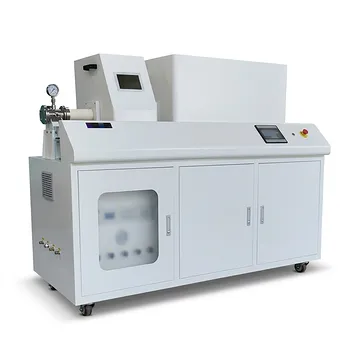
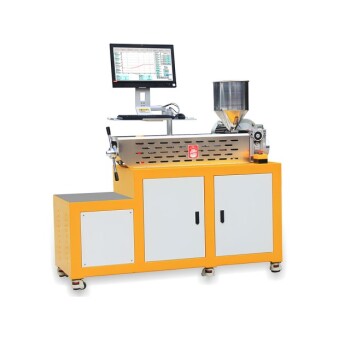
Chemical Vapor Infiltration (CVI) equipment is the fundamental enabler for manufacturing high-performance carbon-carbon (C-C) composites. This technology works by introducing hydrocarbon gases into a high-temperature reaction chamber, allowing them to penetrate the intricate porous structure of a carbon fiber preform. Through this diffusion, a pyrolytic carbon matrix is deposited directly onto fiber surfaces, gradually transforming a loose preform into a dense, structural material.
Core Takeaway CVI is essential because it achieves a level of structural integrity that liquid impregnation methods cannot match. By utilizing gas diffusion to deposit a pyrolytic carbon matrix, CVI ensures uniform densification and minimizes internal defects, making it indispensable for critical aerospace and nuclear applications.
Transforming Preforms into Structural Components
The Mechanism of Diffusion
CVI equipment operates by creating a controlled high-temperature environment.
Hydrocarbon gases are introduced into this chamber, where they diffuse deeply into the pores of the carbon fiber preform. Unlike liquids, these gases can penetrate complex geometries without being blocked by surface tension.
Deposition of Pyrolytic Carbon
As the gas penetrates the preform, it undergoes a chemical reaction on the fiber surfaces.
This reaction deposits a pyrolytic carbon matrix, which acts as the binding agent for the composite. This specific form of carbon is crucial for the material's final thermal and mechanical properties.
Why CVI Outperforms Liquid Impregnation
Superior Matrix Uniformity
A primary challenge in composite manufacturing is ensuring the binding matrix reaches the center of the material.
Liquid impregnation processes often struggle with this, leading to uneven density. CVI equipment solves this by using gas, which achieves more uniform matrix filling throughout the entire depth of the component.
Minimizing Internal Weaknesses
For high-stakes applications, structural consistency is non-negotiable.
Because CVI fills pores more effectively, it significantly reduces internal defects. This results in a composite material with reliable strength and predictable performance characteristics.
Understanding the Trade-offs
The Factor of Time
The CVI process is defined by gradual densification.
Because the matrix is built up layer by layer through gas deposition, this is not an instantaneous process. It requires precise control over time to ensure the preform is fully densified from the inside out without sealing off the outer pores prematurely.
Making the Right Choice for Your Goal
CVI is not merely a manufacturing option; it is a requirement for components that must survive extreme conditions.
- If your primary focus is Extreme Durability: Choose CVI to produce high-strength, heat-resistant materials capable of withstanding aerospace and nuclear environments.
- If your primary focus is Structural Consistency: Rely on CVI to eliminate the internal defects and density gradients common in liquid impregnation processes.
CVI remains the definitive method for converting raw carbon fiber into mission-critical engineering materials.
Summary Table:
| Feature | CVI Process | Liquid Impregnation |
|---|---|---|
| Infiltration Medium | Hydrocarbon Gas | Liquid Resins/Pitch |
| Penetration Depth | Superior (diffuses into complex pores) | Limited (hindered by surface tension) |
| Matrix Uniformity | High (consistent internal density) | Moderate to Low (risk of gradients) |
| Structural Defects | Minimal (reduced internal weaknesses) | Higher (potential for voids) |
| Primary Use Case | Critical Aerospace & Nuclear Parts | General Industrial Components |
Elevate Your Material Science with KINTEK Precision
Manufacturing mission-critical carbon-carbon composites requires absolute control over thermal and mechanical properties. KINTEK specializes in advanced laboratory and production solutions, providing the high-performance CVD/CVI furnace systems and high-temperature reactors necessary for precise pyrolytic carbon deposition.
Whether you are developing next-generation aerospace components or conducting advanced battery research, our comprehensive portfolio—ranging from muffle and vacuum furnaces to high-pressure autoclaves and ceramic crucibles—is designed to meet the rigorous demands of your laboratory.
Ready to achieve superior structural consistency? Contact our technical experts today to find the perfect equipment solution for your C-C composite manufacturing needs.
References
- Kinshuk Dasgupta, Vivekanand Kain. A journey of materials development illustrated through shape memory alloy and carbon-based materials. DOI: 10.18520/cs/v123/i3/417-428
This article is also based on technical information from Kintek Solution Knowledge Base .
Related Products
- Chemical Vapor Deposition CVD Equipment System Chamber Slide PECVD Tube Furnace with Liquid Gasifier PECVD Machine
- Customer Made Versatile CVD Tube Furnace Chemical Vapor Deposition Chamber System Equipment
- Split Chamber CVD Tube Furnace with Vacuum Station Chemical Vapor Deposition System Equipment Machine
- Multi Heating Zones CVD Tube Furnace Machine Chemical Vapor Deposition Chamber System Equipment
- HFCVD Machine System Equipment for Drawing Die Nano-Diamond Coating
People Also Ask
- What are the advantages of chemical vapor deposition? Achieve Superior Thin Films for Your Lab
- What types of substrates are used in CVD to facilitate graphene films? Optimize Graphene Growth with the Right Catalyst
- What is the chemical vapor deposition growth process? Build Superior Thin Films from the Atom Up
- How expensive is chemical vapor deposition? Understanding the True Cost of High-Performance Coating
- Why is Chemical Vapor Deposition (CVD) equipment uniquely suited for constructing hierarchical superhydrophobic structures?