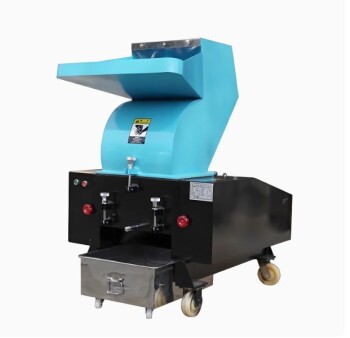
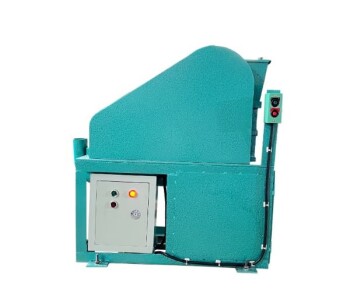
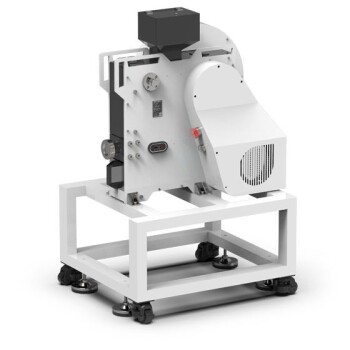
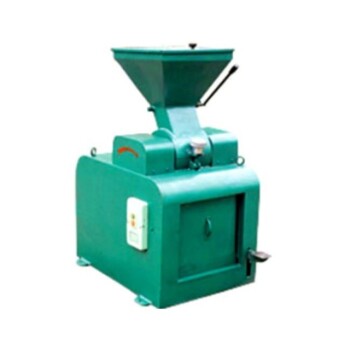
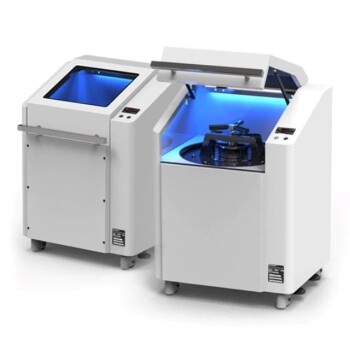
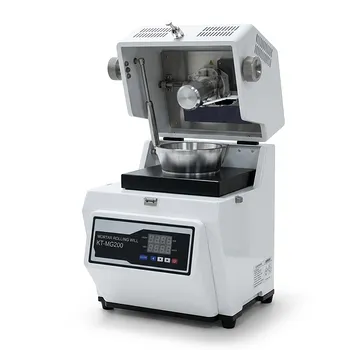
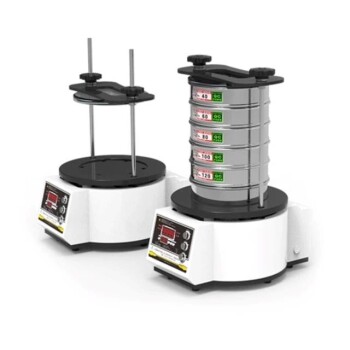
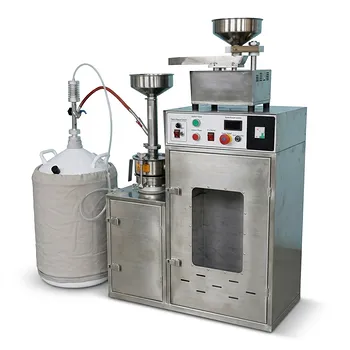
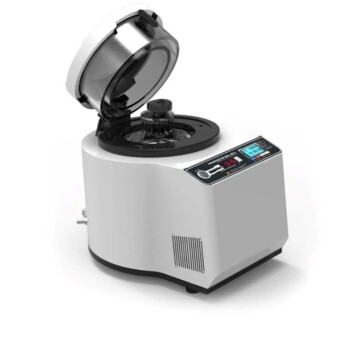
Crushing and sieving systems are the critical enablers of effective CO2 mineralization, serving as the bridge between inert raw materials and active carbon sequestration. By mechanically reducing natural minerals or industrial wastes into micron-sized powders, these systems fundamentally alter the physical state of the feedstock to maximize its chemical reactivity.
By dramatically increasing surface area and disrupting crystal structures, mechanical pre-treatment transforms stable solids into highly reactive agents, ensuring the CO2 mineralization reaction occurs rapidly and completely enough to be industrially viable.
The Mechanics of Enhanced Reactivity
To understand why crushing is non-negotiable, you must look beyond simple size reduction. The process triggers specific physical changes that dictate chemical performance.
Maximizing Specific Surface Area
The primary function of these systems is to reduce feedstock size to the micron scale.
This reduction exponentially increases the specific surface area relative to the material's volume.
In a chemical reaction where a gas (CO2) interacts with a solid, the reaction can only occur at the surface. More surface area equates to more immediate contact points for carbon dioxide.
Destabilizing the Lattice Structure
Natural minerals like serpentine or olivine are geologically stable and resistant to change.
High-intensity crushing applies mechanical energy that literally breaks down the mineral lattice structures.
This physical stress weakens the internal bonds of the mineral, moving it away from its stable equilibrium and making it chemically "hungry" to react with CO2.
Exposing Active Reaction Sites
Chemical reactions do not occur uniformly across a surface; they happen at specific "active sites."
Raw minerals often have their active sites locked away inside the bulk material.
Sieving and crushing fracture the material to expose these previously inaccessible active sites, significantly accelerating the conversion efficiency.
Understanding the Trade-offs
While essential, mechanical pre-treatment introduces operational challenges that must be managed to maintain overall system efficiency.
Energy Penalties
Grinding hard rocks like olivine into micron-sized powders is energy-intensive.
There is a point of diminishing returns where the energy required to crush the material further outweighs the benefits of increased reaction speed.
Equipment Wear
The feedstocks used for mineralization are often abrasive.
Crushing systems face high wear rates, leading to frequent maintenance requirements and potential downtime if equipment is not specifically hardened for these materials.
Optimizing Pre-Treatment for Your Project
The goal is not simply to crush material as fine as possible, but to find the balance between reactivity and operational cost.
- If your primary focus is Reaction Speed: Prioritize high-intensity milling to maximize lattice disruption and specific surface area, even at a higher energy cost.
- If your primary focus is Net Carbon Efficiency: Target a coarser particle size distribution that provides sufficient reactivity without expending excessive energy on grinding.
- If your primary focus is Process Consistency: Implement rigorous sieving protocols to ensure uniform particle sizes, preventing unreacted core material from stalling the process.
Ultimately, precise control over particle size is the lever that turns geological potential into kinetic reality.
Summary Table:
| Feature | Role in CO2 Mineralization | Primary Benefit |
|---|---|---|
| Crushing & Milling | Reduces bulk material to micron-sized powder | Exponentially increases specific surface area |
| Mechanical Stress | Destabilizes mineral lattice structures | Lowers chemical stability to trigger faster reactions |
| Sieving | Ensures uniform particle size distribution | Guarantees process consistency and reaction depth |
| Active Site Exposure | Fractures material to reveal internal sites | Maximizes immediate contact points for CO2 interaction |
Unlock the Potential of Carbon Sequestration with KINTEK
Transitioning from geological potential to industrial-scale CO2 mineralization requires precision at the pre-treatment phase. At KINTEK, we specialize in the high-performance laboratory equipment and consumables essential for advanced material research and carbon capture technology.
Our specialized crushing and milling systems, combined with precision sieving equipment, are designed to handle abrasive minerals and industrial wastes, ensuring you achieve the perfect balance between particle reactivity and energy efficiency. Whether you are scaling up CO2 mineralization or refining battery research, our comprehensive portfolio—including high-temperature furnaces, hydraulic presses, and high-pressure reactors—provides the durability and accuracy your lab demands.
Ready to optimize your carbon mineralization workflow? Contact our technical experts today to find the right equipment for your specific feedstock and research goals.
References
- Chuanbo Zhang, Tao Yue. An Approach to CO2 Emission Reduction in the Iron and Steel Industry: Research Status and Development Trends of Integrated Absorption-Mineralization Technologies. DOI: 10.3390/su17020702
This article is also based on technical information from Kintek Solution Knowledge Base .
Related Products
- Laboratory Test Sieves and Sieving Machines
- Three-dimensional electromagnetic sieving instrument
- Laboratory Vibratory Sieve Shaker Machine for Dry and Wet Three-Dimensional Sieving
- Powerful Plastic Crusher Machine
- Sealed Jaw Crusher High Efficiency Environmental Protection Safe and Reliable
People Also Ask
- What are laboratory test sieves used for? A Guide to Particle Size Analysis
- How do you calculate the sieve test? Master Particle Size Distribution for Quality Control
- How does a lab test sieve contribute to biomass charcoal powder preparation? Achieve Uniform Particle Size
- What are the specifications for test sieves? A Guide to ASTM & ISO Standards for Accurate Particle Analysis
- What materials are required for sieving? Achieve Accurate Particle Size Analysis