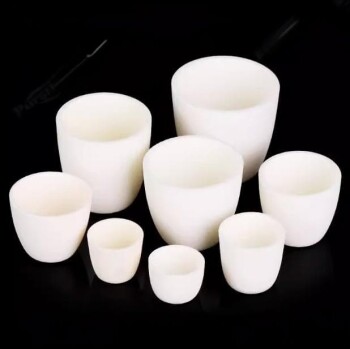
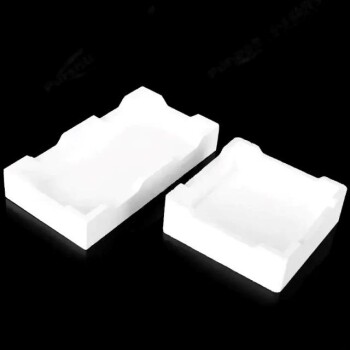
High-purity alumina crucibles are the mandatory standard for synthesizing high-performance titanium dioxide ($TiO_2$) because standard ceramics actively contaminate the catalyst during the heating process. At high calcination temperatures, $TiO_2$ becomes chemically aggressive and will strip impurities—specifically sodium or calcium ions—from lower-grade vessels. High-purity alumina provides the necessary chemical inertness to prevent this interaction, ensuring the catalyst’s lattice remains pure and its performance uncompromised.
The choice of crucible determines the chemical integrity of your final product. Using standard ceramics creates a risk of "uncontrolled doping," where leaching vessel materials degrade the specific photocatalytic properties you are trying to engineer.
The Chemistry of Contamination
High-Temperature Reactivity
Titanium dioxide is not passive during synthesis. At the elevated temperatures required for calcination, it becomes highly chemically active.
In this state, it acts almost like a solvent for adjacent materials. It tends to react with the walls of the crucible if the material is not sufficiently stable.
The Problem with Standard Ceramics
Standard ceramic crucibles often contain binders and fluxes to lower their melting point or reduce cost. These components typically include sodium (Na) and calcium (Ca).
Because $TiO_2$ is reactive, it readily absorbs these ions. This is not a surface-level issue; these impurities can migrate into the catalyst's crystal lattice.
Uncontrolled Doping
In semiconductor synthesis, doping is usually a precise, intentional process. When impurities leach from a crucible, it results in uncontrolled doping.
This alters the electronic structure of the $TiO_2$ unpredictably. Instead of enhancing performance, these random impurities often act as defects that severely degrade photocatalytic activity.
Thermal Stability and Inertness
Preventing Cross-Contamination
High-purity alumina offers exceptional refractoriness (resistance to heat) and chemical inertness. It does not off-gas or degrade at temperatures exceeding 1000°C.
This stability is crucial when working with precursors that are sensitive to reduction or oxidation. The crucible remains a neutral vessel, preventing container components from reacting with the raw materials.
Maintaining Stoichiometry
For high-performance composites, the ratio of elements (stoichiometry) is critical. If the crucible reacts with the sample, it can deplete certain elements or introduce new ones.
High-purity alumina prevents these side reactions. This ensures that the final product maintains the exact chemical composition predicted by your theoretical models.
Isolating Magnetic and Electrical Properties
Beyond $TiO_2$, the principle applies to other sensitive materials like Fe-C@C nanoparticles or LLZTO ceramics.
Impurities from the vessel can interfere with magnetic properties or ionic conductivity. High-purity alumina acts as a barrier, ensuring the physical properties of the synthesized powder are derived solely from the precursors, not the container.
Common Pitfalls to Avoid
The Illusion of "Good Enough"
It is a common error to assume that standard porcelain or lower-grade alumina is sufficient for initial trials.
However, even trace amounts of sodium diffusion can alter phase formation. This leads to false negatives in research, where a catalyst is deemed ineffective when it was actually just contaminated.
Temperature Limits vs. Chemical Limits
A crucible might withstand the temperature of your furnace without melting, yet still fail chemically.
Standard ceramics may survive 1000°C physically but become chemically active at that range. You must select a crucible based on its chemical stability relative to your specific reactant, not just its thermal rating.
Making the Right Choice for Your Goal
Selecting the correct vessel is a fundamental variable in experimental design.
- If your primary focus is Photocatalytic Efficiency: Use high-purity alumina to prevent sodium/calcium leaching that destroys the active sites on the $TiO_2$ lattice.
- If your primary focus is Model Validation: Use high-purity vessels to ensure the stoichiometry of the physical product matches your theoretical calculations exactly.
- If your primary focus is Magnetic or Electrical Purity: Rely on high-purity alumina to prevent impurity phases that disrupt conductivity or magnetic moments.
Your crucible is not just a container; it is a chemical boundary condition that defines the purity limit of your material.
Summary Table:
| Feature | Standard Ceramic Crucible | High-Purity Alumina Crucible |
|---|---|---|
| Purity Level | Contains binders/fluxes (Na, Ca) | >99% Alumina (Al2O3) |
| Chemical Inertness | Low; reactive at high temperatures | High; resistant to chemical attack |
| Impurity Risk | High (Uncontrolled doping) | Negligible |
| Thermal Stability | Varies; may degrade chemically | Excellent; stable >1000°C |
| Impact on Catalyst | Degrades photocatalytic activity | Maintains stoichiometry & lattice purity |
Elevate Your Material Purity with KINTEK Precision Solutions
Don't let vessel impurities compromise years of research. KINTEK specializes in premium laboratory equipment designed for the most demanding synthesis environments. Whether you are engineering high-performance TiO2 catalysts, researching battery materials, or developing advanced ceramics, our high-purity alumina crucibles and consumables ensure your results remain accurate and uncontaminated.
From high-temperature muffle and vacuum furnaces to crushing systems and isostatic presses, KINTEK provides the end-to-end tools needed for superior material science.
Ready to secure your chemical integrity? Contact our specialists today to find the perfect high-purity solution for your laboratory.
References
- Huaitao Yang, Junjiao Yang. Preparation and Photocatalytic Activities of TiO2-Based Composite Catalysts. DOI: 10.3390/catal12101263
This article is also based on technical information from Kintek Solution Knowledge Base .
Related Products
- Arc-Shaped Alumina Ceramic Crucible High Temperature Resistant for Engineering Advanced Fine Ceramics
- Engineering Advanced Fine Alumina Al2O3 Ceramic Crucible for Laboratory Muffle Furnace
- Engineering Advanced Fine Ceramics Alumina Al2O3 Crucible With Lid Cylindrical Laboratory Crucible
- Engineering Advanced Fine Ceramics Alumina Crucibles (Al2O3) for Thermal Analysis TGA DTA
- Alumina Al2O3 Ceramic Crucible Semicircle Boat with Lid for Engineering Advanced Fine Ceramics
People Also Ask
- Why Use Alumina Crucibles & Powder Burial for NaSICON? Ensure Phase Purity and Prevent Elemental Volatilization
- What is the primary purpose of using alumina crucibles for LLTO ceramics? Optimize Your High-Temperature Sintering
- Why are alumina crucibles and mother powder essential for LATP sintering? Optimize Your Solid Electrolyte Performance
- Why are high-purity alumina crucibles used for liquid lead corrosion experiments? Ensure Data Accuracy at 550°C
- Primary considerations for choosing alumina crucibles and quartz tubes in indium intercalation: Ensure Material Purity