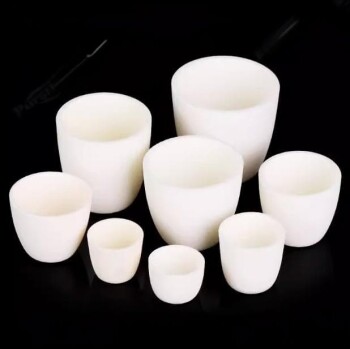
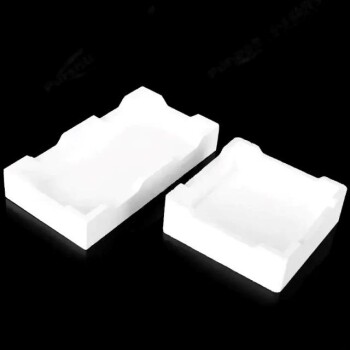
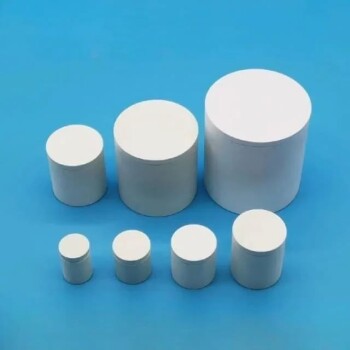
High-purity alumina crucibles are the critical standard for liquid lead experiments due to their exceptional chemical inertness and stability at extreme temperatures. They act as a neutral barrier, ensuring the liquid lead does not react with the container walls even at temperatures as high as 750°C to 800°C, thereby preventing the introduction of metallic impurities into the system.
Core Takeaway: The reliability of corrosion data depends entirely on the purity of the environment. Alumina crucibles are used to isolate variables, ensuring that any corrosion observed is exclusively a reaction between the test specimen and the liquid lead, free from interference by the container material.
The Necessity of Chemical Inertness
Preventing Chemical Reactions
Liquid lead is highly corrosive, capable of dissolving many standard materials. High-purity alumina ($Al_2O_3$) is selected because it possesses extremely low solubility in liquid lead and lead-bismuth eutectic (LBE). Unlike metallic containers, alumina does not react with the molten metal, maintaining a stable environment throughout the duration of the experiment.
Ensuring Thermal Stability
Corrosion experiments often push temperatures to extremes to test material limits. Alumina crucibles maintain their structural and chemical integrity at temperatures reaching 750°C and up to 800°C. This thermal stability ensures the container does not degrade, warp, or release byproducts when subjected to the high heat required to test alloys like FeCrAl or ODS steel.
Preserving Experimental Integrity
Eliminating Contamination Variables
The primary goal of these experiments is to measure how specific alloys oxidize or "self-heal." If the crucible material were to dissolve, it would introduce foreign metal ions into the lead melt. These impurities would alter the purity of the lead, potentially accelerating or inhibiting the corrosion of the test specimen and rendering the resulting data inaccurate.
Isolating the Specimen
To evaluate properties like oxide film formation or selective leaching accurately, the environment must be controlled. Alumina crucibles ensure that the corrosion behavior observed is occurring exclusively between the specimen and the liquid lead. This isolation is vital for determining the true corrosion rate and mechanisms of the alloy being tested.
Role in Equipment Protection
Functioning as a Protective Liner
In high-pressure reactors or autoclaves, the metallic inner walls are susceptible to attack by liquid lead. Alumina crucibles serve as an inert liner, physically separating the corrosive melt from the reactor vessel.
Preventing Secondary Reactions
By isolating the melt, the crucible prevents direct contact between the liquid lead and the pressure vessel. This stops secondary reactions—such as the dissolution of the reactor walls—which would not only damage expensive equipment but also contaminate the melt with elements from the reactor's own alloy.
Common Pitfalls to Avoid
The "High-Purity" Requirement
Not all alumina is suitable for this application. It is a common mistake to assume standard ceramics will suffice. The references explicitly highlight the need for high-purity alumina (typically >99% or >99.7%).
The Risk of Impurity Leaching
Lower-purity ceramics may contain binders or additives that can leach into the liquid lead at 600°C+. Even trace amounts of these contaminants can interfere with the formation of oxide films on the test specimen. For high-fidelity data, specifically regarding trace elements and long-term corrosion rates, strict adherence to high-purity specifications is non-negotiable.
Making the Right Choice for Your Goal
When designing a liquid lead corrosion experiment, the selection of the crucible dictates the validity of your results.
- If your primary focus is Data Accuracy: Prioritize crucibles with >99.7% purity to ensure zero interference with the alloy's oxidation and self-healing mechanisms.
- If your primary focus is Equipment Longevity: Utilize alumina as a robust liner to isolate the corrosive melt from your autoclave or reactor walls, preventing structural dissolution.
Ultimately, the use of high-purity alumina is the only way to guarantee that your corrosion data reflects the material's true performance rather than an experimental artifact.
Summary Table:
| Feature | High-Purity Alumina (>99.7% $Al_2O_3$) | Benefit in Lead Corrosion Experiments |
|---|---|---|
| Chemical Inertness | Extremely low solubility in liquid lead/LBE | Prevents container reaction and impurity leaching. |
| Thermal Stability | Maintains integrity up to 800°C+ | Ensures structural stability during high-heat alloy testing. |
| Purity Control | Minimal binders or additives | Guarantees that corrosion data reflects only the test specimen. |
| Equipment Protection | Acts as a non-reactive liner | Shields reactor/autoclave walls from corrosive melt damage. |
Elevate Your Research Precision with KINTEK
Don't let container contamination compromise your corrosion data. KINTEK specializes in high-performance laboratory equipment and consumables designed for the most demanding environments. Whether you are conducting experiments in high-temperature high-pressure reactors and autoclaves or require specialized high-purity alumina crucibles and ceramics, we provide the tools necessary for high-fidelity results. From crushing and milling systems to advanced battery research tools, our portfolio supports the entire lifecycle of material science.
Ready to protect your equipment and ensure data accuracy? Contact KINTEK today to find the perfect high-purity solution for your laboratory.
References
- Peter Dömstedt, Peter Szakálos. Corrosion Studies of Low-Alloyed FeCrAl Steels in Liquid Lead at 750 °C. DOI: 10.1007/s11085-019-09896-z
This article is also based on technical information from Kintek Solution Knowledge Base .
Related Products
- Arc-Shaped Alumina Ceramic Crucible High Temperature Resistant for Engineering Advanced Fine Ceramics
- Engineering Advanced Fine Alumina Al2O3 Ceramic Crucible for Laboratory Muffle Furnace
- Engineering Advanced Fine Ceramics Alumina Al2O3 Crucible With Lid Cylindrical Laboratory Crucible
- Engineering Advanced Fine Ceramics Alumina Crucibles (Al2O3) for Thermal Analysis TGA DTA
- Alumina Al2O3 Ceramic Crucible Semicircle Boat with Lid for Engineering Advanced Fine Ceramics
People Also Ask
- Why Use Alumina Crucibles & Powder Burial for NaSICON? Ensure Phase Purity and Prevent Elemental Volatilization
- What is the primary purpose of using alumina crucibles for LLTO ceramics? Optimize Your High-Temperature Sintering
- Why are alumina crucibles and mother powder essential for LATP sintering? Optimize Your Solid Electrolyte Performance
- Why are high-purity alumina crucibles used for liquid lead corrosion experiments? Ensure Data Accuracy at 550°C
- Primary considerations for choosing alumina crucibles and quartz tubes in indium intercalation: Ensure Material Purity