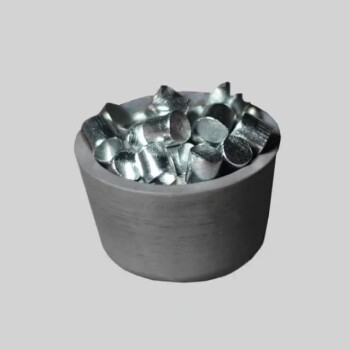
High-purity Nickel Crucibles are the definitive choice for molten salt stability testing primarily due to their exceptional chemical inertness and electrical conductivity. These vessels solve two fundamental challenges: they resist corrosion in aggressive molten fluoride environments to maintain sample purity, and they simplify electrochemical setups by functioning directly as the auxiliary electrode.
The selection of a reaction vessel is not just about containment; it is about chemical compatibility. High-purity Nickel acts as both a stable barrier against corrosion and a functional component of the electrochemical circuit, ensuring valid data in complex molten salt experiments.
The Critical Role of Chemical Inertness
Resisting Aggressive Environments
Molten salts, particularly fluoride salts, are highly corrosive and can rapidly degrade standard container materials.
High-purity Nickel provides a chemically inert barrier in these environments. This resistance is essential for preventing the container walls from reacting with the molten salt, which would compromise the structural integrity of the vessel.
Minimizing Contamination and Corrosion
The validity of a metal stability test depends on the purity of the chemical environment.
By minimizing corrosion reactions, high-purity Nickel ensures that reaction byproducts do not leach into the molten salt. This isolation guarantees that the experimental results reflect the true behavior of the test subject, rather than artifacts caused by container degradation.
Electrochemical Functionality and Design
The Dual Role as Counter Electrode
In a standard three-electrode electrochemical system, the vessel often plays a passive role.
However, high-purity Nickel crucibles are frequently utilized as the auxiliary or counter electrode. This dual functionality eliminates the need to insert a separate, bulky electrode rod into the melt, streamlining the internal arrangement of the cell.
Ensuring Circuit Stability
Reliable electrochemical measurements require a stable connection with sufficient surface area.
Because the crucible itself acts as the electrode, it provides a large, uniform conductive surface area. This maximizes contact with the electrolyte, ensuring stable circuit operation and reducing noise in the electrochemical data.
Simplifying Experimental Apparatus
Designing high-temperature molten salt experiments is mechanically complex.
Using the crucible as the counter electrode significantly simplifies the design of the experimental apparatus. It reduces the number of ports required in the cell lid and minimizes the risk of electrode misalignment during heating cycles.
Understanding the Trade-offs
The Necessity of High Purity
The reference specifically highlights high-purity Nickel, not standard grades.
Using Nickel with impurities can introduce weak points where corrosion can initiate. For the inertness described above to hold true, the material quality must be strictly controlled; lower-grade alloys may react unpredictably with the molten salt.
Specificity to Fluoride Salts
While Nickel is excellent for the environments described, its application is context-dependent.
The primary reference explicitly notes its suitability for molten fluoride salt experiments. You must verify that this chemical compatibility extends to other salt chemistries if you deviate from fluorides, as different ions can induce different corrosion mechanisms.
Making the Right Choice for Your Experiment
To maximize the reliability of your molten salt testing, align your equipment choice with your specific technical requirements.
- If your primary focus is Chemical Purity: Select high-purity Nickel to minimize corrosion reactions and prevent the leaching of container material into your molten fluoride electrolyte.
- If your primary focus is Experimental Simplicity: Utilize the conductive Nickel crucible as your counter electrode to reduce mechanical clutter and ensure a large, stable surface area for electrochemical measurements.
By leveraging the chemical stability and electrical properties of high-purity Nickel, you transform the reaction vessel from a passive container into an active tool for precision.
Summary Table:
| Feature | Benefit for Molten Salt Testing |
|---|---|
| Chemical Inertness | Resists aggressive fluoride corrosion to maintain sample purity. |
| High Purity | Minimizes leaching and prevents contamination of the chemical environment. |
| Dual Functionality | Acts as both the reaction vessel and the electrochemical counter electrode. |
| Large Surface Area | Provides uniform electrical contact, ensuring stable circuit operation. |
| Design Simplicity | Reduces mechanical complexity by eliminating the need for extra electrode rods. |
Elevate Your Research with KINTEK Precision Solutions
Ensure the integrity of your electrochemical experiments with high-performance laboratory equipment from KINTEK. Whether you are conducting molten salt stability tests or complex material synthesis, our high-purity Nickel crucibles, high-temperature furnaces, and electrolytic cells are engineered to withstand the most demanding conditions.
From advanced battery research tools to high-pressure reactors and autoclaves, KINTEK provides a comprehensive range of solutions designed to deliver accuracy and durability. Don't compromise your data with inferior containers—leverage our expertise in high-temperature materials and lab consumables to streamline your workflow.
Ready to optimize your lab setup? Contact KINTEK today to find the perfect fit for your application!
References
- S. A. Dowben, Michael F. Simpson. Electrochemical Analysis of Metal Stability in Candidate Reference Electrode Fluoride Salts (FLiNaK + 1 wt% AgF, MnF<sub>2</sub>, or NiF<sub>2</sub>). DOI: 10.1149/1945-7111/ad2151
This article is also based on technical information from Kintek Solution Knowledge Base .
Related Products
- High Purity Pure Graphite Crucible for Evaporation
- High Purity Pure Graphite Crucible for Electron Beam Evaporation
- Electron Beam Evaporation Coating Tungsten Crucible and Molybdenum Crucible for High Temperature Applications
- Custom Machined and Molded PTFE Teflon Parts Manufacturer with PTFE Crucible and Lid
- Arc-Shaped Alumina Ceramic Crucible High Temperature Resistant for Engineering Advanced Fine Ceramics
People Also Ask
- Why are high-purity graphite crucibles preferred for sulfide solid electrolytes? Achieve Superior Material Purity
- Why is a high-purity graphite crucible required for Chromel-TaC composites? Ensure Peak Purity at 1400°C
- What role do high-purity graphite crucibles play in molten salt corrosion research? Ensure Reactor-Grade Precision
- Why are high-purity graphite crucibles used for magnesium distillation? Ensure 3N8 Purity & Thermal Stability
- Why is a high-purity graphite crucible ideal for nitrogen-doped graphene at 1500 °C? Maximize Purity and Stability