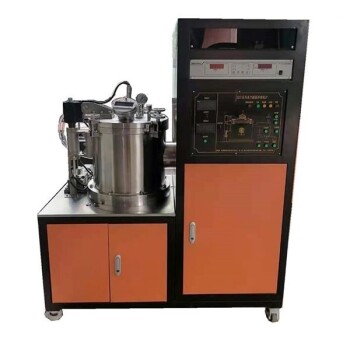
Induction melting furnaces and alumina crucibles are the industry standard for silicide thermoelectric materials because they provide a precise, high-purity environment for volatile and reactive elements. This combination ensures uniform alloying of magnesium, calcium, and silicon while preventing chemical contamination from the crucible walls. By utilizing electromagnetic fields for heating and inert ceramic for containment, manufacturers can maintain the strict stoichiometric ratios required for high-performance thermoelectric conversion.
The use of induction heating and alumina containment solves the critical challenge of processing highly reactive alkaline earth silicides. This pairing ensures thermal uniformity and chemical inertness, which are essential for producing the high-purity ingots necessary for efficient energy harvesting.
The Role of Induction Furnaces in Silicide Production
Achieving Uniform Alloying Through Electromagnetic Stirring
Induction furnaces utilize an electromagnetic field to generate heat directly within the raw materials. This process creates a natural stirring effect in the melt, which ensures that elements like magnesium and silicon are thoroughly and uniformly alloyed.
Precision Control and Rapid Heating
These furnaces offer fast melting speeds and high energy efficiency compared to traditional resistive heating. This rapid response allows for precise temperature control, which is vital for managing the high vapor pressure of magnesium and preventing material loss.
Protection Against Oxidation
The induction process is easily performed under argon protection or a vacuum. This atmosphere is critical for silicide materials, as magnesium and calcium react violently with oxygen at elevated temperatures.
Why Alumina Crucibles are Essential for Purity
Superior Chemical Inertness
Alumina (aluminum oxide) exhibits exceptional chemical corrosion resistance, even when in contact with active metal melts. It remains stable against the aggressive nature of molten alkaline earth metals, ensuring that the crucible does not leach impurities into the silicide.
High-Temperature Structural Integrity
Silicide melting often requires temperatures exceeding 1000°C, where many other materials fail. Alumina crucibles maintain their mechanical strength and stability at these extremes, providing a reliable vessel for the synthesis of high-quality ingots.
Prevention of Impurity Contamination
By acting as a non-reactive barrier, alumina ensures the chemical accuracy of the initial ingot. Any introduction of foreign atoms from the crucible could significantly degrade the thermoelectric figure of merit ($ZT$) by altering the material's carrier concentration.
Understanding the Trade-offs
The Cost of High-Purity Synthesis
While alumina crucibles and induction furnaces produce superior materials, they represent a higher capital and operational investment. Alumina is sensitive to thermal shock, meaning crucibles must be heated and cooled gradually to prevent cracking, which can extend production cycles.
Refractory Limitations
Alumina is highly effective for silicides but may not be suitable for every alloy type. In some cases, the cost of frequent crucible replacement due to thermal fatigue must be weighed against the necessity for extreme purity.
How to Apply This to Your Project
Selecting the Right Process for Your Goal
To achieve the best results with silicide thermoelectric materials, you must align your equipment choices with your specific performance targets.
- If your primary focus is Maximum Thermoelectric Efficiency: You must use high-purity alumina crucibles and induction melting to ensure the strict stoichiometry required for a high $ZT$ value.
- If your primary focus is High-Volume Production Scalability: Consider automated induction systems with argon recovery to manage the high energy and gas costs associated with large-scale silicide synthesis.
- If your primary focus is Prototyping New Alloy Compositions: Use small-scale induction melting to leverage its rapid heating and cooling capabilities, allowing for faster experimental iterations.
Selecting the right combination of induction heating and alumina containment is the foundational step in ensuring the chemical integrity and performance of silicide-based energy converters.
Summary Table:
| Component | Key Function | Benefit for Silicide Materials |
|---|---|---|
| Induction Furnace | Electromagnetic Stirring | Ensures uniform alloying of Mg, Ca, and Si; prevents material loss. |
| Alumina Crucible | Chemical Inertness | Prevents contamination from reactive melts; maintains high $ZT$ values. |
| Process Control | Rapid Heating & Atmosphere | Protects volatile elements from oxidation under argon or vacuum. |
| Material Integrity | High-Temp Stability | Maintains structural strength above 1000°C for reliable ingot synthesis. |
Elevate Your Thermoelectric Research with KINTEK
Achieving the perfect stoichiometric ratio in silicide materials requires precision and high-purity containment. KINTEK specializes in advanced laboratory solutions, providing the high-performance induction melting furnaces and high-purity alumina crucibles essential for your synthesis needs.
Our extensive portfolio includes:
- High-Temperature Furnaces: Atmosphere, vacuum, and induction melting systems for reactive alloys.
- Specialized Consumables: Durable alumina, PTFE, and ceramic products designed for chemical inertness.
- Advanced Lab Tools: High-pressure reactors, hydraulic pellet presses, and crushing/milling systems for material preparation.
Whether you are prototyping new compositions or scaling production, our technical experts are ready to provide the reliable equipment and OEM/ODM support you need to maximize your thermoelectric figure of merit.
Contact KINTEK Today to Optimize Your Melting Process!
References
- Imants Dirba, Oliver Gutfleisch. Bulk Nanostructured Silicide Thermoelectric Materials by Reversible Hydrogen Absorption–Desorption. DOI: 10.1002/smll.202208098
This article is also based on technical information from Kintek Solution Knowledge Base .
Related Products
- Lab-Scale Vacuum Induction Melting Furnace
- Vacuum Heat Treat Furnace and Levitation Induction Melting Furnace
- Non Consumable Vacuum Arc Induction Melting Furnace
- Vacuum Arc Induction Melting Furnace
- 600T Vacuum Induction Hot Press Furnace for Heat Treat and Sintering
People Also Ask
- How do vacuum induction or arc melting furnaces facilitate the synthesis of U-Al-C MAX phases? Precision Heat & Purity
- What is the primary function of a vacuum induction melting furnace in Ni-Mo-Cr-Fe master alloy prep? Ensure High Purity
- What types of metals are typically processed in a vacuum induction melting furnace? High-Purity Alloys for Critical Applications
- Why use VIM for rare earth steel? Essential Precision for Melting Reactive Lanthanum and Cerium
- What is the function of a vacuum induction melting furnace? Essential Guide for High-Purity FeCrAl Alloy Production