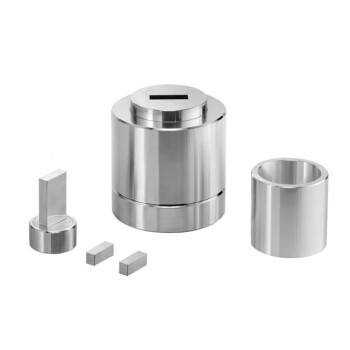
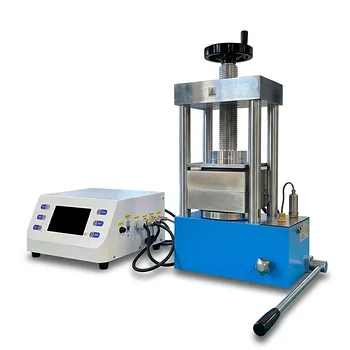
Industrial-grade hydraulic pellet presses are essential for transforming inconsistent raw biomass into a standardized, reliable fuel source. By employing physical extrusion to compress loose waste into high-density pellets or blocks, this equipment directly resolves the critical handling challenges caused by low-density raw materials.
The primary value of this equipment lies in standardization: it converts variable biomass into uniform inputs to prevent physical blockages and ensure consistent airflow within the gasification reactor. This process is the keystone for ensuring the operational stability of the entire hydrogen production system.
Overcoming the Physics of Raw Biomass
The Challenge of Low Density
Raw biomass waste is inherently loose, voluminous, and difficult to handle. This low density makes it inefficient to feed directly into high-precision energy systems.
Hydraulic pellet presses solve this by using massive force to compress the material. This physical extrusion drastically increases the density of the feedstock, making it viable for industrial processing.
Addressing Uneven Composition
Biomass waste is rarely uniform; it comes in various shapes, sizes, and textures. This uneven composition leads to unpredictable reaction rates if left untreated.
Granulation equipment homogenizes the material into uniform pellets or blocks. This ensures that every unit of fuel entering the system has consistent physical properties.
Ensuring Reactor Stability
Optimizing Airflow Distribution
For a gasification reactor to produce hydrogen efficiently, gases must flow through the feedstock evenly. Loose biomass creates pockets of resistance and chaotic flow patterns.
Standardizing the feed material into pellets ensures uniform airflow distribution inside the reactor. This allows the chemical reactions necessary for hydrogen production to occur consistently throughout the chamber.
Preventing Mechanical Blockages
One of the most common failure points in biomass processing is material getting stuck. Loose biomass is prone to bridging or clogging at narrow feed points.
Compressed pellets flow like a fluid, eliminating these physical bottlenecks. This prevents costly downtime and maintenance interruptions.
Understanding the Trade-offs
Pretreatment Energy vs. System Efficiency
Adding high-pressure hydraulic presses to the line increases the initial energy consumption of the pretreatment stage. You are expending energy to create the pellets.
However, this energy cost is generally offset by the gains in the gasification stage. Without this step, the instability and inefficiency of the reactor would likely result in a net loss of hydrogen production.
Making the Right Choice for Your Goal
While the equipment requires an upfront investment, it is a necessary safeguard for continuous operation.
- If your primary focus is System Uptime: The pellet press is non-negotiable, as it eliminates the bridging and clogging that cause frequent unplanned shutdowns.
- If your primary focus is Reaction Efficiency: Standardized pellets provide the uniform surface area and airflow required to maximize the conversion of biomass to hydrogen.
Ultimately, the hydraulic pellet press acts not just as a compactor, but as a critical standardization tool that safeguards the reliability of your hydrogen generation.
Summary Table:
| Feature | Raw Biomass Challenges | Pellet Press Solution | Impact on Hydrogen Production |
|---|---|---|---|
| Material Density | Low & Voluminous | High-Density Compression | Efficient feeding & storage |
| Physical Form | Irregular & Uneven | Uniform Pellets/Blocks | Prevents bridging & mechanical clogs |
| Airflow | Chaotic & Restricted | Even Distribution | Consistent chemical reaction rates |
| Operational Stability | High Downtime Risk | Smooth Fluid-like Flow | Maximized system uptime & reliability |
Maximize Your Green Energy Potential with KINTEK
Transform your biomass processing with KINTEK’s industry-leading industrial-grade hydraulic pellet presses. We specialize in providing high-precision laboratory and industrial equipment—including hydraulic presses (pellet, hot, isostatic), high-temperature furnaces, and crushing systems—designed to ensure your pretreatment stage is optimized for maximum efficiency.
Whether you are scaling up hydrogen production or refining your research, our team offers the expertise and durable solutions required to eliminate system downtime and achieve superior gasification results.
Ready to standardize your feedstock for peak performance? Contact KINTEK today to discuss your project requirements!
References
- Iman Bengharbia, T Younus. Sustainable Green Hydrogen Generation from Biomass Waste: Technologies and Environmental Impact. DOI: 10.54361/ajmas.258335
This article is also based on technical information from Kintek Solution Knowledge Base .
Related Products
- Laboratory Hydraulic Pellet Press for XRF KBR FTIR Lab Applications
- Automatic Laboratory Hydraulic Pellet Press Machine for Lab Use
- Automatic Laboratory Hydraulic Press for XRF & KBR Pellet Press
- Laboratory Manual Hydraulic Pellet Press for Lab Use
- Laboratory Manual Hydraulic Pellet Press for Lab Use
People Also Ask
- What is the role of a laboratory hydraulic pellet press and stainless steel molds in the fabrication of RuO2/NbC anodes?
- How does a laboratory hydraulic pellet press contribute to SiCw/2024 aluminum composite preforms? Optimize Densification
- What is the necessity of using a laboratory hydraulic pellet press in the preparation of biomass fuel pellets? Guide
- What is the significance of applying 200 MPa of pressure with a laboratory hydraulic pellet press for composite ceramics?
- What function does a laboratory pellet press or rolling mill serve? Enhance Electrode Density and Performance