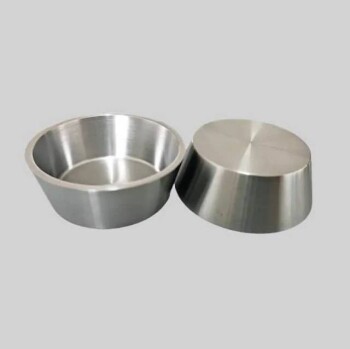
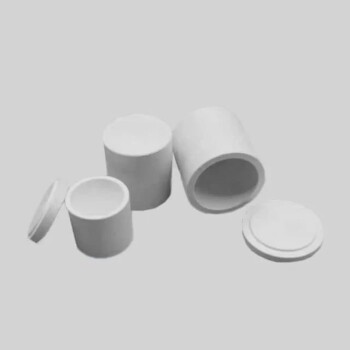
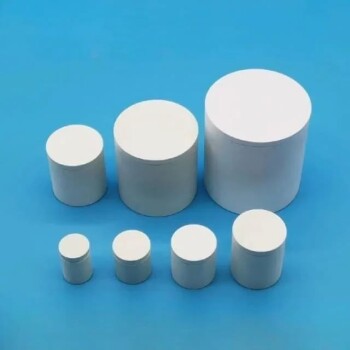
Mullite crucibles and spacers are chosen primarily for their exceptional chemical inertness and ability to withstand extreme thermal environments. Specifically, in the synthesis of Si2N2O-based composites, they function as a critical physical barrier between the sample and the heating elements. This isolation is necessary to maintain material purity during high-temperature processing.
The defining advantage of mullite is its ability to prevent carbon infiltration and resist reaction with molten silicon at temperatures above 1430°C, thereby preserving the chemical integrity of the synthesized composite.
Thermal and Chemical Stability
Withstanding High Processing Temperatures
The synthesis of Si2N2O requires an environment heated to approximately 1430 degrees Celsius or higher.
Mullite components are selected because they maintain structural stability under these intense thermal conditions.
Resisting High-Temperature Corrosion
At these elevated temperatures, many materials become susceptible to chemical degradation.
Mullite exhibits excellent corrosion resistance, ensuring the crucible does not break down or introduce contaminants into the reaction zone.
The Mechanism of Contamination Prevention
Shielding Against Carbon Infiltration
The synthesis setup typically involves carbon resistors used as heating elements.
Mullite spacers act as a physical shield, preventing carbon atoms from migrating from the resistors into the composite sample.
This barrier is essential for avoiding carbon contamination, which would alter the composition and properties of the final material.
Containing Molten Silicon
The process involves high-temperature molten silicon, a highly reactive substance.
Mullite crucibles prevent this molten material from reacting with the underlying support structures.
Preserving Material Purity
By isolating the sample from both the heating elements and the structural supports, mullite ensures the final product remains pure.
The use of these components guarantees that the composite consists solely of the intended material components without external impurities.
Understanding the Operational Risks
The Consequence of Inadequate Barriers
While mullite provides a robust solution, it is critical to understand the risks of using inferior materials or insufficient spacing.
Without the physical barrier provided by mullite, carbon infiltration becomes almost inevitable in this heating environment.
Furthermore, direct contact between molten silicon and non-inert support structures can lead to destructive chemical reactions, potentially compromising both the sample and the furnace equipment.
Making the Right Choice for Your Synthesis
To ensure the success of your Si2N2O composite synthesis, prioritize your component selection based on your specific purity requirements.
- If your primary focus is Chemical Purity: Ensure complete physical isolation using mullite spacers to block carbon infiltration from heating resistors.
- If your primary focus is Equipment Protection: Utilize mullite crucibles to prevent reactive molten silicon from damaging support structures during the 1430°C+ heating cycle.
By leveraging the inert properties of mullite, you effectively eliminate the variables of contamination and reaction, ensuring a consistent and high-quality composite output.
Summary Table:
| Feature | Benefit in Si2N2O Synthesis |
|---|---|
| Thermal Stability | Maintains structural integrity at temperatures exceeding 1430°C. |
| Chemical Inertness | Prevents reactions between molten silicon and support structures. |
| Infiltration Barrier | Blocks carbon migration from heating resistors into the sample. |
| Corrosion Resistance | Resists high-temperature degradation to avoid sample contamination. |
| Material Purity | Ensures the final composite remains free of external impurities. |
Elevate Your Material Synthesis with KINTEK Precision
Don't let contamination compromise your high-temperature research. KINTEK specializes in high-performance laboratory equipment and consumables, offering a robust selection of mullite crucibles, ceramic spacers, and high-temperature furnaces designed to withstand the most demanding thermal environments.
From advanced muffle and vacuum furnaces to essential crucibles and high-temperature high-pressure reactors, our solutions ensure your Si2N2O-based composites and other advanced materials achieve maximum purity and structural integrity.
Ready to optimize your synthesis process? Contact our experts today to discover how KINTEK's premium laboratory consumables and equipment can enhance your lab's efficiency and precision.
References
- Brice Taillet, F. Teyssandier. Densification of Ceramic Matrix Composite Preforms by Si2N2O Formed by Reaction of Si with SiO2 under High Nitrogen Pressure. Part 1: Materials Synthesis. DOI: 10.3390/jcs5070178
This article is also based on technical information from Kintek Solution Knowledge Base .
Related Products
- High Purity Pure Graphite Crucible for Electron Beam Evaporation
- High Purity Pure Graphite Crucible for Evaporation
- Electron Beam Evaporation Coating Gold Plating Tungsten Molybdenum Crucible for Evaporation
- Electron Beam Evaporation Coating Tungsten Crucible and Molybdenum Crucible for High Temperature Applications
- Engineering Advanced Fine Alumina Al2O3 Ceramic Crucible for Laboratory Muffle Furnace
People Also Ask
- What is the container that holds the metal source material called in e-beam evaporation? Ensure Purity and Quality in Your Thin-Film Deposition
- What role do high-purity graphite crucibles play in molten salt corrosion research? Ensure Reactor-Grade Precision
- Why is a high-purity graphite crucible ideal for nitrogen-doped graphene at 1500 °C? Maximize Purity and Stability
- What dual roles do high-purity graphite crucibles play? Expert Insights into Fluoride Salt Testing
- What role does a high-purity graphite crucible play in CaO-MgO-Al2O3-SiO2 system equilibrium experiments? Maximize Accuracy