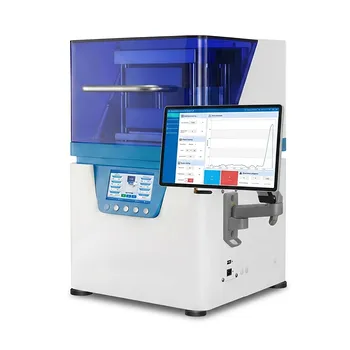
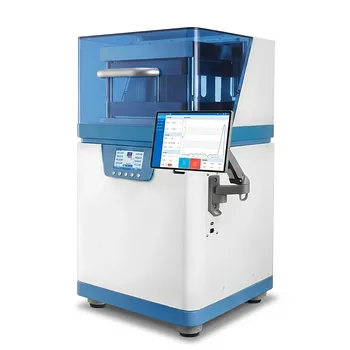
The fabrication of Al2O3–LaPO4 composite green bodies requires precision hydraulic presses and specialized molds to achieve the exact density and geometric uniformity necessary for advanced sintering. These tools transform loose ceramic powders into a structurally sound "green" state by applying controlled uniaxial pressure that forces particle rearrangement and mechanical interlocking. This precision is vital to ensure the material can withstand handling and maintain an even electric field distribution during specialized processes like flash sintering.
Precision laboratory equipment is required to bridge the gap between loose powder and a functional ceramic, ensuring that the initial density and shape are uniform enough to prevent failure during high-temperature densification.
Establishing Structural Integrity and Green Strength
Mechanical Interlocking through Controlled Pressure
A laboratory hydraulic press applies high, stable pressure—often reaching 200 kN—to force Al2O3 and LaPO4 particles into close contact. This process triggers mechanical interlocking and plastic deformation, which gives the green body sufficient strength to be handled without crumbling.
Elimination of Internal Voids
Precision pressing is essential for removing entrapped air and reducing internal porosity between the mixed granules. By eliminating these air-filled voids, the press ensures a sound physical structure that serves as a stable substrate for subsequent high-pressure or high-temperature processing.
The Critical Role of Geometric Uniformity
Ensuring Even Electric Field Distribution
For advanced techniques like flash sintering, geometric uniformity is not just a preference but a technical requirement. The precise pressure control offered by a hydraulic press ensures a consistent initial density, which is critical for maintaining an even electric field distribution throughout the specimen.
Preventing Post-Sintering Deformation
Specialized molds, such as cylindrical or dog-bone shapes, define the final dimensions of the composite. By providing a consistent initial state, these tools significantly reduce shrinkage and deformation when the material is subjected to sintering temperatures ranging from 1000°C to 1600°C.
Consistency as a Scientific Foundation
Standardizing the Initial Material State
In a research environment, the hydraulic press allows for the application of specific static pressures, such as 44.8 MPa or 10 MPa, to create a repeatable baseline. This standardization is necessary to accurately study how different sintering temperatures affect final thermal diffusivity and densification.
Precision Molds and Particle Rearrangement
High-precision molds, often made of cemented carbide, provide the rigid environment needed for axial pressure to break and rearrange powder granules. This ensures that the resulting green body, whether a thin disc or a complex shape, has a regular geometry and a uniform internal density distribution.
Understanding the Trade-offs and Limitations
The Challenge of Density Gradients
While hydraulic presses provide high axial pressure, they can sometimes create density gradients where the powder closest to the plunger is more compacted than the powder at the bottom of the mold. This variation can lead to non-uniform shrinkage if the height-to-diameter ratio of the mold is not carefully managed.
Mold Wear and Contamination
Using specialized hard molds ensures geometric accuracy but introduces the risk of die wear over time, especially with abrasive ceramic powders like Al2O3. Furthermore, without proper lubrication or material selection, the green body may stick to the mold walls, causing surface defects or "capping" during ejection.
How to Apply This to Your Project
Selecting the Right Pressing Strategy
- If your primary focus is Flash Sintering: Prioritize a press with the highest level of pressure stability to ensure an even electric field and prevent specimen "hot spots."
- If your primary focus is Material Characterization: Use precision-ground cemented carbide molds to ensure that your geometric dimensions are exact for accurate thermal diffusivity measurements.
- If your primary focus is High-Volume Testing: Implement standardized pressure settings (e.g., 44.8 MPa) to ensure that every green body begins the sintering process with the same initial packing density.
Ultimately, the precision of the green body fabrication determines the reliability and performance of the final Al2O3–LaPO4 composite.
Summary Table:
| Equipment Component | Primary Role in Fabrication | Impact on Al2O3–LaPO4 Composite |
|---|---|---|
| Precision Hydraulic Press | Controlled uniaxial pressure application | Achieves mechanical interlocking & eliminates internal voids |
| Specialized Molds | Geometric shaping (Cylindrical/Dog-bone) | Ensures even electric field distribution for flash sintering |
| Carbide Die Sets | Rigid particle rearrangement | Standardizes initial packing density for repeatable research |
| Pressure Control | Static load maintenance (e.g., 44.8 MPa) | Prevents non-uniform shrinkage during high-temp sintering |
Elevate Your Ceramic Research with KINTEK Precision
Fabricating advanced Al2O3–LaPO4 composites requires more than just pressure; it requires the absolute control and reliability that KINTEK provides. As specialists in laboratory equipment, we offer a comprehensive range of hydraulic presses (pellet, hot, and isostatic) and precision-engineered ceramic molds designed to eliminate density gradients and ensure structural integrity.
Whether you are conducting flash sintering, measuring thermal diffusivity, or exploring high-temperature densification, our tools—including high-temperature furnaces, crushing systems, and specialized crucibles—are built to standardize your scientific foundation.
Ready to achieve perfect geometric uniformity and green strength? Contact our laboratory experts today to find the ideal pressing solution for your material science project.
References
- Yingjie Yang, Daniel R. Mumm. Mechanical properties of Al <sub>2</sub> O <sub>3</sub> –LaPO <sub>4</sub> composites with eutectic microstructure produced by flash sintering. DOI: 10.1111/jace.19634
This article is also based on technical information from Kintek Solution Knowledge Base .
Related Products
- Fully Automatic Heated Hydraulic Lab Press for Materials Sintering and Sample Preparation
- Laboratory Hydraulic Press Lab Pellet Press Machine for Glove Box
- Automatic Laboratory Hot Press 400x400 mm with Programmable High Temperature and Hydraulic Force Control
- Laboratory Hydraulic Press Split Electric Lab Pellet Press
- Hydraulic Diaphragm Lab Filter Press for Laboratory Filtration
People Also Ask
- How is a laboratory hydraulic press used in the preparation of modified biochar samples for FTIR analysis? Expert Guide
- How does a laboratory heating hydraulic press contribute to the preparation of recycled graphite green bodies? - Optimize Density.
- How does the laboratory hydraulic press contribute to the preparation of solid targets for laser ablation?
- What role does a laboratory hydraulic press play in perovskite-MOF glass fabrication? Master Material Densification
- Why use a laboratory hydraulic press for Fe2O3-CoP conductivity? Achieve Precise Material Characterization