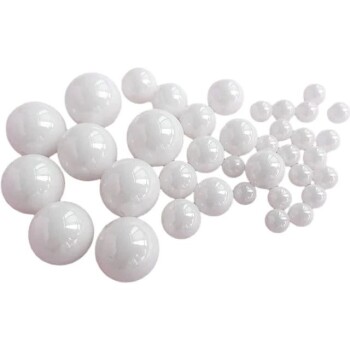
The primary reason for selecting Zirconia (ZrO2) grinding balls is to maintain chemical purity through material compatibility. Because the target composite material (Al2O3/ZrO2) already contains zirconia, utilizing grinding media made of the exact same substance ensures that any material lost due to abrasive wear becomes an inherent part of the mixture rather than a harmful foreign contaminant. Furthermore, the high density and hardness of zirconia balls provide the necessary kinetic energy to efficiently pulverize the powder without degrading the media significantly.
The selection of grinding media is governed by the principle of compatible wear: since mechanical attrition is inevitable, choosing media that matches the composition of the product ensures that wear debris does not compromise the chemical integrity of the final composite.
The Imperative of Purity Control
Eliminating Foreign Contamination
In high-performance ceramics, even trace amounts of foreign elements can degrade the material's final properties. Using steel or tungsten carbide balls would introduce iron or tungsten impurities as the media wears down.
By using zirconia balls for a zirconia-containing composite, you eliminate the risk of introducing "foreign" elements. The wear debris generated is chemically identical to one of the target components.
Managing Inevitable Media Wear
All high-energy milling processes result in some degree of media degradation. The goal is not necessarily to stop wear entirely, but to render it benign.
Since the Al2O3/ZrO2 composite requires zirconia as an ingredient, the "contamination" from the balls is simply additional raw material. This allows for aggressive milling cycles without sacrificing the purity of the final powder.
Mechanics of Grinding Efficiency
Leveraging High Density for Impact
Zirconia balls possess a high density compared to other ceramic media. This physical property translates directly into higher impact kinetic energy during the milling process.
High-energy impact is critical for breaking down hard agglomerates and crushing particles. The substantial mass of zirconia balls ensures sufficient force is delivered to effectively mix and refine the Al2O3/ZrO2 powder.
Durability Through Hardness
Zirconia is an extremely hard ceramic material. This hardness allows the balls to retain their shape and surface quality over long milling durations.
Superior wear resistance means the balls last longer and maintain consistent grinding performance, ensuring uniform mixing of the composite powders over extended processing times.
Understanding the Trade-offs
While zirconia balls are excellent for this specific application, they are not a universal solution for all milling scenarios.
The "Shifted Ratio" Risk Although zirconia wear debris is not a foreign impurity, it still adds mass to the mixture. If wear is excessive, it can alter the stoichiometric ratio of Al2O3 to ZrO2 in your final composite. You must monitor the weight of the media before and after milling to account for this addition in sensitive formulations.
Cost Considerations High-quality zirconia media is generally more expensive than alumina or steel alternatives. However, this cost is usually justified by the elimination of downstream purification steps required to remove metal contaminants.
Making the Right Choice for Your Project
When preparing composite powders, your choice of media defines the quality of your output.
- If your primary focus is Chemical Purity: Select grinding media that chemically matches one of your major powder components to render wear debris benign.
- If your primary focus is Grinding Efficiency: Prioritize media with high density (like Zirconia) to maximize the kinetic energy transferred to the powder during impact.
By aligning the grinding media composition with your target material, you turn the inevitability of mechanical wear from a defect into a manageable process parameter.
Summary Table:
| Feature | Zirconia (ZrO2) Grinding Media Benefit |
|---|---|
| Material Compatibility | Matches composite components; wear debris becomes a benign part of the powder. |
| Chemical Purity | Eliminates foreign contamination from steel or tungsten carbide media. |
| Kinetic Energy | High density provides superior impact force for pulverizing hard particles. |
| Durability | Exceptional hardness ensures low wear rates and long-term shape retention. |
| Processing Outcome | Produces highly uniform and refined Al2O3/ZrO2 composite powders. |
Elevate Your Powder Processing with KINTEK Precision Solutions
Don't let foreign contaminants compromise your material integrity. KINTEK specializes in premium laboratory equipment, offering high-density Zirconia grinding media and advanced crushing and milling systems tailored for high-performance ceramics.
Whether you are refining Al2O3/ZrO2 composites or exploring advanced battery research, our comprehensive portfolio—from planetary ball mills and high-temperature furnaces to precision hydraulic presses—ensures your lab achieves repeatable, ultra-pure results.
Ready to optimize your milling efficiency? Contact our technical experts today to find the perfect grinding media and equipment for your specific application.
Related Products
- Laboratory Jar Ball Mill with Alumina Zirconia Grinding Jar and Balls
- Precision Machined Zirconia Ceramic Ball for Engineering Advanced Fine Ceramics
- Laboratory Jar Mill with Agate Grinding Jar and Balls
- Laboratory Ball Mill Jar Mill with Metal Alloy Grinding Jar and Balls
- High Energy Planetary Ball Mill Milling Machine for Laboratory
People Also Ask
- What are the primary functions of using a ball mill for BZCY72 powder? Achieve High Purity and Enhanced Sintering
- In what way does a laboratory ball mill affect material properties when modifying PHBV/pulp fiber composites?
- Why is a laboratory ball mill required for ultra-fine fly ash? Unlock Nano-Scale Adsorption Power
- What is the function of a laboratory ball mill in the preparation of AMMCs? Optimize Dispersion & Grain Refinement
- What is the function of a laboratory ball mill in the pretreatment of waste tire char (WTC)? Optimize Material Reactivity