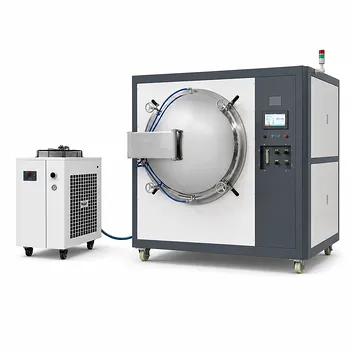
Vacuum hot pressing achieves higher thermal conductivity in uncoated diamond and pure aluminum composites primarily because it facilitates sufficient interfacial diffusion. While Spark Plasma Sintering (SPS) is efficient, its rapid cycle time prevents the formation of a robust interface between pure aluminum and diamond, creating a bottleneck for heat transfer.
Core Takeaway In systems without alloying elements to aid bonding, time is a critical variable that cannot be rushed. Vacuum hot pressing provides the necessary duration and thermal energy to overcome the natural non-wetting behavior of aluminum and diamond, significantly reducing interfacial thermal resistance where SPS fails to do so.
The Critical Role of Time and Diffusion
The Limitation of Spark Plasma Sintering (SPS)
SPS is renowned for high heating efficiency and short sintering cycles. However, this speed becomes a liability when working with pure aluminum and uncoated diamond.
The holding time in SPS is typically just a few minutes. This brief window is insufficient for atoms to diffuse effectively across the interface between the metal matrix and the diamond particles.
The Advantage of Extended Process Cycles
A vacuum hot pressing furnace operates with significantly longer diffusion times and often higher sintering temperatures.
This extended duration allows the aluminum to bond more effectively with the diamond surface. The process promotes the necessary atomic movement to create a continuous path for heat transfer, rather than a series of disjointed contacts.
Overcoming Interfacial Resistance
Reducing Phonon Scattering
The primary enemy of thermal conductivity in composites is phonon scattering.
When the bond between aluminum and diamond is weak—as seen in SPS-processed composites—phonons (vibrational energy packets carrying heat) scatter at the interface. This scattering drastically impedes heat flow, resulting in lower overall thermal conductivity.
Superior Interface Conductance
Vacuum hot pressing establishes a superior interface thermal conductance by ensuring a tighter, more chemically intimately bonded structure.
Because of this superior bonding, composites made via this method can achieve over 85% of their theoretical predicted thermal conductivity.
Mechanics of Densification
Overcoming Non-Wetting Behavior
Diamond and liquid/softened metals often exhibit "non-wetting" behavior, meaning the metal resists spreading over the diamond surface.
The simultaneous application of high temperature and uniaxial mechanical pressure in a hot press forces the aluminum matrix into the microscopic voids between diamond particles. This mechanical force overcomes surface tension, ensuring physical contact where chemical affinity is low.
Eliminating Internal Porosity
The high-vacuum environment is essential for removing adsorbed gases and volatiles from the powder particles before and during densification.
By evacuating these gases, the process prevents the formation of gas pockets (pores) within the final composite. Eliminating porosity is vital, as air gaps act as insulators that disrupt thermal pathways.
Understanding the Trade-offs
Efficiency vs. Performance
While vacuum hot pressing yields superior thermal properties for this specific material pairing, it is an energy-intensive and time-consuming batch process.
SPS offers speed and throughput, but for pure aluminum/diamond systems, that speed sacrifices the physical integrity of the interface. SPS may be more viable if alloying elements (like silicon or titanium) are added to speed up bonding, but for pure constituents, hot pressing is physically superior.
Grain Growth Concerns
The longer heating times required by vacuum hot pressing can sometimes lead to grain growth in the metal matrix.
However, in the context of thermal conductivity, the benefit of a solid interface vastly outweighs the minor downsides of grain coarsening in the aluminum matrix.
Making the Right Choice for Your Goal
When selecting a fabrication method for metal matrix composites, you must prioritize based on your specific constituents and performance metrics.
- If your primary focus is maximum thermal conductivity in pure systems: Choose Vacuum Hot Pressing to ensure sufficient diffusion time and minimal phonon scattering at the interface.
- If your primary focus is process speed and efficiency: Consider SPS, but be aware you may need to introduce alloying elements to facilitate bonding within the short cycle time.
Ultimately, for uncoated diamond and pure aluminum, you must trade process speed for the time required to engineer a low-resistance thermal interface.
Summary Table:
| Feature | Vacuum Hot Pressing (VHP) | Spark Plasma Sintering (SPS) |
|---|---|---|
| Sintering Duration | Long (extended diffusion time) | Short (rapid cycle) |
| Interfacial Bonding | Robust chemical/mechanical bond | Weak/disjointed contact |
| Phonon Scattering | Minimized due to tight interface | High due to interfacial resistance |
| Thermal Performance | >85% of theoretical conductivity | Lower (limited by bottleneck) |
| Best Application | Pure systems requiring max conductivity | Alloyed systems requiring high throughput |
Elevate Your Material Performance with KINTEK
Achieving peak thermal conductivity requires the right balance of pressure, temperature, and time. KINTEK specializes in advanced laboratory equipment, providing the precision vacuum hot pressing furnaces and hydraulic hot presses needed to overcome interfacial resistance in demanding metal-matrix composites.
Whether you are developing next-generation heat sinks or researching advanced ceramics, our comprehensive portfolio—including high-temperature furnaces (muffle, tube, vacuum), crushing systems, and specialized consumables—is designed to meet the rigorous standards of your lab.
Ready to optimize your sintering process? Contact KINTEK today to consult with our experts on the perfect solution for your research and production needs!
Related Products
- Vacuum Hot Press Furnace Heated Vacuum Press Machine Tube Furnace
- 600T Vacuum Induction Hot Press Furnace for Heat Treat and Sintering
- Vacuum Hot Press Furnace Machine Heated Vacuum Press
- Vacuum Hot Press Furnace Machine for Lamination and Heating
- Vacuum Heat Treat and Pressure Sintering Furnace for High Temperature Applications
People Also Ask
- What advantages does a vacuum hot press furnace provide for LSLBO ceramic electrolytes? Achieve 94% Relative Density
- What role does a Vacuum Hot Press (VHP) furnace play in the densification of austenitic stainless steel 316 composites?
- What are the advantages of using a vacuum hot pressing furnace? Superior Densification for 2024Al/Gr/SiC Composites
- What are the advantages of a vacuum hot press furnace for LTPO solid electrolytes? Boost Density and Conductivity
- What core processing conditions does a vacuum hot press furnace provide? Achieve High-Density Cu-SiC/Diamond Composites