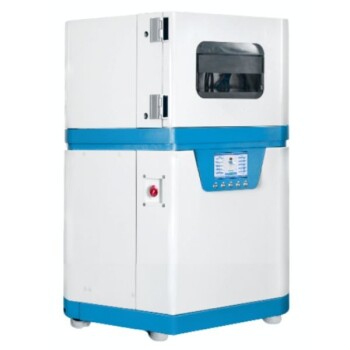
The furnace-cooling capability acts as the primary regulator for the phase composition and structural integrity of SiCf/Ti-43Al-9V composites. By utilizing programmable, slow cooling rates, the furnace allows the matrix material to undergo essential solid-state phase transformations that define the final microstructure.
The ability to control the cooling rate is the deciding factor in transforming the initial alpha phase into a robust alpha-2/gamma lamellar structure. Without this slow cooling capability, the material cannot achieve the granular precipitation of the B2 phase or effectively release the residual thermal stresses accumulated during consolidation.
Regulating Phase Composition
The Alpha to Lamellar Transformation
The primary function of the furnace-cooling cycle is to provide sufficient time for the high-temperature alpha phase to transform.
A slow cooling rate facilitates the transition of this phase into an alpha-2/gamma lamellar structure. This specific microstructure is critical for the mechanical performance of the Ti-43Al-9V matrix.
Precipitation of the B2 Phase
Beyond the lamellar structure, precise cooling controls the precipitation of secondary phases.
Specifically, the programmable cooling curve is essential for obtaining the granular precipitation of the B2 phase. The presence and distribution of this phase are directly tied to the thermal history dictated by the furnace's cooling capability.
Managing Thermal Stresses
Releasing Residual Stress
During the hot pressing cycle, significant thermal stresses are generated due to the mismatch between the fiber and the matrix, as well as the high pressures applied.
The furnace's slow cooling function allows the material to relax gradually. This controlled temperature reduction effectively releases residual thermal stresses, preventing cracking or distortion in the final composite.
The Role of Environmental Control
Preventing Oxidation
While cooling is the active mechanism for phase change, the vacuum environment plays a critical passive role during this stage.
Titanium alloys are highly reactive with oxygen at elevated temperatures. Maintaining a high vacuum throughout the cooling process prevents the oxidation of the matrix and fiber coatings, ensuring the phase transformations occur without chemical degradation or embrittlement.
Understanding the Trade-offs
The Risk of Rapid Cooling
While faster cycle times are often desired in manufacturing, rapid cooling is detrimental to this specific composite system.
Accelerated cooling arrests the necessary phase transformations, potentially locking the material in an unstable high-temperature phase. This prevents the formation of the strengthening alpha-2/gamma structure and locks in destructive residual stresses.
Balancing Time and Microstructure
The "slow furnace-cooling" requirement implies a longer overall processing time.
Operators must accept reduced throughput to achieve the necessary metallurgical bonding and phase composition. Prioritizing speed over the programmable slow cooling curve will result in sub-optimal microstructures and potential component failure.
Making the Right Choice for Your Goal
To optimize the production of SiCf/Ti-43Al-9V composites, you must align the furnace parameters with your specific material requirements.
- If your primary focus is microstructural optimization: Ensure the furnace is programmed for a slow cooling rate to maximize the formation of the alpha-2/gamma lamellar structure and B2 phase precipitation.
- If your primary focus is mechanical longevity: Prioritize extended cooling durations to fully release residual thermal stresses, reducing the risk of premature failure or warping.
Ultimately, the furnace-cooling phase should not be viewed as downtime, but as an active processing step that defines the material's final identity.
Summary Table:
| Mechanism | Role in SiCf/Ti-43Al-9V Composite |
|---|---|
| Slow Cooling Rate | Enables Alpha to Alpha-2/Gamma lamellar transformation |
| Phase Control | Promotes granular precipitation of the B2 phase |
| Thermal Management | Releases residual stresses from fiber/matrix mismatch |
| Vacuum Environment | Prevents oxidation and embrittlement during cooling |
| Stress Mitigation | Minimizes risks of cracking or component distortion |
Elevate Your Material Research with KINTEK Precision
Achieving the perfect alpha-2/gamma lamellar structure requires more than just heat—it requires absolute thermal control. KINTEK specializes in advanced vacuum hot pressing furnaces and high-temperature furnaces designed to deliver the precise programmable cooling curves essential for SiCf/Ti-43Al-9V composites.
From crushing and milling systems to high-pressure reactors and specialized ceramics, our laboratory equipment empowers researchers to master phase transformations and eliminate residual stresses. Partner with KINTEK to optimize your manufacturing throughput and material integrity.
Contact Our Technical Experts Today
Related Products
- Vacuum Hot Press Furnace Heated Vacuum Press Machine Tube Furnace
- 600T Vacuum Induction Hot Press Furnace for Heat Treat and Sintering
- Vacuum Hot Press Furnace Machine Heated Vacuum Press
- Vacuum Hot Press Furnace Machine for Lamination and Heating
- Vacuum Heat Treat and Pressure Sintering Furnace for High Temperature Applications
People Also Ask
- What advantages does a vacuum hot press furnace provide for LSLBO ceramic electrolytes? Achieve 94% Relative Density
- What role does a Vacuum Hot Press (VHP) furnace play in the densification of austenitic stainless steel 316 composites?
- What are the advantages of using a vacuum hot pressing furnace? Superior Densification for 2024Al/Gr/SiC Composites
- What are the advantages of a vacuum hot press furnace for LTPO solid electrolytes? Boost Density and Conductivity
- What core processing conditions does a vacuum hot press furnace provide? Achieve High-Density Cu-SiC/Diamond Composites