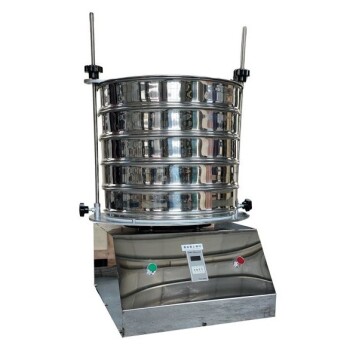
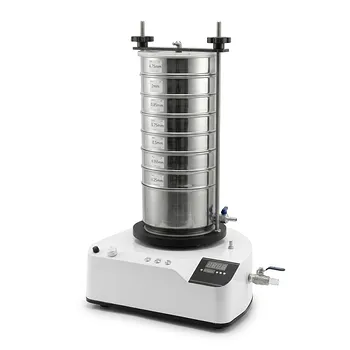
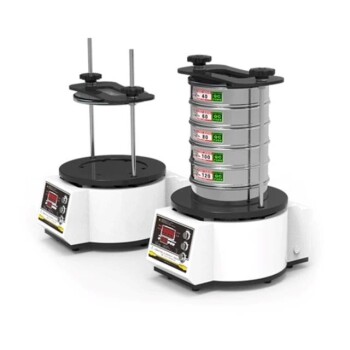
A 100 µm standard test sieve is a critical quality control tool used to refine ball-milled Li3.5Ge0.5V0.5O4 (LGVO) powder before it is used for coating applications. Its primary function is to mechanically separate and remove large particles or aggregates that persist after the initial ball-milling process. By filtering the powder through this specific aperture, you establish a definitive upper limit on particle size.
By enforcing a strict particle size limit, the sieving process prevents critical equipment failure—specifically nozzle clogging—and guarantees the structural uniformity of the final coating layer during aerosol deposition.
The Mechanics of Particle Control
Removing Process Artifacts
While ball-milling is effective at reducing average particle size, it often leaves behind inconsistencies.
Small particles can re-agglomerate, or harder fragments may fail to break down completely. The sieve captures these large aggregates, preventing them from contaminating the final feedstock.
Defining the Upper Limit
In precision applications, average particle size is not the only metric that matters.
The 100 µm sieve provides a hard stop for the maximum particle diameter. This ensures that the LGVO powder entering the deposition system meets a verified standard of fineness.
Impact on Aerosol Deposition
Preventing Nozzle Clogging
Aerosol deposition systems rely on accelerating powder through restricted, high-velocity nozzles.
Particles exceeding the nozzle's tolerance create a high risk of blockage. Sieving at 100 µm mitigates this risk, ensuring a continuous, uninterrupted flow of material during the coating process.
Ensuring Coating Uniformity
The quality of the deposited LGVO layer is directly dependent on the consistency of the input powder.
Large particles create defects, voids, or rough patches in the coating. Eliminating them ensures the resulting layer has a uniform thickness and dense microstructure.
Operational Considerations and Trade-offs
Balancing Yield vs. Quality
Using a sieve inevitably results in a small loss of total material yield.
The material trapped by the sieve is waste. However, attempting to reclaim this material without re-milling would compromise the integrity of the entire batch.
Process Efficiency
Adding a sieving step increases the total processing time for the LGVO powder.
This time investment is a necessary trade-off. The cost of sieving is significantly lower than the cost of downtime caused by clogged equipment or the rejection of a non-uniform coating.
Making the Right Choice for Your Process
If you are preparing LGVO powder for aerosol deposition, strict size control is not optional—it is a requirement for system stability.
- If your primary focus is equipment protection: Strict sieving prevents costly damage and downtime associated with nozzle clogs.
- If your primary focus is layer quality: Sieving ensures the deposition of a smooth, defect-free ceramic coating.
Consistently screening your powder ensures the transition from raw material to a high-performance functional layer is successful.
Summary Table:
| Feature | Function in LGVO Processing | Impact on Aerosol Deposition |
|---|---|---|
| Particle Size Control | Removes aggregates and large fragments | Prevents high-velocity nozzle clogging |
| Material Consistency | Establishes a 100 µm maximum diameter | Ensures dense, uniform coating microstructure |
| Quality Assurance | Filters out ball-milling artifacts | Reduces surface defects and voids in layers |
| Process Stability | Standardizes feedstock for deposition | Minimizes equipment downtime and material waste |
Optimize Your LGVO Material Processing with KINTEK
Achieving the perfect particle size distribution is critical for the success of your aerosol deposition and battery research. KINTEK specializes in high-precision laboratory equipment, providing the standard test sieves, crushing and milling systems, and hydraulic presses needed to refine your LGVO powders to perfection.
Whether you require advanced high-temperature furnaces for material synthesis or specialized sieving equipment for quality control, KINTEK offers the reliable tools necessary to prevent equipment failure and ensure superior coating uniformity.
Ready to elevate your material performance? Contact KINTEK today for expert solutions and premium laboratory consumables!
Related Products
- Laboratory Test Sieves and Sieving Machines
- Laboratory Test Sieves and Vibratory Sieve Shaker Machine
- Custom PTFE Teflon Parts Manufacturer for PTFE Mesh F4 Sieve
- Laboratory Vibratory Sieve Shaker Machine Slap Vibrating Sieve
- Laboratory Vibratory Sieve Shaker Machine for Dry and Wet Three-Dimensional Sieving
People Also Ask
- What are laboratory test sieves used for? A Guide to Particle Size Analysis
- How do you calculate the sieve test? Master Particle Size Distribution for Quality Control
- How does a lab test sieve contribute to biomass charcoal powder preparation? Achieve Uniform Particle Size
- What are the specifications for test sieves? A Guide to ASTM & ISO Standards for Accurate Particle Analysis
- What materials are required for sieving? Achieve Accurate Particle Size Analysis