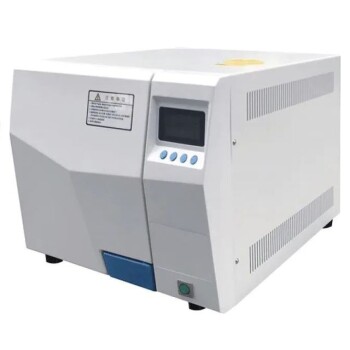
The controlled long-duration drying process is critical for maintaining the structural integrity of the adsorbent precursor. By subjecting the slurry to a stable 80 °C environment for 24 hours, you ensure the distilled water introduced during ball milling is removed gradually. This slow rate of evaporation is the primary defense against severe powder agglomeration, which occurs when moisture is removed too rapidly.
Core Takeaway: Rapid drying destroys adsorbent efficiency by forcing particles to clump together. Controlled evaporation in a laboratory oven prevents this agglomeration, preserving the essential micro-porous structure required to generate active sites and high specific surface area.
The Mechanism of Drying and Agglomeration
Regulating Evaporation Rates
The slurry produced during the ball milling of Zirconium-doped Calcium Oxide (CaO) is saturated with distilled water. To remove this solvent without damaging the solid, the laboratory oven maintains a stable, relatively low temperature of 80 °C. Extending this process over 24 hours ensures that evaporation occurs at a gentle, linear rate rather than a chaotic boil.
Preventing Particle Fusion
When water evaporates rapidly, strong capillary forces can pull individual powder particles together. This phenomenon leads to severe powder agglomeration, resulting in large, dense clumps rather than a fine powder. A controlled drying environment mitigates these physical forces, allowing the particles to settle without fusing into a solid mass.
Impact on Micro-Structure and Performance
Preserving Porosity
The effectiveness of an adsorbent is defined by its internal architecture. The precursor material relies on a delicate micro-porous structure to function correctly. By preventing agglomeration during the drying phase, the oven process protects this structure from collapsing or becoming blocked by fused particles.
Maximizing Surface Area
Agglomerated powders suffer from drastically reduced surface area because the internal surfaces are sealed off. The controlled drying process ensures the precursor remains open and porous. This directly correlates to a high specific surface area, which is the physical workspace available for chemical reactions.
Preparing for Activation
The drying phase is a prerequisite for the subsequent activation phase. If the precursor is agglomerated, the activation process cannot effectively create active sites throughout the material. Proper drying ensures the formation of these active sites is maximized, optimizing the final performance of the Zirconium-doped CaO.
Risks of Improper Drying
The Danger of Rapid Heating
It is a common error to increase temperatures to speed up the synthesis. However, rushing this step triggers rapid water evaporation, which acts as a binding agent for the powder. This results in a material that is mechanically hard and chemically inaccessible.
Irreversible Structural Loss
Once severe agglomeration occurs due to poor drying, it is difficult to reverse. The micro-pores that are crushed or sealed during a high-speed dry cannot be easily reopened. This permanently degrades the potential capacity of the adsorbent before it is even activated.
Making the Right Choice for Your Goal
To ensure the Zirconium-doped CaO performs as intended, the drying protocol must be viewed as a structural engineering step, not just moisture removal.
- If your primary focus is maximizing catalytic activity: Adhere strictly to the 80 °C limit to prevent particle fusion and ensure maximum accessibility to active sites.
- If your primary focus is structural uniformity: Maintain the full 24-hour duration to ensure the water removal is homogenous throughout the entire batch, preventing density gradients.
The quality of your final adsorbent is determined by the patience applied during the drying of its precursor.
Summary Table:
| Parameter | Recommended Setting | Key Benefit |
|---|---|---|
| Drying Temperature | 80 °C | Prevents rapid boiling and damaging capillary forces |
| Process Duration | 24 Hours | Ensures gentle, linear moisture removal |
| Core Objective | Anti-Agglomeration | Preserves micro-porous structure and active sites |
| Final Result | High Surface Area | Maximizes chemical reactivity and adsorbent efficiency |
Optimize Your Material Synthesis with KINTEK Precision
Achieving the perfect micro-structure for your adsorbents requires uncompromising thermal stability. KINTEK specializes in high-performance laboratory equipment designed for meticulous research. Whether you need precise laboratory ovens for long-duration drying, high-temperature furnaces (muffle, vacuum, or CVD) for activation, or crushing and milling systems for slurry preparation, we provide the tools to ensure your materials reach their full potential.
Don't let improper drying compromise your results. From hydraulic presses to PTFE consumables and cooling solutions, KINTEK is your partner in advanced material science.
Ready to elevate your lab's efficiency? Contact our technical experts today to find the ideal solution for your specific application!
References
- Vyacheslav V. Rodaev, Svetlana S. Razlivalova. Performance and Durability of the Zr-Doped CaO Sorbent under Cyclic Carbonation–Decarbonation at Different Operating Parameters. DOI: 10.3390/en14164822
This article is also based on technical information from Kintek Solution Knowledge Base .
Related Products
- Laboratory Scientific Electric Heating Blast Drying Oven
- 56L Vertical Laboratory Vacuum Drying Oven
- 23L Laboratory Vacuum Drying Oven
- 1200℃ Muffle Furnace Oven for Laboratory
- 1700℃ Muffle Oven Furnace for Laboratory
People Also Ask
- How does a laboratory electric drying oven contribute to the formation of the initial coating? Expert Insights
- What role does a precision laboratory drying oven play in the synthesis of GO-PANI nanocomposites? Protect Material Integrity
- What role does a laboratory drying oven play in the preparation of zinc oxide nanoparticle precursors?
- What is the necessity of using a laboratory drying oven when processing MoO3/GO composite nanopowders? Find out here.
- What is the role of a laboratory drying oven in cellulose citrate production? Ensure Material Stability & Purity