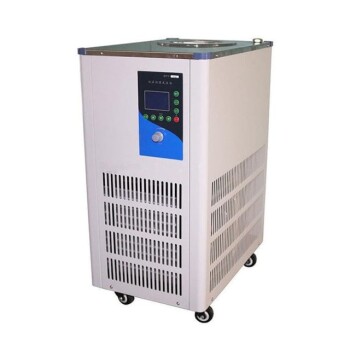
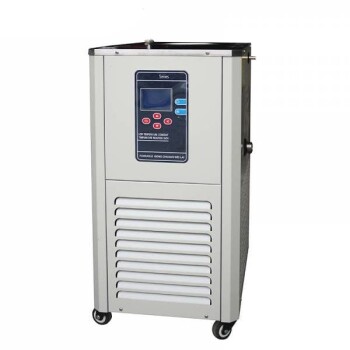
A cooling circulation system is mandatory for niobium electropolishing apparatus to counteract the significant electrochemical heat generated during the process. By encasing the electrolytic cell in a water jacket, the system actively maintains a constant temperature—typically around 25 °C—which is critical for stabilizing the reaction and ensuring a high-quality surface finish.
Niobium polishing is extremely sensitive to thermal fluctuations. The cooling system serves as a stabilizer that prevents electrolyte decomposition and ensures consistent voltage, resulting in a uniform and defect-free polish.
The Critical Role of Temperature Control
Managing Electrochemical Heat
The electropolishing of niobium is an energy-intensive process. As current flows through the material, it generates a substantial amount of electrochemical heat.
Without a mechanism to remove this heat, the temperature of the apparatus would rise rapidly. The cooling circulation system acts as a thermal buffer, absorbing this excess energy to keep the environment stable.
The Water Jacket Mechanism
To achieve this stability, the system typically employs a water jacket that encases the electrolytic cell.
Fluid circulates continuously through this jacket, transferring heat away from the electrolyte. This design allows for precise thermal regulation without contaminating the chemical bath.
Achieving Optimal Surface Quality
The quality of a polished niobium surface is directly linked to temperature consistency. The process relies on a specific chemical reaction rate that occurs most effectively around 25 °C.
Deviating from this range can alter the reaction kinetics. By locking the temperature at this set point, the system ensures the polish is smooth, reflective, and uniform.
Risks of Uncontrolled Heat
Instability in Voltage and Current
Temperature changes alter the conductivity of the electrolyte. If the heat is not managed, the voltage and current states will fluctuate unpredictably.
These fluctuations prevent a steady-state polishing process. This often results in uneven material removal and a suboptimal surface finish.
Electrolyte Decomposition
High temperatures can cause the chemical breakdown of the electrolyte solution itself.
Electrolyte decomposition degrades the efficiency of the bath. This not only ruins the current batch but also requires frequent, costly replacement of the chemicals.
Thermal Damage to the Substrate
Beyond the chemicals, the niobium material itself is at risk.
Excessive heat accumulation can cause thermal damage to the niobium substrate. This compromises the physical integrity of the part, potentially rendering it unusable for its intended application.
Optimizing the Polishing Process
To achieve a pristine finish on niobium components, temperature regulation is just as important as voltage settings.
- If your primary focus is surface uniformity: Ensure your cooling system is calibrated to maintain a strict 25 °C limit to guarantee stable current density and an even polish.
- If your primary focus is process efficiency: monitor the cooling loop to prevent electrolyte decomposition, which protects your chemical investment and prevents damage to the niobium substrate.
Precise thermal management transforms a volatile chemical reaction into a controlled, high-precision manufacturing process.
Summary Table:
| Feature | Function in Niobium Electropolishing | Impact of Failure |
|---|---|---|
| Water Jacket | Encases the cell to transfer heat away | Rapid temperature spikes and safety risks |
| Constant 25 °C | Maintains optimal reaction kinetics | Uneven polishing and surface defects |
| Thermal Buffer | Absorbs intensive electrochemical heat | Electrolyte decomposition and chemical loss |
| Voltage Stability | Ensures consistent conductivity levels | Unpredictable current states and substrate damage |
Elevate Your Niobium Processing with KINTEK Precision
Achieving a flawless, mirror-like finish on niobium requires more than just chemistry; it requires rigorous thermal stability. KINTEK specializes in high-performance laboratory equipment designed to handle the most demanding electrochemical processes. From advanced electrolytic cells and high-precision electrodes to our robust cooling solutions and chillers, we provide the integrated systems necessary to maintain a perfect 25 °C environment.
Don't let thermal fluctuations compromise your material integrity or waste expensive electrolytes. Whether you are conducting cutting-edge battery research or high-purity material finishing, KINTEK’s comprehensive range—including high-temperature furnaces, hydraulic presses, and specialized ceramics—is engineered to meet your exact specifications.
Ready to optimize your lab’s efficiency and surface quality? Contact KINTEK today for expert consultation and customized solutions!
References
- Tadeusz Hryniewicz, Ryszard Rokicki. Hydrogen Reduction in MEP Niobium Studied by Secondary Ion Mass Spectrometry (SIMS). DOI: 10.3390/met7100442
This article is also based on technical information from Kintek Solution Knowledge Base .
Related Products
- 100L Chilling Circulator Cooling Water Circulator for Low Temperature Constant Temperature Reaction Bath Water Bath Cooling
- 10L Chilling Circulator Cooling Water Bath Low Temperature Constant Temperature Reaction Bath
- 40L Chiller Water Bath Cooling Circulator Low Temperature Constant Temperature Reaction Bath
- 30L Chiller Water Bath Cooling Circulator Low Temperature Constant Temperature Reaction Bath
- 50L Chiller Water Bath Cooling Circulator Low Temperature Constant Temperature Reaction Bath
People Also Ask
- What function does a circulating cooling chiller perform during the gas adsorption isotherm testing of nanoporous carbon?
- Why is a circulating water chiller required for Prussian Blue nanoparticles? Ensure Stability & Batch Reproducibility
- What is the purpose of a cooling circulation water bath system in electrochemical experiments? Enhance Lab Precision
- How does a constant temperature circulator support the leaching reaction of gold scrap? Optimize Gold Recovery Results
- How do constant temperature circulators impact weight-loss immersion tests? Ensure Precision in Corrosion Analysis