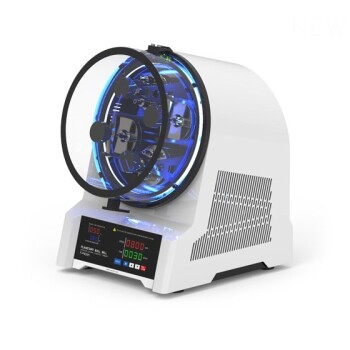
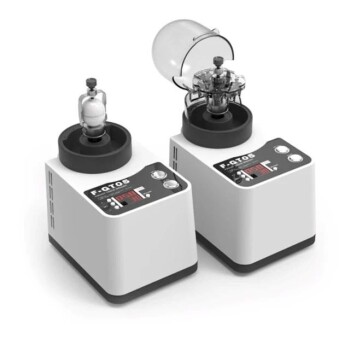
High-energy ball milling is a critical processing step required to precisely control the particle size and surface characteristics of LSTZ perovskite ceramic powders. By utilizing intense mechanical shear and impact forces, this process refines the powder to an average particle size of approximately 1 μm, a dimension necessary for successful integration into composite electrolytes.
Core Insight: The necessity of this process extends beyond simple size reduction; it is about maximizing the specific surface area of the ceramic filler. This increased surface area is the catalyst for enhancing chemical interactions between the LSTZ filler, the PEO polymer matrix, and the lithium salt anions (TFSI-).
The Mechanics of Particle Refinement
Achieving the Target Microstructure
To prepare effective LSTZ powders, the material must be broken down from coarse grains into fine particles.
A high-energy ball mill achieves this by subjecting the ceramic to rigorous mechanical shear and impact forces.
According to the primary technical data, the specific goal for LSTZ is to reduce the average particle size to approximately 1 μm.
Breaking Agglomerates
Raw ceramic powders often exist as clusters or agglomerates that hinder performance.
High-energy milling effectively de-agglomerates these clusters, ensuring the individual particles are separated before they are introduced to the polymer.
This step prevents the formation of "dead zones" in the final composite where ionic conductivity might be impeded.
Enhancing Chemical Interactions
Increasing Specific Surface Area
The reduction in particle size leads to a significant increase in specific surface area.
This is the physical property that drives the chemical efficiency of the composite electrolyte.
With more surface area exposed, there is a greater interface available for the ceramic filler to interact with its surroundings.
Facilitating Component Synergy
The refined LSTZ particles must interact chemically with two other key components: the polymer matrix (PEO) and the lithium salt anions (TFSI-).
High-energy milling ensures the particles are chemically active enough to promote this three-way interaction.
This chemical synergy is essential for creating efficient ion conduction pathways within the electrolyte.
Understanding the Process Trade-offs
Process Intensity vs. Material Integrity
While high-energy milling is effective, it is an aggressive mechanical process.
Operators must carefully balance rotation speeds and grinding times to achieve uniformity without introducing contamination from the grinding media.
The Necessity of Uniform Dispersion
If the milling process is insufficient, the LSTZ particles will not disperse uniformly within the PEO matrix.
Poor dispersion leads to phase separation, which compromises the mechanical strength and electrochemical stability of the electrolyte.
Therefore, the milling parameters are not just about size reduction, but about ensuring a homogeneous blend capable of stable performance.
Making the Right Choice for Your Goal
When optimizing the preparation of LSTZ powders for composite electrolytes, consider the following technical priorities:
- If your primary focus is maximizing ionic conductivity: Prioritize milling protocols that maximize specific surface area to enhance the interaction between the filler and the TFSI- anions.
- If your primary focus is mechanical stability of the membrane: Ensure the milling process achieves a strict 1 μm average particle size to guarantee uniform dispersion within the PEO matrix, preventing structural weak points.
High-energy ball milling is the definitive method for transforming raw LSTZ ceramic into a functional, high-performance electrolyte filler.
Summary Table:
| Feature | Requirement | Impact on Composite Electrolyte |
|---|---|---|
| Target Particle Size | Approximately 1 μm | Ensures uniform dispersion in PEO matrix |
| Mechanical Force | Intense shear & impact | De-agglomerates clusters and refines microstructure |
| Surface Area | High Specific Surface Area | Enhances interaction between filler, PEO, and TFSI- |
| Material Integrity | Balanced milling parameters | Prevents contamination and maintains phase stability |
Elevate Your Battery Research with KINTEK Precision
Achieving the perfect 1μm particle size for LSTZ perovskite ceramic powders demands high-performance equipment. KINTEK specializes in advanced crushing and milling systems, including high-energy ball mills, designed to deliver the mechanical shear and uniformity required for cutting-edge composite electrolytes.
From high-temperature furnaces for material synthesis to hydraulic presses for pellet preparation and battery research tools, KINTEK provides the comprehensive laboratory solutions your research deserves. Our equipment ensures your ceramic fillers achieve maximum synergy with polymer matrices, driving superior ionic conductivity and mechanical stability.
Ready to optimize your powder refinement process? Contact KINTEK today to find the perfect milling solution for your lab!
Related Products
- High Energy Planetary Ball Mill Milling Machine for Laboratory
- High Energy Planetary Ball Mill for Laboratory Horizontal Tank Type Milling Machine
- High-Energy Omnidirectional Planetary Ball Mill Milling Machine for Laboratory
- High Energy Planetary Ball Mill Milling Machine for Laboratory
- High Energy Planetary Ball Mill Machine for Laboratory Horizontal Tank Type
People Also Ask
- What role do planetary ball mills and zirconia media play in LLZT preparation? Optimize Your Solid Electrolyte Research
- What is the primary function of a planetary ball mill? Mastering SiC/Al Composite Mixing for Homogeneity
- What is the primary purpose of using a planetary ball mill for LAGP? Achieve High-Purity Solid-State Electrolytes
- What role does a planetary ball mill play in the preparation of LGVO powders? Precision Refinement for Aerosol Deposition
- What is the function of a planetary ball mill in the preparation of high-entropy rare earth silicate multi-phase ceramics?