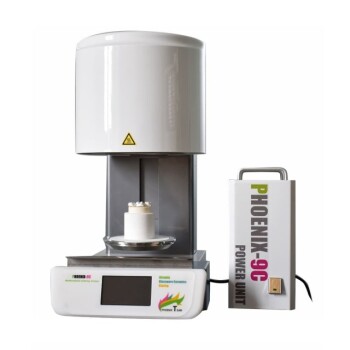
High-precision temperature control is the fundamental requirement for successfully converting fragile ceramic green bodies into robust materials. Because these printed bodies contain significant amounts of organic binders, they must undergo a meticulous drying and debinding process that can last between 8 to 72 hours. Without strict thermal regulation, the rapid release of gases will destroy the internal structure before sintering can even begin.
Core Takeaway The structural integrity of a finished ceramic relies entirely on the controlled removal of organic binders during the initial heating phase. Precision furnaces prevent internal pressure buildup, ensuring that gases escape slowly through micropores to avoid catastrophic cracking or deformation.
Managing the Volatile Debinding Process
The Critical Role of Binder Removal
Ceramic green bodies are held together by organic binders that must be removed completely. This process involves two distinct physical changes: solvent evaporation and polymer decomposition.
Controlled Gas Discharge
As the furnace heats, these binders turn into gas. High-precision control ensures this gas is generated at a rate slow enough to discharge through the material's micropores.
Preventing Internal Pressure
If the temperature rises too quickly, gas generation exceeds the discharge rate. This creates massive internal pressure within the green body, which is the primary cause of structural failure.
Avoiding Structural Defects
Eliminating Cracks and Delamination
When internal pressure goes unchecked, the material cannot withstand the stress. This leads to cracks, deformation, and layer delamination, rendering the part useless.
Ensuring Uniformity
A precise furnace maintains a stable thermal environment. This uniformity is essential to prevent differential expansion or shrinkage, which creates internal stress concentrations.
Achieving Densification and Performance
Transition to Sintering
Once debinding is safely complete, the furnace must ramp up to high temperatures (often up to 1140°C). This phase drives grain growth and effectively eliminates remaining pores.
Forming a Robust Structure
During this densification transformation, the ceramic particles fuse. This results in high mechanical strength and the formation of continuous structures necessary for performance.
Functional Implications
In applications like solid-state electrolytes (e.g., LLZTO), this densification creates continuous ion transport channels. A defect-free structure is required to achieve high ionic conductivity and block lithium dendrite growth.
Understanding the Trade-offs
The Cost of Speed
There is a direct trade-off between processing speed and yield. Attempting to accelerate the 8–72 hour debinding cycle almost invariably leads to higher scrap rates due to fracturing.
Precision vs. Equipment Cost
High-precision furnaces capable of maintaining strict profiles over long durations require a higher initial investment. However, using lower-grade equipment often results in inconsistent material properties that fail validation.
Making the Right Choice for Your Goal
To select the appropriate thermal processing strategy, evaluate your specific performance metrics:
- If your primary focus is Structural Integrity: Prioritize a furnace with exceptional low-temperature control to navigate the sensitive debinding phase without inducing micro-cracks.
- If your primary focus is Electrochemical Performance: Ensure the furnace can achieve and hold high sintering temperatures (1140°C+) to guarantee full densification and ion channel formation.
Precision in the thermal profile is the only way to translate the potential of a green body into the reality of a high-performance ceramic.
Summary Table:
| Process Phase | Temperature Range | Key Function | Risk of Poor Control |
|---|---|---|---|
| Debinding | Low to Mid Range | Controlled removal of organic binders | Internal pressure, cracking, delamination |
| Drying | Low | Solvent evaporation through micropores | Surface defects, structural warping |
| Sintering | High (Up to 1140°C+) | Grain growth and densification | Residual porosity, low mechanical strength |
| Cooling | Controlled Ramp | Stress relaxation | Thermal shock, structural failure |
Elevate Your Ceramic Research with KINTEK Precision
Don't let inconsistent thermal profiles compromise your material's integrity. KINTEK specializes in high-performance laboratory equipment designed for the most demanding ceramic processing workflows. From high-precision muffle and tube furnaces for meticulous debinding to advanced vacuum and atmosphere furnaces for sintering, we provide the thermal stability you need to prevent structural failure and maximize electrochemical performance.
Whether you are developing solid-state electrolytes or high-strength technical ceramics, our comprehensive range—including high-temperature reactors, crushing systems, and hydraulic presses—ensures your lab is equipped for excellence.
Ready to achieve superior densification and defect-free results? Contact our technical experts today to find the perfect thermal solution for your green body post-processing.
References
- Jürgen Stampfl, Fritz B. Prinz. Lithography-based additive manufacturing of ceramics: Materials, applications and perspectives. DOI: 10.1557/s43579-023-00444-0
This article is also based on technical information from Kintek Solution Knowledge Base .
Related Products
- Vacuum Heat Treat Furnace with Ceramic Fiber Liner
- Molybdenum Vacuum Heat Treat Furnace
- 600T Vacuum Induction Hot Press Furnace for Heat Treat and Sintering
- 2200 ℃ Graphite Vacuum Heat Treat Furnace
- 1400℃ Controlled Atmosphere Furnace with Nitrogen and Inert Atmosphere
People Also Ask
- What is a vacuum heat treatment furnace? The Ultimate Guide to Controlled Atmosphere Processing
- What is vacuum heat treatment process? Achieve Superior Control, Cleanliness, and Quality
- What is a vacuum heat treatment furnace? Achieve Unmatched Purity and Control
- What is the temperature of vacuum heat treatment? Achieve Superior Material Properties & Pristine Finishes
- How does a vacuum heat treatment work? Achieve Superior Material Properties in a Pristine Environment