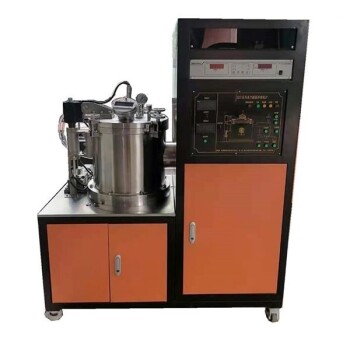
High-purity Argon acts as a critical chemical shield when processing reactive metals like Uranium and Zirconium. At melting temperatures, these metals become highly susceptible to reacting with oxygen and nitrogen in the surrounding air. An atmosphere of high-purity Argon displaces these reactive gases, preventing the formation of brittle oxides that would otherwise compromise the alloy's structural integrity and experimental validity.
The primary function of high-purity Argon is to serve as an inert barrier against oxidation, ensuring the stability of critical alloy phases. Beyond chemical protection, it also suppresses element evaporation and improves thermal uniformity within the furnace.
The Chemistry of High-Temperature Reactivity
Vulnerability of Uranium and Zirconium
Uranium and Zirconium are chemically active metals, particularly when subjected to elevated temperatures. As they heat up, their atomic structure becomes increasingly prone to bonding with external elements.
The Threat of Oxidation
Without protection, these metals react readily with oxygen and nitrogen present in the atmosphere. This reaction leads to the immediate formation of oxides and nitrides.
Consequences for Material Integrity
The formation of these compounds results in brittle oxides within the metal matrix. This alters the mechanical properties of the alloy, often making it unusable for high-stress applications.
The Protective Role of Argon
Creating an Inert Barrier
High-purity Argon is chemically inert, meaning it does not react with the molten metal. By filling the melting chamber with Argon, you effectively displace the reactive air.
Preserving Phase Stability
Maintaining a pure environment is critical for experimental accuracy. Specifically, it ensures the stability of delicate phases, such as the $\gamma$-U phase.
Ensuring Data Accuracy
If oxidation occurs during melting or cooling, the resulting material data will be flawed. Argon ensures that the experimental results reflect the properties of the metal, not its oxides.
Physical and Thermal Benefits
Controlling Evaporation
In a pure vacuum, volatile alloy elements might evaporate due to high vapor pressure. Introducing Argon allows operators to adjust the pressure (vacuum degree) to suppress this evaporation.
Enhancing Heat Distribution
A vacuum relies largely on radiation for heat transfer, which can be uneven. The presence of Argon gas facilitates a convection cycle within the furnace.
Uniform Heating
This convection allows heat to circulate more effectively around the material. The result is a more uniform temperature profile throughout the melting process.
Understanding the Trade-offs
The Necessity of Purity
Using standard industrial Argon is often insufficient for chemically active metals like Uranium. Even trace amounts of impurities in the gas can lead to surface contamination, necessitating the expense of high-purity grades.
Management of Gas Pressure
While Argon prevents evaporation, excessive pressure can alter the solidification rate. Operators must balance the need for suppression against the desired cooling kinetics.
No Reduction Capability
It is important to note that Argon is a shielding gas, not a reducing agent. It prevents new oxidation but cannot remove oxides that were already present on the raw material before melting.
Making the Right Choice for Your Goal
To maximize the quality of your melt, align your atmospheric control with your specific objectives:
- If your primary focus is Data Integrity: Prioritize the highest available purity of Argon to prevent micro-oxidation and ensure the accuracy of phase measurements like $\gamma$-U.
- If your primary focus is Composition Control: Adjust the Argon pressure levels to suppress the evaporation of volatile alloying elements without impeding the melt.
By strictly controlling the atmosphere with high-purity Argon, you convert a volatile chemical process into a stable, repeatable scientific procedure.
Summary Table:
| Feature | Benefit of Argon Atmosphere | Impact on Material Quality |
|---|---|---|
| Inert Shielding | Displaces Oxygen and Nitrogen | Prevents brittle oxide/nitride formation |
| Phase Stability | Protects delicate $\gamma$-U phases | Ensures accurate experimental data |
| Vapor Control | Suppresses element evaporation | Maintains precise alloy composition |
| Heat Transfer | Enables convection cycles | Achieves uniform temperature distribution |
Elevate Your Materials Research with KINTEK Precision Solutions
Processing chemically active metals like Uranium and Zirconium requires uncompromising atmospheric control. At KINTEK, we specialize in high-performance laboratory equipment designed to meet the rigorous demands of advanced metallurgy. Our comprehensive range includes high-temperature vacuum and atmosphere furnaces, induction melting systems, and specialized high-pressure reactors tailored for reactive metal processing.
Whether you are focused on preserving delicate alloy phases or ensuring superior thermal uniformity, KINTEK provides the tools—from PTFE and ceramic consumables to advanced cooling solutions—to guarantee stable, repeatable scientific results.
Ready to optimize your melting process? Contact KINTEK today to find the perfect furnace for your lab!
References
- Aílton da Silva Ferreira, Andrea Paesano Júnior. Synthesis and Structural Characterization of U-Zr-Nb Alloys. DOI: 10.1590/1980-5373-mr-2017-0411
This article is also based on technical information from Kintek Solution Knowledge Base .
Related Products
- Non Consumable Vacuum Arc Induction Melting Furnace
- Mesh belt controlled atmosphere furnace
- 2200 ℃ Tungsten Vacuum Heat Treat and Sintering Furnace
- 1400℃ Controlled Atmosphere Furnace with Nitrogen and Inert Atmosphere
- Vacuum Arc Induction Melting Furnace
People Also Ask
- What is the use of induction melting furnace? Achieve Fast, Clean, and Precise Metal Melting
- What are the advantages of induction melting furnace? Achieve Purity, Efficiency, and Safety
- What is the temperature range of the induction melting furnace? Find the Right Heat for Your Metals
- How do specialized industrial-grade small melting furnaces address challenges in precision jewelry casting? Expert Guide
- How do vacuum induction or arc melting furnaces facilitate the synthesis of U-Al-C MAX phases? Precision Heat & Purity