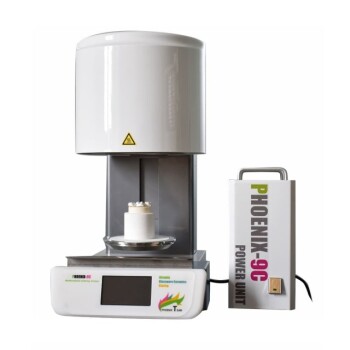
The application of a high-temperature muffle furnace is critical for transforming a raw, dried gel film into a functional biomedical coating. Specifically, annealing at temperatures around 500°C removes organic residues and drives the phase transition of titanium dioxide from an amorphous state to a crystalline structure, ensuring the coating adheres securely to the dental alloy.
The heat treatment process is not merely about drying; it is a fundamental chemical synthesis that unlocks the coating's biological compatibility and mechanical durability.
The Mechanism of Material Transformation
From Amorphous to Crystalline
Initially, the dip-coated film exists in an amorphous, disordered state. The high thermal energy provided by the furnace forces the atomic structure to rearrange.
This rearrangement converts the titanium dioxide into a specific crystalline form, typically anatase. It is this specific crystalline structure that provides the coating with its necessary physicochemical properties.
Elimination of Impurities
The dip-coating process often utilizes organic precursors or solvents to create the initial film. These organic residues can be toxic or structurally weakening if left behind.
The 500°C annealing process effectively burns off these organic components. This purification step leaves behind a clean, solid oxide layer suitable for biological interaction.
Enhancing Structural Integrity
Maximizing Bonding Strength
A major challenge in dental coatings is preventing delamination (flaking) under stress. The thermal treatment facilitates diffusion and chemical bonding at the interface between the coating and the dental alloy.
This significantly improves the bonding strength, ensuring the coating remains intact during the mechanical stresses of chewing and daily wear.
Controlled Atmosphere Processing
While the primary goal is treating the coating, the underlying alloy must also be protected. Muffle furnaces can be equipped to provide an inert atmosphere or maintain positive pressure.
This controlled environment prevents the dental alloy from suffering unwanted oxidation while the coating is being processed. It ensures that while the coating crystallizes, the metal substrate retains its original strength and corrosion resistance.
Understanding the Trade-offs
The Risk of Temperature Deviation
Precision is paramount; the process relies on hitting a "Goldilocks" zone, often cited as 500°C for this specific application.
If the temperature is too low, organic residues will remain trapped, and the coating will fail to crystallize, resulting in poor biological performance. Conversely, excessive heat can alter the grain structure of the underlying dental alloy, potentially making it brittle or susceptible to corrosion.
Atmosphere Management
While muffle furnaces are excellent for heat distribution, standard models may not automatically protect against oxidation.
Using a furnace without gas-tight features or an inert gas supply can lead to the formation of oxide scales on the metal alloy. This requires a careful balance between the oxygen needed for the TiO2 structure and the protection required for the metal substrate.
Making the Right Choice for Your Goal
To ensure the success of your titanium dioxide coating, consider your primary objective when configuring your heat treatment:
- If your primary focus is Biological Activity: Ensure your furnace creates a stable 500°C environment to guarantee the complete transformation to the anatase crystalline structure.
- If your primary focus is Coating Longevity: Prioritize a furnace with atmosphere controls to prevent substrate oxidation, which ensures the alloy supports the coating without degrading over time.
By strictly controlling the thermal environment, you turn a fragile gel film into a permanent, biocompatible interface.
Summary Table:
| Process Step | Temperature | Primary Outcome | Benefit for Dental Alloy |
|---|---|---|---|
| Phase Transition | ~500°C | Amorphous to crystalline (Anatase) | Provides essential physicochemical properties |
| Impurity Removal | ~500°C | Burn-off of organic precursors | Ensures a clean, non-toxic biomedical surface |
| Interface Bonding | ~500°C | Diffusion and chemical bonding | Maximizes adhesion and prevents delamination |
| Atmosphere Control | Variable | Inert/Controlled environment | Protects alloy substrate from unwanted oxidation |
Elevate Your Dental Research with KINTEK Precision
Precision thermal processing is the bridge between a fragile gel and a high-performance biomedical coating. KINTEK specializes in advanced laboratory equipment designed for the rigorous demands of dental and materials science. From high-temperature muffle and vacuum furnaces with precise atmosphere control to crushing systems and hydraulic presses for material preparation, our solutions ensure your coatings achieve the perfect crystalline structure without compromising the integrity of the underlying alloy.
Ready to optimize your coating process? Contact KINTEK today to find the perfect furnace solution for your lab!
References
- Katarzyna Banaszek, L. Klimek. Adhesion of<i>E. coli</i>Bacteria Cells to Prosthodontic Alloys Surfaces Modified by TiO<sub>2</sub>Sol-Gel Coatings. DOI: 10.1155/2013/179241
This article is also based on technical information from Kintek Solution Knowledge Base .
Related Products
- 1800℃ Muffle Oven Furnace for Laboratory
- 1200℃ Muffle Furnace Oven for Laboratory
- High Temperature Muffle Oven Furnace for Laboratory Debinding and Pre Sintering
- 1400℃ Muffle Oven Furnace for Laboratory
- 1700℃ Muffle Oven Furnace for Laboratory
People Also Ask
- Why is calcination in a Muffle Furnace necessary for niobate synthesis? Achieve Perfect Phase-Pure Solid Solutions
- What is the role of a high-temperature muffle furnace in YZAO synthesis? Master Nanocrystalline Phase Transformation
- What role do High-Temperature Muffle Furnaces play in metal oxide precursor pre-treatment? Ensure Structural Integrity
- What role does a high-temperature muffle furnace play in BZCY72 densification? Master Precision Sintering at 1500°C
- What is the role of a High-Temperature Muffle Furnace in the preparation of Ce-Mn catalysts? Boost Structural Reactivity