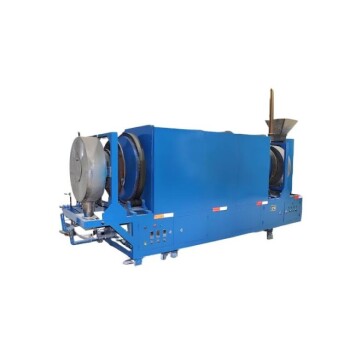
A high-temperature pyrolysis furnace is the critical instrument responsible for transforming adsorbed organometallic precursors into stable, catalytically active single atoms. It provides the precise thermal energy required to strip away organic ligands and force the remaining metal atoms to chemically bond with the support material, preventing them from clumping together or washing away.
Core Takeaway The pyrolysis furnace acts as a stabilization reactor. It simultaneously drives the decomposition of organic shells and the formation of strong metal-support anchors. Without this high-temperature treatment, metal atoms would lack the chemical linkage necessary to resist aggregation, rendering the catalyst unstable and ineffective.
The Mechanics of Single-Atom Formation
Stripping the Organic Shell
The initial role of the furnace is destructive. Organometallic complexes adsorbed on carriers (such as commercial carbon black) are surrounded by organic ligands.
High temperatures effectively remove these excess organic ligands via decomposition. This exposes the metal center, making it available for bonding with the substrate.
Anchoring the Atom
Once the ligands are removed, the metal atom is thermodynamically unstable and prone to movement. The heat provided by the furnace supplies the activation energy needed to form strong chemical bonds between the metal atom and the carrier (often creating Metal-Nitrogen-Carbon linkages).
This chemical anchoring is the defining characteristic of a stable single-atom catalyst.
Preventing Aggregation
Paradoxically, high heat is used to prevent the metal from fusing together. By locking the metal atoms into the support structure through strong chemical bonds, the furnace prevents aggregation.
If the atoms were not chemically anchored, they would naturally migrate and sinter into larger nanoparticles, destroying the unique properties of the single-atom catalyst.
The Role of Environmental Control
Optimizing Support Structure
Beyond the metal itself, the furnace treats the support material. As noted in advanced synthesis methods, high-performance furnaces ensure that organic frameworks (like glucose or polymers) undergo thorough carbonization.
This process constructs hierarchical porous graphitized structures, which are essential for achieving high specific surface area and electrical conductivity.
Atmosphere Management
The furnace allows for the maintenance of specific atmospheric environments, such as nitrogen or ammonia.
This control is vital for nitrogen-doping modification, where nitrogen atoms are introduced into the carbon lattice to help coordinate and trap the metal atoms.
Precise Thermal Profiles
Success depends on programmable heating rates. A programmable tube furnace allows for specific heating profiles (ramping and dwelling).
This precision ensures that the carbonization and bonding happen at the correct rates, avoiding thermal shock that could collapse the porous structure of the support.
Understanding the Trade-offs
The Risk of Sintering
While high temperature is necessary for bonding, excessive heat is the enemy. If the temperature exceeds the stability limit of the support or the anchoring sites, the metal atoms will break free and sinter into unwanted nanoparticles.
Stability vs. Activity
Higher pyrolysis temperatures generally lead to higher stability (stronger bonds) but can sometimes lower the density of active sites if the support surface area degrades.
You must balance the thermal energy needed to "lock" the atom in place against the thermal tolerance of your carbon support.
Making the Right Choice for Your Goal
To maximize the effectiveness of your adsorption-pyrolysis process, align your furnace parameters with your specific catalytic needs:
- If your primary focus is Catalyst Durability: Prioritize higher pyrolysis temperatures to maximize the strength of the metal-support interaction, ensuring the metal does not detach during continuous-flow reactions.
- If your primary focus is Conductivity: Ensure your furnace profile allows for complete carbonization of organic precursors to create a graphitized, highly conductive framework.
- If your primary focus is Active Site Density: Use precise, programmable heating ramps to prevent the collapse of the porous support structure, maximizing the surface area available for atomic dispersion.
Ultimately, the furnace is not just a heater; it is the tool that kinetically traps individual atoms in a thermodynamically stable state.
Summary Table:
| Feature | Role in Single-Atom Catalyst Synthesis | Key Benefit |
|---|---|---|
| Ligand Removal | Thermal decomposition of organic shells from metal precursors | Exposes metal centers for bonding |
| Chemical Anchoring | Provides activation energy for Metal-Support bond formation | Prevents atomic migration and sintering |
| Atmosphere Control | Enables Nitrogen-doping and controlled carbonization | Enhances conductivity and site coordination |
| Thermal Profiles | Precise ramping and dwelling via programmable controls | Preserves porous structure and surface area |
| Stability Control | Balancing heat to lock atoms without over-sintering | Ensures long-term catalytic durability |
Elevate Your Material Synthesis with KINTEK Precision
Unlock the full potential of your single-atom catalyst research with KINTEK’s high-performance laboratory solutions. Whether you require programmable tube furnaces for precise thermal anchoring, crushing and milling systems for precursor preparation, or high-temperature high-pressure reactors, our equipment is engineered to provide the stability and control your breakthroughs demand.
From advanced carbonization to nitrogen-doping environments, KINTEK empowers researchers with a comprehensive range of furnaces, PTFE consumables, and battery research tools designed for the most rigorous laboratory standards.
Ready to optimize your pyrolysis process? Contact KINTEK today to discover how our expert heating and processing solutions can enhance your lab's efficiency and results.
References
- Mario Pagliaro, Rosaria Ciriminna. Continuous Flow Single‐Atom Catalysis: A Viable Organic Process Technology?**. DOI: 10.1002/cctc.202200768
This article is also based on technical information from Kintek Solution Knowledge Base .
Related Products
- 1700℃ Laboratory High Temperature Tube Furnace with Alumina Tube
- High Temperature Muffle Oven Furnace for Laboratory Debinding and Pre Sintering
- Vertical High Temperature Graphite Vacuum Graphitization Furnace
- Ultra-High Temperature Graphite Vacuum Graphitization Furnace
- Vacuum Heat Treat and Pressure Sintering Furnace for High Temperature Applications
People Also Ask
- What functions does a laboratory high-temperature tube furnace perform? Master Catalyst Synthesis & Carbonization
- What roles does a high-temperature tube furnace play in the synthesis of N/O co-doped carbon? Master Precise Doping
- How does a laboratory tube furnace facilitate methane catalyst evaluation & regeneration? Optimize Thermal Performance
- Why is a high-temperature tube furnace required for the production of biochar from tobacco straw? Expert Pyrolysis Guide
- What are the primary applications of muffle and tube furnaces in photocatalysts? Optimize Metal Loading & Support Synthesis