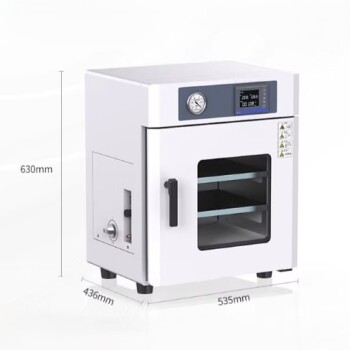
High-temperature vacuum ovens and tube furnaces are essential tools for liberating the internal structure of Metal-Organic Frameworks (MOFs) after synthesis. During the initial creation of MOFs, the material's pores become clogged with "guest molecules," including unreacted ligands, catalysts, and non-volatile solvents. These specialized heating devices provide the necessary thermal energy and controlled environment to evacuate these residues, effectively "activating" the material without destroying it.
The core purpose of this equipment is not merely drying, but structural liberation. Without precise thermal activation under vacuum or protective gas, the MOF remains a dormant, clogged framework with inaccessible pores, rendering it useless for high-performance applications like adsorption or catalysis.
The Objectives of MOF Activation
Removing Stubborn Guest Molecules
Freshly synthesized MOFs are rarely empty; they are filled with debris from the chemical reaction. This includes residual unreacted ligands and catalysts that occupy the internal voids. Furthermore, the synthesis often involves non-volatile solvents that are difficult to evaporate under standard conditions.
Unlocking Specific Surface Area
The primary value of a MOF lies in its porosity. As long as guest molecules occupy the pores, the internal surface area is effectively zero. By forcing these molecules out, you free the internal pore space, drastically increasing the specific surface area available for interaction.
Exposing Active Sites
Many applications, such as wastewater treatment or catalysis, rely on specific chemical "active sites" within the framework. Activation removes the solvent molecules that physically block these sites. This ensures the material achieves its maximum adsorption capacity and reactivity.
Why Specialized Equipment is Mandatory
The Role of the Vacuum Oven
Standard drying methods often require high heat that can damage sensitive frameworks. A vacuum drying oven allows for the removal of moisture and solvents at significantly lower temperatures. By lowering the pressure, you lower the boiling point of the solvents, preventing the high-temperature oxidation or particle agglomeration that might occur at atmospheric pressure.
The Role of the Tube Furnace
For more rigorous activation, a tube furnace offers a strictly controlled thermal environment under a protective atmosphere (such as helium or nitrogen). This setup allows for programmed temperature ramping (e.g., from 200°C to 500°C), which is crucial for the gradual removal of stubborn residual groups.
Controlling the Atmosphere
Both devices allow you to control the chemical environment surrounding the MOF. Processing under vacuum or inert gas prevents the oxidation of metal nodes or the degradation of organic linkers. This control ensures the final product maintains a catalytic interface with high thermal stability.
Understanding the Trade-offs
The Risk of Thermal Collapse
While heat is necessary to remove solvents, excessive heat can destroy the MOF itself. If the temperature exceeds the thermal stability of the organic linkers, the entire framework can collapse. This results in a dense, non-porous solid rather than an open framework.
The Danger of Rapid Heating
Rushing the process is a common pitfall. Rapidly heating the material can cause solvents to vaporize too quickly, creating internal pressure that shatters the delicate pore structure. Gradual heating profiles are required to maintain the structural integrity and distribution of active components.
Incomplete Activation
Conversely, being too cautious with temperature or vacuum levels can lead to incomplete activation. If residue remains trapped deep within the pores, the material will exhibit lower-than-expected surface area and poor performance in real-world applications.
Making the Right Choice for Your Goal
To ensure you select the right activation protocol for your specific MOF, consider your primary objective:
- If your primary focus is maximizing surface area: Prioritize high-vacuum environments to ensure the complete evacuation of non-volatile solvents from the smallest micropores.
- If your primary focus is structural integrity: Utilize a tube furnace with a slow, programmed temperature ramp to prevent thermal shock and pore collapse.
- If your primary focus is preventing oxidation: Ensure a strictly inert atmosphere (Argon or Helium) or high vacuum is maintained throughout the entire heating and cooling cycle.
Proper activation is the difference between a theoretical chemical structure and a functional, high-performance material.
Summary Table:
| Feature | Vacuum Oven | Tube Furnace |
|---|---|---|
| Primary Function | Low-temp solvent removal | High-temp thermal activation |
| Atmosphere Control | High vacuum environment | Inert gas (Ar/He/N2) or vacuum |
| Heating Profile | Uniform drying | Programmed ramping (200°C - 500°C+) |
| Key Benefit | Prevents oxidation & agglomeration | Gradual removal of stubborn residues |
| Best For | Moisture & volatile solvents | Maximizing surface area & stability |
Maximize Your Material Performance with KINTEK
Don't let clogged pores compromise your research. KINTEK specializes in precision laboratory equipment designed for the delicate activation of Metal-Organic Frameworks. From high-temperature vacuum ovens that prevent structural collapse to advanced tube furnaces and CVD systems for controlled thermal environments, we provide the tools you need to achieve maximum adsorption capacity.
Whether you are working on battery research, catalysis, or high-pressure reactor applications, our expert team is ready to help you select the ideal furnace, crushing system, or high-purity ceramic consumables for your lab.
Unlock the full surface area of your MOFs today.
→ Contact KINTEK for a Professional Consultation
References
- Shuxian Tang, Gang Wei. Recent Advances in Metal–Organic Framework (MOF)-Based Composites for Organic Effluent Remediation. DOI: 10.3390/ma17112660
This article is also based on technical information from Kintek Solution Knowledge Base .
Related Products
- 2200 ℃ Graphite Vacuum Heat Treat Furnace
- Ultra-High Temperature Graphite Vacuum Graphitization Furnace
- Graphite Vacuum Continuous Graphitization Furnace
- Large Vertical Graphite Vacuum Graphitization Furnace
- High Temperature Muffle Oven Furnace for Laboratory Debinding and Pre Sintering
People Also Ask
- How does heat transmit in a vacuum? Mastering Thermal Radiation for Purity & Precision
- Why do you heat treat in a vacuum? Achieve Perfect Surface Finish and Material Integrity
- What is the process of vacuum heat treating? Achieve Superior Hardening with a Clean, Bright Finish
- How does a vacuum heat treat furnace work? Achieve Pristine, Oxide-Free Metal Parts
- What is graphite heating? A Guide to Durable, High-Temp Industrial Furnace Solutions