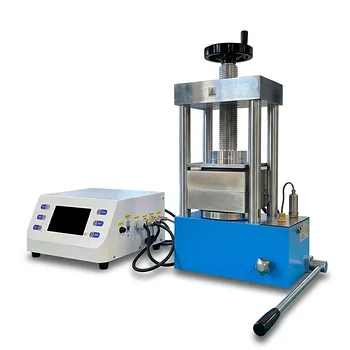
A high-tonnage hydraulic press is the critical prerequisite for transforming loose Uranium Dioxide (UO2) powder into a viable nuclear fuel source. By applying intense directional pressure, the press consolidates calcined powder into a solid "green body," creating the specific particle arrangement necessary to eliminate large internal pores before heat treatment.
Core Insight: The hydraulic press does not merely shape the pellet; it establishes the structural foundation for density. Without the high-pressure compaction of the powder's initial arrangement, it is physically impossible to achieve the required >90% theoretical density during the subsequent sintering process.
The Role of Mechanical Consolidation
Establishing the "Green Body"
The primary function of the press is to convert loose, calcined UO2 powder into a cohesive unit known as a green body.
This disk-shaped compact possesses the specific shape and mechanical strength required to be handled and transported to the next stage of production.
Controlling Particle Arrangement
High tonnage is required to force powder particles into a compact initial arrangement.
This mechanical force significantly reduces the distance between particles, minimizing the volume of large internal pores that cannot be removed by heat alone.
Enhancing Contact Area
By compressing the powder, the press maximizes the contact area between individual grains.
As seen in similar powder metallurgy processes, increasing this contact area is vital for enhancing reaction kinetics and uniformity in later stages.
Enabling High-Density Sintering
The Density Pre-Requisite
The ultimate goal of UO2 pellet production is to reach a high theoretical density (greater than 90%).
While the sintering furnace provides the heat (up to 1600°C) for final densification, the hydraulic press provides the necessary starting point. If the green body is too porous, the sintering process will fail to reach the target density.
Facilitating Diffusion
The sintering process relies on atomic diffusion to bond particles and eliminate remaining microscopic pores.
The high-tonnage press ensures particles are physically close enough for this diffusion to occur efficiently, allowing the material to reach a design density of approximately 10.41 g/cm³.
Understanding the Trade-offs
Precision vs. Force
While "high tonnage" implies raw power, the application must be highly controlled.
Precise pressure control is as important as the total force applied. Inconsistent pressure leads to density gradients within the pellet, which can cause cracking or warping during sintering.
The Consequence of Low Density
If the initial pressing is insufficient, the final pellet will suffer from low density.
Low-density pellets have poor thermal conductivity and are unable to effectively retain fission gases during reactor service, compromising both safety and efficiency.
Making the Right Choice for Your Production
To ensure your UO2 pellets meet the rigorous standards of nuclear fuel, you must view the hydraulic press and the sintering furnace as an interconnected system.
- If your primary focus is Structural Integrity: Ensure your press delivers enough directional pressure to eliminate large pores, creating a robust green body that can withstand handling.
- If your primary focus is Reactor Performance: Calibrate pressure control to maximize particle contact area, which directly correlates to higher thermal conductivity and fission gas retention in the final product.
The high-tonnage press is the non-negotiable gateway to achieving the density required for safe and efficient nuclear energy generation.
Summary Table:
| Process Stage | Function of High Tonnage Press | Impact on UO2 Pellet Quality |
|---|---|---|
| Green Body Formation | Consolidates loose powder into a cohesive disk | Ensures mechanical strength for handling and transport |
| Pore Management | Minimizes volume of large internal pores | Prevents structural defects that heat cannot fix |
| Particle Contact | Maximizes contact area between powder grains | Enhances reaction kinetics and atomic diffusion |
| Final Sintering Prep | Establishes critical initial density | Enables target theoretical density of >90% (10.41 g/cm³) |
Optimize Your Nuclear Fuel Production with KINTEK
Precision and power are the foundations of high-performance ceramic pellet production. At KINTEK, we specialize in the advanced laboratory equipment required to meet rigorous nuclear standards. Our high-tonnage hydraulic presses (including pellet, hot, and isostatic models) provide the precise pressure control and force necessary to eliminate internal porosity and maximize green body density.
Whether you are refining UO2 pellets or developing advanced materials, KINTEK offers a comprehensive portfolio—from high-temperature muffle and vacuum furnaces for sintering to crushing systems and ceramic crucibles. Partner with us to ensure your materials achieve superior thermal conductivity and structural integrity.
Ready to elevate your lab’s capabilities? Contact KINTEK today for a customized solution.
References
- Annika Carolin Maier, Mats Jönsson. On the change in UO<sub>2</sub> redox reactivity as a function of H<sub>2</sub>O<sub>2</sub> exposure. DOI: 10.1039/c9dt04395k
This article is also based on technical information from Kintek Solution Knowledge Base .
Related Products
- kbr pellet press 2t
- Laboratory Hydraulic Pellet Press for XRF KBR FTIR Lab Applications
- Automatic Laboratory Hydraulic Pellet Press Machine for Lab Use
- Automatic Laboratory Hydraulic Press for XRF & KBR Pellet Press
- Laboratory Manual Hydraulic Pellet Press for Lab Use
People Also Ask
- How do you prepare samples for IR spectroscopy? A Step-by-Step Guide for Solids, Liquids, and Gases
- What measurement methods are commonly used for powder samples in infrared spectroscopy? Optimize Your FTIR Analysis
- Why KBr is used in IR spectrophotometry? A Key to Transparent Sample Analysis
- How are a KBr pellet press and mortar utilized in FTIR analysis of activated carbon? Expert Sample Prep Guide
- How do you prepare KBr pellets for FTIR analysis? Master the Technique for High-Quality IR Spectra