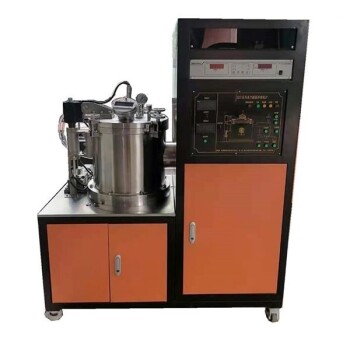
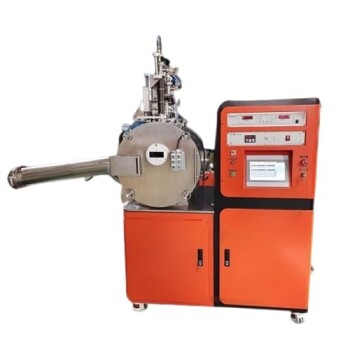
High-vacuum induction melting is the only viable method for preparing high-performance zirconium alloys because these metals possess an extreme affinity for atmospheric gases at melting temperatures. By utilizing non-contact induction heating within a strict vacuum environment, this furnace completely eliminates the risk of reaction with oxygen, nitrogen, and hydrogen. This ensures the alloy retains the precise chemical composition and high purity required for advanced mechanical applications.
The critical barrier to success: Zirconium functions as a "getter" material, meaning it actively absorbs impurities from the air when hot. Without the protective environment of a high-vacuum furnace, the metal becomes brittle and chemically compromised before it even solidifies.
The Challenge of Reactive Metals
The Reactivity of Zirconium
Zirconium elements are highly reactive with oxygen, nitrogen, and hydrogen. This reactivity intensifies drastically as temperatures rise to the melting point.
The Consequence of Exposure
If these alloys are melted in the presence of air, they immediately form oxides, nitrides, and hydrides. These impurities act as defects in the metal matrix, destroying the material's mechanical integrity and ductility.
The Necessity of Hydrogen Removal
Titanium and zirconium alloys are particularly prone to absorbing hydrogen, which leads to brittle hydrides. A high-vacuum environment is essential not just for preventing intake, but for actively encouraging hydrogen atoms to diffuse out of the metal matrix.
How High-Vacuum Induction Melting Solves the Problem
Non-Contact Heating Mechanism
The furnace utilizes Joule heat generated by induction currents. This allows the metal to be heated without direct contact with a heat source that could introduce further contaminants.
Precision Control of Composition
By eliminating atmospheric interference, the furnace ensures that the final chemical composition matches the theoretical design exactly. This precision is non-negotiable for high-performance alloys like Zr-Ti-Al-V.
Establishing the Foundation for Performance
The purity achieved during the melting phase is the prerequisite for all subsequent material properties. You cannot achieve advanced characteristics, such as shape memory or superelasticity, if the base ingot contains atmospheric impurities.
Understanding the Trade-offs
Volatility of Alloying Elements
While the vacuum protects reactive metals like Zirconium, it can be problematic for alloying elements with high vapor pressures (like Aluminum).
Managing Evaporation
In a high-vacuum environment, these volatile elements may evaporate before the alloy mixes. Operators must carefully control pressure and temperature profiles to maintain the correct ratio of elements like Aluminum in the Zr-Ti-Al-V matrix.
Making the Right Choice for Your Goal
To ensure your zirconium alloy meets its performance targets, consider the following:
- If your primary focus is Mechanical Ductility: Ensure your melting process prioritizes high vacuum levels to eliminate oxygen and nitrogen, which are the primary causes of brittleness.
- If your primary focus is Complex Phase Formation: Focus on precise temperature control during induction melting to guarantee a homogeneous mix, as this sets the stage for successful solution treatments later.
- If your primary focus is Hydrogen Control: Utilize the vacuum environment to disrupt the thermodynamic stability of hydrides, ensuring the material remains fracture-resistant.
The high-vacuum induction melting furnace is not just a heating tool; it is a contamination control system that makes modern zirconium metallurgy possible.
Summary Table:
| Feature | Impact on Zirconium Alloy (Zr-Ti-Al-V) | Benefit |
|---|---|---|
| High-Vacuum Environment | Prevents absorption of O₂, N₂, and H₂ | Eliminates brittleness and maintains high purity |
| Induction Heating | Non-contact Joule heating | Minimizes external contamination during melting |
| Degassing Capability | Removes dissolved hydrogen | Enhances fracture resistance and ductility |
| Composition Control | Precise management of alloying elements | Guarantees exact chemical ratios for advanced performance |
| Thermal Precision | Homogeneous mixing of reactive metals | Sets foundation for shape memory and superelasticity |
Elevate Your Material Research with KINTEK
Don't let atmospheric contamination compromise your high-performance alloys. KINTEK specializes in advanced laboratory solutions, providing high-precision induction melting furnaces, high-temperature vacuum systems, and crushing and milling equipment tailored for reactive metal processing.
Whether you are developing Zr-Ti-Al-V alloys or exploring cutting-edge battery research, our comprehensive portfolio—including vacuum furnaces, pellet presses, and ceramic crucibles—ensures your materials achieve their theoretical performance.
Ready to achieve superior alloy purity? Contact our technical experts today to find the perfect furnace for your laboratory.
References
- Na Zhang, Ri-ping LIU. Research progress of novel zirconium alloys with high strength and toughness. DOI: 10.55713/jmmm.v32i4.1526
This article is also based on technical information from Kintek Solution Knowledge Base .
Related Products
- Vacuum Arc Induction Melting Furnace
- Vacuum Heat Treat Furnace and Levitation Induction Melting Furnace
- Lab-Scale Vacuum Induction Melting Furnace
- Vacuum Induction Melting Spinning System Arc Melting Furnace
- 600T Vacuum Induction Hot Press Furnace for Heat Treat and Sintering
People Also Ask
- How do vacuum induction or arc melting furnaces facilitate the synthesis of U-Al-C MAX phases? Precision Heat & Purity
- What core role does a Vacuum Induction Melting furnace play in nickel-free steel production? Achieve High-Purity Alloys
- What is the function of a vacuum arc melting furnace? Master Homogeneity for Amorphous Alloy Ribbons
- What is the primary function of a vacuum arc melting furnace in RHEA preparation? Achieving Extreme Thermal Fusion
- What is the function of a vacuum arc melting furnace? Prepare High-Purity Alx(CrFeNi)1-x High-Entropy Alloys