The secondary carbonization of SiC-C@Fe3O4 at 500 °C is essential for phase transformation and structural anchoring. This specific thermal treatment drives the decomposition of precursors into stable $Fe_3O_4$ crystal phases while simultaneously forging strong chemical bonds between the metal oxide nanoparticles and the carbon substrate. These dual effects are critical for ensuring high electron transfer rates and long-term stability in alkaline environments.
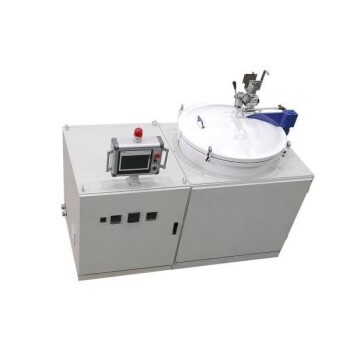
A laboratory atmosphere furnace is utilized to provide a precise thermal field that converts chemical precursors into active magnetic phases. By controlling the environment at 500 °C, the process optimizes the interface between the nanoparticles and the support, creating a robust electrocatalytic structure.
Achieving Phase Purity and Stability
The Transformation to $Fe_3O_4$
The primary role of the 500 °C treatment is to trigger the thermal decomposition of precursors previously deposited on the SiC-C surface. This temperature is sufficient to reorganize these precursors into stable $Fe_3O_4$ crystal phases, which are the active components required for the material's intended performance.
Preventing Structural Degradation
Using a controlled atmosphere furnace ensures that this transformation occurs without the interference of unwanted oxidation or contamination. Maintaining this specific temperature threshold prevents the over-growth of particles, ensuring the nanoparticles remain finely dispersed across the carbon substrate for maximum surface area.
Strengthening the Catalyst Interface
Enhancing Chemical Bonding
The secondary carbonization process does more than just change the chemistry of the iron; it strengthens the chemical bonding between the $Fe_3O_4$ nanoparticles and the underlying carbon matrix. This robust attachment is vital for preventing "leaching" or detachment of the active material during rigorous electrochemical reactions.
Optimizing Electron Transfer
A high-quality interface is the foundation for efficient energy conversion. By hardening the bond between the metal oxide and the conductive carbon, the furnace treatment significantly increases the electron transfer rate, allowing the catalyst to perform more efficiently in alkaline electrolytes.
Understanding the Trade-offs
Temperature Sensitivity
While 500 °C is ideal for $Fe_3O_4$ formation, higher temperatures—such as the 800 °C or 1100 °C used for pure SiC roasting—could lead to the reduction of $Fe_3O_4$ into metallic iron or other less stable phases. Precision is required to balance the carbonization of the shell with the phase integrity of the metal oxide.
Atmosphere Control Risks
The "atmosphere" in the furnace must be strictly managed to avoid the combustion of the carbon substrate. If oxygen levels are not precisely controlled, the carbon matrix intended to support the $Fe_3O_4$ could be lost to $CO_2$ evolution, destroying the composite's structural integrity.
Making the Right Choice for Your Goal
To achieve the best results with SiC-C@Fe3O4 composites, the thermal parameters must align with your specific performance requirements:
- If your primary focus is Electrocatalytic Activity: Ensure the 500 °C hold time is sufficient to complete the $Fe_3O_4$ phase transformation without causing nanoparticle agglomeration.
- If your primary focus is Mechanical Durability: Prioritize the ramp rate within the atmosphere furnace to allow for the gradual formation of interfacial bonds, preventing micro-cracks in the carbon shell.
- If your primary focus is Electrical Conductivity: Verify that the furnace atmosphere is sufficiently inert to preserve the graphitized carbon structure while the $Fe_3O_4$ precursors decompose.
The precise application of a 500 °C thermal field is the definitive factor in turning a raw precursor mix into a high-performance, stable electrocatalyst.
Summary Table:
| Feature | Process Goal | Performance Benefit |
|---|---|---|
| Phase Transformation | Converts precursors to stable $Fe_3O_4$ | Optimizes electrocatalytic active sites |
| Structural Anchoring | Forges strong bonds with carbon substrate | Prevents leaching & increases durability |
| Thermal Precision | Maintains 500 °C threshold | Prevents nanoparticle agglomeration |
| Atmosphere Control | Inert/Controlled environment | Preserves carbon matrix & prevents oxidation |
| Electron Transfer | Interface optimization | Higher efficiency in alkaline electrolytes |
Elevate Your Material Synthesis with KINTEK Precision
Achieving the perfect phase transformation in SiC-C@Fe3O4 composites requires more than just heat—it requires the absolute precision of a KINTEK Laboratory Atmosphere Furnace.
As specialists in high-performance laboratory equipment, KINTEK provides the tools necessary for advanced material research, including:
- Advanced Atmosphere Furnaces: Ensuring uniform thermal fields for precise secondary carbonization.
- Comprehensive Thermal Range: From muffle and tube furnaces to CVD, PECVD, and vacuum systems.
- Material Integrity Solutions: High-temperature reactors, autoclaves, and specialized ceramics/cruibles designed for rigorous chemical environments.
Whether you are focusing on electrocatalytic activity or mechanical durability, our equipment ensures your nanoparticles remain finely dispersed and structurally stable. Contact KINTEK today to discover how our high-precision furnaces and consumables can optimize your laboratory’s research outcomes!
References
- Changwei Li, Honglei Chen. Effectively Controlled Structures of Si-C Composites from Rice Husk for Oxygen Evolution Catalyst. DOI: 10.3390/molecules28166117
This article is also based on technical information from Kintek Solution Knowledge Base .
Related Products
- 1200℃ Controlled Atmosphere Furnace Nitrogen Inert Atmosphere Furnace
- 1700℃ Controlled Atmosphere Furnace Nitrogen Inert Atmosphere Furnace
- 1400℃ Controlled Atmosphere Furnace with Nitrogen and Inert Atmosphere
- Controlled Nitrogen Inert Hydrogen Atmosphere Furnace
- Mesh belt controlled atmosphere furnace
People Also Ask
- What is a controlled atmosphere furnace for heat treatment? Master Surface Chemistry and Metallurgy
- Why is a high-temperature furnace with a controlled atmosphere required for S@MMPC? Master Precision Synthesis
- What is the role of the furnace atmosphere? Master Precise Metallurgical Control for Your Heat Treatment
- What are the two primary purposes of using a controlled atmosphere? Master Protection vs. Material Modification
- What is a controlled atmosphere furnace? Achieve Purity and Precision in High-Temp Processing