Knowledge Why is a laboratory freeze dryer essential for Cr–Mn-doped TiO2@Graphene Oxide aerogel films? Preserve Porous Architecture
Author avatar

Tech Team · Kintek Solution

Updated 3 days ago

Why is a laboratory freeze dryer essential for Cr–Mn-doped TiO2@Graphene Oxide aerogel films? Preserve Porous Architecture


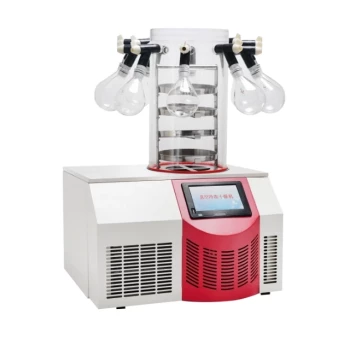
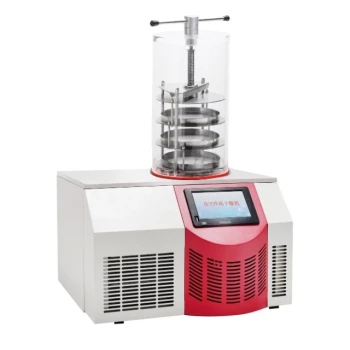
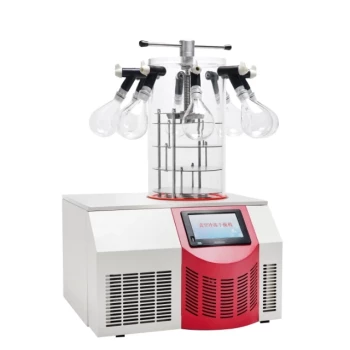
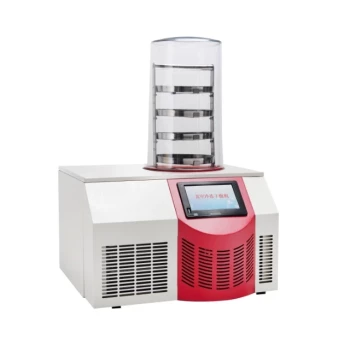
A laboratory freeze dryer is the critical processing tool required to transform polymerized hydrogels into functional aerogel films without destroying their internal architecture. By removing solvents through sublimation rather than evaporation, this technology prevents the structural collapse caused by liquid surface tension, ensuring the material retains the high porosity required for effective performance.

The freeze dryer preserves the delicate three-dimensional network of the aerogel by bypassing the liquid phase during drying. This ensures maximum specific surface area, providing the necessary active sites for photocatalytic reactions.

The Mechanics of Structural Preservation

The Problem with Conventional Thermal Drying

If you attempt to dry a hydrogel using standard thermal methods, the solvent must pass through a liquid phase to evaporate.

During this transition, liquid surface tension exerts significant force on the material's internal walls. This physical stress typically causes the porous network to collapse, resulting in a dense, non-porous solid rather than an aerogel.

The Solution: Sublimation

A laboratory freeze dryer operates under vacuum conditions to facilitate sublimation.

This process converts the frozen solvent directly from a solid state into vapor, completely bypassing the liquid phase. By eliminating the liquid state, the destructive forces of surface tension are removed, leaving the polymerized structure intact.

Impact on Material Performance

Preserving the 3D Skeleton

The freeze-drying process protects the complex three-dimensional porous skeleton formed by composites like alginate and titanium dioxide.

This results in a final material characterized by extremely low density and high structural integrity. The preservation of this skeleton is not merely cosmetic; it is defined by the successful conversion of a wet hydrogel into a dry, stable aerogel film.

Maximizing Catalytic Efficiency

For materials designed for photocatalysis, such as Cr–Mn-doped TiO2@Graphene Oxide, surface area is the defining metric of quality.

Freeze drying ensures an extremely high specific surface area is maintained. This vast internal surface area exposes a maximum number of active catalytic sites, directly enhancing the material's ability to react with its environment.

Enhancing Molecular Contact

The high porosity achieved through this method creates an open network within the film.

This allows pollutant molecules to freely penetrate the material. Because the pores are not collapsed, reactants can come into full contact with the active sites deep within the aerogel, significantly improving overall efficiency.

Understanding the Trade-offs

Process Necessity vs. Material Failure

The primary "trade-off" in this context is not between two viable options, but between a functional material and a failed one.

While conventional drying methods may be more accessible or faster, they are fundamentally incompatible with aerogel formation. Choosing any method other than freeze drying results in the loss of the porous network, rendering the material useless for applications requiring high surface area and porosity.

Making the Right Choice for Your Goal

When developing aerogel films for catalytic applications, your processing method dictates your material's properties.

  • If your primary focus is Photocatalytic Activity: You must use a freeze dryer to maximize specific surface area and active site exposure.
  • If your primary focus is Structural Integrity: You must rely on sublimation to prevent pore collapse and maintain the 3D composite skeleton.

Sublimation is the only pathway to retaining the porous architecture that defines a high-performance aerogel.

Summary Table:

Feature Conventional Thermal Drying Laboratory Freeze Drying (Sublimation)
Phase Transition Liquid to Vapor Solid to Vapor (Bypassing Liquid)
Surface Tension High (Causes pore collapse) Eliminated (No destructive force)
Internal Structure Dense, non-porous solid 3D porous skeleton intact
Surface Area Low (Limited active sites) Extremely High (Maximizes active sites)
Application Fit General solids High-performance photocatalytic aerogels

Elevate Your Advanced Material Research with KINTEK

Precision in drying is the difference between a collapsed solid and a high-performance aerogel. KINTEK specializes in providing state-of-the-art laboratory equipment designed to preserve the delicate architecture of your composites.

Our extensive portfolio includes professional-grade freeze dryers, cold traps, and ULT freezers, alongside high-temperature vacuum furnaces and chemical vapor deposition (CVD) systems essential for advanced material synthesis. Whether you are developing photocatalytic films or exploring battery research, our tools ensure maximum porosity and structural integrity for your laboratory breakthroughs.

Ready to optimize your material performance? Contact our experts today to find the perfect solution for your research goals.

References

  1. Maryam Yousaf, Ihsanullah Sohoo. On-Site Application of Solar-Activated Membrane (Cr–Mn-Doped TiO2@Graphene Oxide) for the Rapid Degradation of Toxic Textile Effluents. DOI: 10.3390/membranes12121178

This article is also based on technical information from Kintek Solution Knowledge Base .

Related Products

People Also Ask

Related Products

Benchtop Laboratory Freeze Dryer for Lab Use

Benchtop Laboratory Freeze Dryer for Lab Use

Premium benchtop laboratory freeze dryer for lyophilization, preserving samples with ≤ -60°C cooling. Ideal for pharmaceuticals & research.

1800℃ Muffle Oven Furnace for Laboratory

1800℃ Muffle Oven Furnace for Laboratory

KT-18 muffle furnace with Japan Al2O3 polycrystalline fibe and Silicon Molybdenum heating element, up to 1900℃, PID temperature control and 7" smart touch screen. Compact design, low heat loss, and high energy efficiency. Safety interlock system and versatile functions.

Automatic Heated Hydraulic Press Machine with Heated Plates for Laboratory Hot Press 25T 30T 50T

Automatic Heated Hydraulic Press Machine with Heated Plates for Laboratory Hot Press 25T 30T 50T

Efficiently prepare your samples with our Automatic Heated Lab Press. With a pressure range up to 50T and precise control, it's perfect for various industries.

Custom PTFE Teflon Parts Manufacturer for PTFE Tweezers

Custom PTFE Teflon Parts Manufacturer for PTFE Tweezers

PTFE tweezers inherit the excellent physical and chemical properties of PTFE, such as high temperature resistance, cold resistance, acid and alkali resistance, and corrosion resistance to most organic solvents.

Circulating Water Vacuum Pump for Laboratory and Industrial Use

Circulating Water Vacuum Pump for Laboratory and Industrial Use

Efficient circulating water vacuum pump for labs - oil-free, corrosion-resistant, quiet operation. Multiple models available. Get yours now!

Manual Lab Heat Press

Manual Lab Heat Press

Manual hydraulic presses are mainly used in laboratories for various applications such as forging, molding, stamping, riveting and other operations. It allows the creation of complex shapes while saving material.

Graphite Vacuum Furnace IGBT Experimental Graphitization Furnace

Graphite Vacuum Furnace IGBT Experimental Graphitization Furnace

IGBT experimental graphitization furnace, a tailored solution for universities and research institutions, with high heating efficiency, user-friendliness, and precise temperature control.

Vacuum Hot Press Furnace Machine for Lamination and Heating

Vacuum Hot Press Furnace Machine for Lamination and Heating

Experience clean and precise lamination with Vacuum Lamination Press. Perfect for wafer bonding, thin-film transformations, and LCP lamination. Order now!

Laboratory Disc Rotary Mixer for Efficient Sample Mixing and Homogenization

Laboratory Disc Rotary Mixer for Efficient Sample Mixing and Homogenization

Efficient Laboratory Disc Rotary Mixer for Precise Sample Mixing, Versatile for Various Applications, DC Motor and Microcomputer Control, Adjustable Speed and Angle.

Small Vacuum Heat Treat and Tungsten Wire Sintering Furnace

Small Vacuum Heat Treat and Tungsten Wire Sintering Furnace

The small vacuum tungsten wire sintering furnace is a compact experimental vacuum furnace specially designed for universities and scientific research institutes. The furnace features a CNC welded shell and vacuum piping to ensure leak-free operation. Quick-connect electrical connections facilitate relocation and debugging, and the standard electrical control cabinet is safe and convenient to operate.

Automatic Lab Cold Isostatic Press CIP Machine Cold Isostatic Pressing

Automatic Lab Cold Isostatic Press CIP Machine Cold Isostatic Pressing

Efficiently prepare samples with our Automatic Lab Cold Isostatic Press. Widely used in material research, pharmacy, and electronic industries. Provides greater flexibility and control compared to electric CIPs.

Vacuum Heat Treat Furnace with Ceramic Fiber Liner

Vacuum Heat Treat Furnace with Ceramic Fiber Liner

Vacuum furnace with polycrystalline ceramic fiber insulation liner for excellent heat insulation and uniform temperature field. Choose from 1200℃ or 1700℃ max. working temperature with high vacuum performance and precise temperature control.

Graphite Vacuum Furnace High Thermal Conductivity Film Graphitization Furnace

Graphite Vacuum Furnace High Thermal Conductivity Film Graphitization Furnace

The high thermal conductivity film graphitization furnace has uniform temperature, low energy consumption and can operate continuously.

Dental Porcelain Zirconia Sintering Ceramic Vacuum Press Furnace

Dental Porcelain Zirconia Sintering Ceramic Vacuum Press Furnace

Get precise dental results with Dental Vacuum Press Furnace. Automatic temperature calibration, low noise tray, and touch screen operation. Order now!

Horizontal High Temperature Graphite Vacuum Graphitization Furnace

Horizontal High Temperature Graphite Vacuum Graphitization Furnace

Horizontal Graphitization Furnace: This type of furnace is designed with the heating elements placed horizontally, allowing for uniform heating of the sample. It's well-suited for graphitizing large or bulky samples that require precise temperature control and uniformity.

Ultra-High Temperature Graphite Vacuum Graphitization Furnace

Ultra-High Temperature Graphite Vacuum Graphitization Furnace

The ultra-high temperature graphitization furnace utilizes medium frequency induction heating in a vacuum or inert gas environment. The induction coil generates an alternating magnetic field, inducing eddy currents in the graphite crucible, which heats up and radiates heat to the workpiece, bringing it to the desired temperature. This furnace is primarily used for graphitization and sintering of carbon materials, carbon fiber materials, and other composite materials.

1400℃ Muffle Oven Furnace for Laboratory

1400℃ Muffle Oven Furnace for Laboratory

Get precise high-temperature control up to 1500℃ with KT-14M Muffle furnace. Equipped with a smart touch screen controller and advanced insulation materials.

Engineering Advanced Fine Ceramics Head Tweezers with Pointed Elbow Zirconia Ceramic Tip

Engineering Advanced Fine Ceramics Head Tweezers with Pointed Elbow Zirconia Ceramic Tip

Zirconia ceramic tweezers are a high-precision tool made of advanced ceramic materials, especially suitable for operating environments that require high precision and corrosion resistance. This type of tweezers not only has excellent physical properties, but is also popular in the medical and laboratory fields because of its biocompatibility.

Laboratory Single Horizontal Jar Mill

Laboratory Single Horizontal Jar Mill

KT-JM3000 is a mixing and grinding instrument for placing a ball milling tank with a volume of 3000ml or less. It adopts frequency conversion control to realize timing, constant speed, direction change, overload protection and other functions.

Manual High Temperature Heated Hydraulic Press Machine with Heated Plates for Lab

Manual High Temperature Heated Hydraulic Press Machine with Heated Plates for Lab

The High Temperature Hot Press is a machine specifically designed for pressing, sintering and processing materials in a high temperature environment. It is capable of operating in the range of hundreds of degrees Celsius to thousands of degrees Celsius for a variety of high temperature process requirements.


Leave Your Message