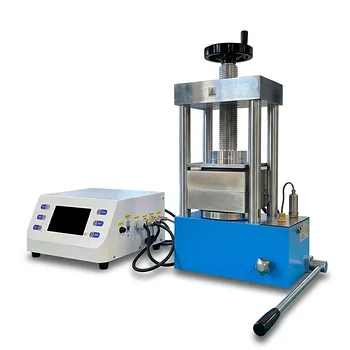
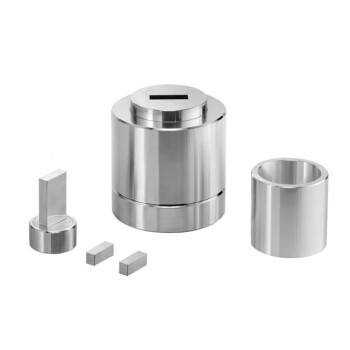
Precision pressure control is the defining factor in successfully synthesizing Ti3SiC2 reaction green bodies. A laboratory hydraulic press is required to apply the exact axial pressure needed to compress mixed powders into a specific relative density, typically around 50 percent. This creates the critical physical environment required for the chemical reaction to sustain itself.
Core Takeaway The hydraulic press does not merely shape the powder; it establishes the essential heat transfer paths between particles. Without the tight contact achieved through precise compression, the self-sustained combustion wave necessary for Ti3SiC2 synthesis cannot propagate, leading to failed synthesis or structural collapse.
Facilitating the Combustion Reaction
The primary function of the hydraulic press in this context goes beyond simple shaping; it is a tool for thermodynamic enablement.
Establishing Heat Transfer Paths
For the self-sustained combustion wave to travel through the reactant mixture, particles must be in intimate contact. The hydraulic press forces these particles together, minimizing air gaps that act as insulators. This tight inter-particle contact creates a continuous conductive path, allowing the heat generated by the reaction to ignite adjacent layers of powder.
Achieving Specific Relative Density
The process requires hitting a precise density target, such as 50 percent relative density.
- If the density is too low: The particles are too far apart, and the combustion wave will extinguish due to poor heat transfer.
- If the density is uncontrolled: The reaction becomes unpredictable. The hydraulic press allows for the repeatable application of axial pressure to ensure this specific density is met every time.
Ensuring Structural Integrity
A green body must maintain its form both before and during the violent synthesis process.
Mechanical Stability During Synthesis
The synthesis of Ti3SiC2 involves high temperatures and chemical transformations. The hydraulic press compacts the powder sufficiently to maintain the structural shape of the reactants throughout this process. Without adequate compression, the green body could crumble or deform as the reaction wave propagates.
Particle Rearrangement and Interlocking
The high pressure forces powder particles to overcome friction and rearrange themselves. In mixtures containing ductile components, this pressure can cause deformation that leads to mechanical interlocking. This provides the green body with enough strength to be handled and moved into the furnace without the need for additional chemical binders that could contaminate the reaction.
Optimizing Microstructure
The quality of the final product is heavily dependent on the uniformity of the green body prior to reaction.
Eliminating Internal Defects
By applying uniform static pressure, the press minimizes the formation of internal voids and large pores. A lack of pressure control can lead to density variations within the green body. These variations often manifest as micro-cracks or structural weaknesses in the final synthesized material.
Shortening Diffusion Distances
High-pressure compaction brings atomic species closer together. This shortened distance facilitates faster atomic diffusion during the reaction. While the primary goal is heat transfer for combustion, this proximity also promotes effective grain growth and pore elimination, contributing to a higher quality final density.
Understanding the Trade-offs
While pressure is essential, it must be applied with an understanding of the material's limits and the reaction's requirements.
The Risk of Density Gradients
Applying pressure from only one direction (axial) can sometimes create density gradients, where the edges are denser than the center. This nonuniformity can lead to warped products or incomplete reactions in less dense areas.
Over-Compaction Issues
More pressure is not always better. For self-propagating high-temperature synthesis (SHS), a specific relative density is required. Over-compacting the material (approaching 100% density) might actually hinder the reaction propagation or trap gases that need to escape, leading to bloating or cracking. Precision, not maximum force, is the goal.
Making the Right Choice for Your Goal
When selecting or configuring a hydraulic press for Ti3SiC2 synthesis, align your parameters with your specific objectives.
- If your primary focus is Combustion Efficiency: Target a pressure that achieves exactly 50% relative density to maximize heat transfer paths without over-densifying.
- If your primary focus is Structural Handling: Ensure the press provides enough force to achieve mechanical interlocking of particles, preventing the green body from crumbling during transport.
- If your primary focus is Defect Minimization: Use precision molds and uniform pressure application to prevent density gradients that cause cracks during the thermal shock of synthesis.
The hydraulic press is the gatekeeper of your reaction kinetics; it turns a loose pile of potential into a viable, conductive solid capable of sustaining synthesis.
Summary Table:
| Parameter | Impact on Ti3SiC2 Synthesis |
|---|---|
| Relative Density | Targets ~50% to enable self-sustained combustion waves |
| Heat Transfer | Establishes tight particle contact for conductive paths |
| Structural Integrity | Prevents crumbling through mechanical interlocking |
| Defect Control | Minimizes internal voids and density gradients to prevent cracks |
| Reaction Kinetics | Shortens diffusion distances for faster atomic species movement |
Elevate Your Material Synthesis with KINTEK
Precision is the difference between a successful synthesis and a failed experiment. KINTEK specializes in advanced laboratory equipment designed for the rigorous demands of material science. Our high-performance hydraulic presses (pellet, hot, isostatic) provide the exact axial pressure control required to achieve perfect relative density for Ti3SiC2 reaction green bodies and other advanced ceramics.
From high-temperature furnaces and reactors to precision crushing, milling, and sieving systems, KINTEK offers a comprehensive ecosystem of tools to support your research from powder preparation to final sintering. Our mission is to provide global labs with the reliability and accuracy needed to push the boundaries of innovation.
Ready to optimize your green body compaction? Contact our technical experts today to find the perfect pressing solution for your target application!
References
- C.L. Yeh, K. L. Lai. Effects of TiC, Si, and Al on Combustion Synthesis of Ti3SiC2/TiC/Ti5Si3 Composites. DOI: 10.3390/ma16186142
This article is also based on technical information from Kintek Solution Knowledge Base .
Related Products
- Heated Hydraulic Press Machine with Integrated Manual Heated Plates for Lab Use
- Automatic Laboratory Hydraulic Press for XRF & KBR Pellet Press
- Manual Lab Heat Press
- Laboratory Manual Hydraulic Pellet Press for Lab Use
- Automatic High Temperature Heated Hydraulic Press Machine with Heated Plates for Lab
People Also Ask
- Why is a heated laboratory hydraulic press necessary for composite laminates? Achieve Void-Free Structural Integrity
- What role does a heated hydraulic press play in Cold Sintering (CSP)? Enhancing LATP-Halide Densification
- What technical conditions does a heated hydraulic press provide for PEO batteries? Optimize Solid-State Interfaces
- Why is the heating function of a laboratory hydraulic press essential for MEA assembly in DEFC? Optimize Cell Bonding
- What are heated hydraulic presses used for? Molding Composites, Vulcanizing Rubber, and More