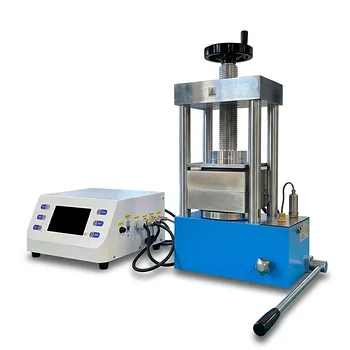
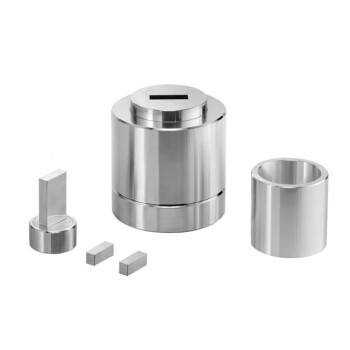
Precision compaction is the bridge between loose powder and a high-performance ceramic component. To prepare supported Solid Oxide Fuel Cell (SOFC) green bodies, a laboratory hydraulic press is required to apply uniform static pressure to ceramic powders within a mold. This process transforms the raw material into a shaped, structurally sound "green body" that is dense enough to withstand handling and subsequent high-temperature processing.
The hydraulic press is critical not just for shaping, but for controlling density distribution. By applying precise pressure, it minimizes internal voids and micro-defects, which is the only way to ensure the component survives sintering without cracking and achieves the necessary ionic conductivity for operation.
Achieving Structural Integrity and Uniformity
Creating a Handleable "Green" State
The immediate purpose of the press is to consolidate loose ceramic powders into a solid geometric form.
The press applies sufficient axial pressure to force particles into tight contact. This creates mechanical interlocking, resulting in a "green body" with enough structural strength to be removed from the mold and handled without binders or crumbling.
Ensuring Uniform Density
According to the primary technical guidelines, the press must provide uniform static pressure.
If pressure is applied unevenly, the density of the green body will vary from one section to another. A laboratory hydraulic press allows for precise regulation to ensure density is consistent throughout the electrolyte or anode support structure.
Eliminating Micro-Defects
Precise pressure control is the primary defense against internal flaws.
By maintaining consistent pressure, the press prevents the formation of micro-cracks and macroscopic defects. These defects, if present in the green stage, will almost certainly propagate into catastrophic failures during the high-stress environment of fuel cell operation.
Optimizing for Sintering and Performance
Shortening Atomic Diffusion Distances
High forming pressure significantly increases the "green density" (the density before firing).
By minimizing the voids between particles, the press reduces the distance atoms must travel (diffuse) during the heating process. This shortens the atomic diffusion distance, promoting effective grain growth and pore elimination.
Facilitating Densification
For an SOFC to function, the electrolyte layer must be gas-tight (dense) to prevent fuel crossover.
High-pressure compaction aids in achieving near-theoretical density (often over 95%) after sintering. This high final density is essential for maximizing mechanical strength and ionic conductivity, directly influencing the efficiency of the fuel cell.
Understanding the Trade-offs
The Risk of Pressure Gradients
While essential, uniaxial hydraulic pressing can introduce density gradients.
Friction between the powder and the die walls can cause the parts to be denser near the plunger and less dense in the center. This limitation restricts the aspect ratio (height vs. diameter) of the SOFC components you can successfully produce.
Elastic Recovery Issues
More pressure is not always better.
If the pressure is too high for the specific material formulation, the green body may experience elastic recovery (spring-back) upon ejection. This sudden expansion can introduce laminar cracks that ruin the structural integrity before sintering even begins.
Making the Right Choice for Your Goal
To maximize the effectiveness of your laboratory hydraulic press, align your pressing parameters with your specific research objectives:
- If your primary focus is Structural Stability: Prioritize uniform pressure distribution to prevent density gradients that cause warping or cracking during the sintering phase.
- If your primary focus is Electrochemical Performance: Target higher forming pressures to maximize green density, which is critical for achieving the gas-tight electrolyte layers required for high ionic conductivity.
Ultimately, the hydraulic press determines the fate of your SOFC: precise compaction yields a robust energy device, while inconsistent pressure leads inevitably to component failure.
Summary Table:
| Key Feature | Impact on SOFC Green Bodies | Research Benefit |
|---|---|---|
| Precision Compaction | Minimizes internal voids and micro-defects | Prevents cracking during high-temperature sintering |
| Uniform Static Pressure | Ensures consistent density distribution | Maintains structural integrity across electrolyte/anode layers |
| High Forming Pressure | Shortens atomic diffusion distances | Facilitates gas-tight densification and high ionic conductivity |
| Mechanical Interlocking | Creates handleable "green" state | Allows for safe removal from molds and transport to furnaces |
Elevate Your SOFC Research with KINTEK Precision
Achieving gas-tight electrolyte layers and robust ceramic components requires the ultimate control over powder compaction. KINTEK specializes in high-performance laboratory hydraulic presses (pellet, hot, and isostatic) designed to eliminate density gradients and micro-defects in your SOFC green bodies.
From crushing and milling systems for powder preparation to high-temperature muffle and tube furnaces for final sintering, KINTEK provides a comprehensive ecosystem for energy research. Our expertise ensures your fuel cell components survive the stress of operation and achieve peak ionic conductivity.
Ready to optimize your lab's workflow? Contact us today to find the perfect hydraulic press and consumables for your application!
References
- Muhammad Sarfraz Arshad, Ghulam Yasin. Advances and Perspectives on Solid Oxide Fuel Cells: From Nanotechnology to Power Electronics Devices. DOI: 10.1002/ente.202300452
This article is also based on technical information from Kintek Solution Knowledge Base .
Related Products
- Automatic Laboratory Hydraulic Press for XRF & KBR Pellet Press
- Laboratory Hydraulic Pellet Press for XRF KBR FTIR Lab Applications
- Laboratory Hydraulic Press Split Electric Lab Pellet Press
- Laboratory Manual Hydraulic Pellet Press for Lab Use
- Laboratory Manual Hydraulic Pellet Press for Lab Use
People Also Ask
- What is the significance of applying 200 MPa of pressure with a laboratory hydraulic pellet press for composite ceramics?
- What is the role of a laboratory hydraulic pellet press and stainless steel molds in the fabrication of RuO2/NbC anodes?
- What is the necessity of using a laboratory hydraulic pellet press in the preparation of biomass fuel pellets? Guide
- How does a laboratory hydraulic pellet press contribute to SiCw/2024 aluminum composite preforms? Optimize Densification
- What role does a laboratory hydraulic pellet press play in fly ash utilization? Enhancing Adsorption and Flow Control