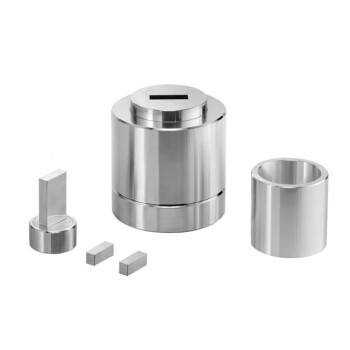
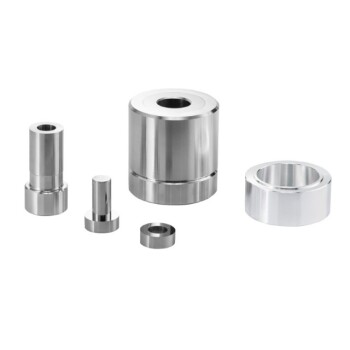
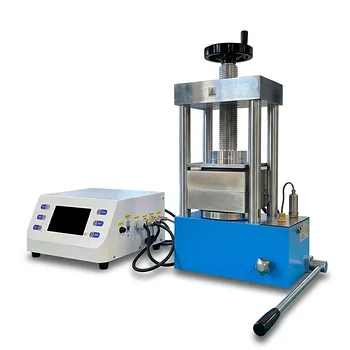
The primary reason a laboratory hydraulic press must provide pressures up to 360 MPa is to force loose powder particles into a dense, solid state where they are in intimate physical contact. Without this extreme mechanical pressure, the battery layers retain microscopic voids that act as barriers to lithium-ion movement, rendering the battery ineffective.
High-pressure consolidation is not merely about shaping the battery; it is the fundamental mechanism used to replace the wetting action of liquid electrolytes. By crushing pores and forcing particles together, you lower interfacial impedance to a level that allows the battery to function.
The Critical Role of High Density
Eliminating Microscopic Pores
In their raw state, the solid electrolyte and electrode materials are powders filled with empty space.
A pressure of 360 MPa is required to mechanically eliminate the pores between these powder particles. This consolidation transforms a porous volume into a dense, continuous layer essential for battery operation.
Maximizing Contact Area
For a solid-state battery to work, lithium ions must physically jump from one solid particle to another.
High pressure forces these particles to deform and press against one another, maximizing the surface area of contact. This ensures that the monolithic battery structure is mechanically stable and chemically connected.
Overcoming Impedance Barriers
Reducing Grain Boundary Impedance
The boundaries between individual grains of powder are the points of highest resistance (impedance) in the system.
If these boundaries contain gaps, ions cannot cross them. The hydraulic press applies enough force to "bridge" these gaps, significantly reducing the impedance at the grain boundaries.
Ensuring Efficient Ion Transport
Unlike liquid electrolytes, which flow into gaps to transport ions, solid electrolytes rely entirely on physical pathways.
High density ensures a continuous path for lithium-ion transport across the solid-state interfaces. If the pressure is insufficient, the path is broken, and ion conductivity drops drastically.
Common Pitfalls to Avoid
The Risk of Insufficient Pressure
Using pressures significantly lower than 360 MPa often leads to "under-densification."
In this state, even high-quality materials will perform poorly because the physical contact is too weak to support ion flow. Researchers often mistake this for material failure when it is actually a processing failure.
Interface Voids in LFP Systems
Specifically in Lithium Iron Phosphate (LFP) and sulfide electrolyte systems, interface voids are a primary cause of failure.
These voids create dead spots where no electrochemical reaction can occur. Mechanical pressure is the only tool available in the pelletizing process to close these voids effectively.
Making the Right Choice for Your Goal
To ensure your solid-state battery pellets perform correctly, align your processing parameters with your specific objectives:
- If your primary focus is reducing internal resistance: Prioritize maintaining consistent pressure at or near 360 MPa to minimize grain boundary impedance.
- If your primary focus is structural integrity: Ensure the press applies force evenly to consolidate the monolithic structure without cracking the electrolyte layer.
Ultimate success in ASSB fabrication depends on treating pressure as a critical manufacturing variable, not just a shaping tool.
Summary Table:
| Factor | Impact on ASSB Performance | Importance of 360 MPa Pressure |
|---|---|---|
| Porosity | High porosity blocks lithium-ion flow | Eliminates microscopic voids for a dense layer |
| Contact Area | Poor contact increases interfacial resistance | Forces particle deformation for maximum surface contact |
| Impedance | High grain boundary resistance stops ions | Bridges gaps to lower impedance for efficient transport |
| Structural Integrity | Weak pellets lead to mechanical failure | Creates a stable, monolithic structure for the cell |
Elevate Your Battery Research with KINTEK Precision
Achieving the critical 360 MPa threshold is essential for the performance of all-solid-state batteries. KINTEK specializes in high-performance laboratory hydraulic presses (pellet, hot, and isostatic) designed specifically for the rigorous demands of material science and ASSB fabrication.
Our comprehensive portfolio supports every stage of your research, from high-temperature furnaces (CVD, Vacuum, Muffle) for material synthesis to crushing and milling systems for powder preparation. Whether you need high-pressure reactors, electrolytic cells, or specialized battery research consumables, KINTEK provides the reliability and precision your lab requires to bridge the gap between material innovation and functional battery performance.
Ready to eliminate interfacial impedance? Contact KINTEK Today to find the perfect hydraulic press and consumables for your research goals.
Related Products
- Automatic Laboratory Hydraulic Pellet Press Machine for Lab Use
- Automatic Laboratory Hydraulic Press for XRF & KBR Pellet Press
- Laboratory Hydraulic Press Split Electric Lab Pellet Press
- Laboratory Hydraulic Pellet Press for XRF KBR FTIR Lab Applications
- Laboratory Manual Hydraulic Pellet Press for Lab Use
People Also Ask
- What is the role of a laboratory hydraulic pellet press and stainless steel molds in the fabrication of RuO2/NbC anodes?
- What role does a laboratory pellet press play in the enhancement of biomass energy products? Optimize Fuel Efficiency
- What is the purpose of using a laboratory pellet press when evaluating the electronic conductivity of carbon powders? Guide
- How does a laboratory hydraulic pellet press contribute to SiCw/2024 aluminum composite preforms? Optimize Densification
- What is the significance of applying 200 MPa of pressure with a laboratory hydraulic pellet press for composite ceramics?