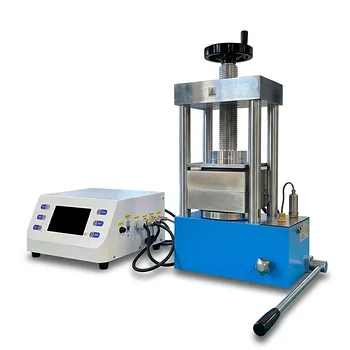
The primary reason for using a laboratory hydraulic press is to transform loose metal oxide nanopowders into solid, uniform pellets with high structural integrity. This compression creates the tight inter-particle contact necessary to establish a reliable conductive path. Without this step, the electrical interference caused by loose powder would make it impossible to obtain accurate resistance data or verify gas-sensing sensitivity.
Compressing powders into pellets eliminates the electrical noise inherent in loose materials. By ensuring uniform density and expelling air gaps, researchers can isolate the true gas-sensing response of the material from physical inconsistencies.
The Necessity of Tight Particle Contact
Overcoming Electrical Resistance
Loose metal oxide powders naturally contain significant air gaps between particles. Since air acts as an electrical insulator, these gaps prevent the consistent flow of current required for testing.
Creating a Continuous Path
The hydraulic press applies high, uniform pressure to the sample. This forces the nanoparticles into close proximity, creating a "green compact."
This tight packing ensures that when electrodes are attached, the electrical signal travels through the material itself, not through intermittent contacts.
Expelling Trapped Air
Beyond insulation, trapped air destabilizes the physical structure of the sample. Compression expels this air, increasing the packing density of the material.
Enhancing Data Accuracy
Reducing Signal Noise
Gas sensing characterization relies on measuring subtle changes in electrical resistance when gas is introduced.
If the powder is loose, physical shifting of particles causes resistance fluctuations unrelated to the gas. Pressed pellets provide a mechanically stable baseline, eliminating this interference.
Standardizing Sensitivity Measurements
To compare different materials, the physical form factor must be consistent.
The hydraulic press ensures that every pellet has a specific shape and density. This uniformity allows researchers to attribute differences in performance to the material's chemistry, rather than variations in how the powder was packed.
Critical Considerations and Trade-offs
The Risk of Density Gradients
While high pressure is necessary, applying it unevenly can create density gradients within the pellet. This can lead to warping or cracking, which breaks the electrical path and ruins the sample.
Balancing Strength and Porosity
Gas sensors require gas to diffuse into the material to react. If a pellet is pressed with excessive force, it may become too dense, hindering gas diffusion and artificially lowering sensitivity.
Conversely, if the pressure is too low (e.g., below 10 MPa for certain materials), the pellet may lack the strength to withstand handling or the heat of subsequent sintering processes.
Making the Right Choice for Your Research
To ensure your gas-sensing characterization is valid, tailor your pressing parameters to your specific analytical goals:
- If your primary focus is electrical stability: Prioritize higher pressures to maximize particle-to-particle contact and minimize baseline noise.
- If your primary focus is gas diffusion speed: Use moderate pressure to maintain a porous structure that allows gas to penetrate the pellet quickly.
- If your primary focus is sample durability: Ensure the pressure is sufficient to create a robust compact that will not crumble during electrode attachment or storage.
Uniform compression is the bridge between a synthesized powder and a verifiable scientific result.
Summary Table:
| Feature | Impact on Gas-Sensing Characterization |
|---|---|
| Particle Contact | Creates reliable conductive paths by eliminating insulating air gaps. |
| Structural Density | Expels trapped air to increase packing density and mechanical stability. |
| Signal Consistency | Reduces baseline resistance fluctuations unrelated to gas exposure. |
| Physical Uniformity | Standardizes pellet shape and density for repeatable material comparison. |
| Diffusion Control | Allows tuning of porosity to balance structural strength with gas penetration. |
Elevate Your Material Characterization with KINTEK
Precise gas-sensing research demands perfection in sample preparation. At KINTEK, we specialize in high-performance laboratory hydraulic presses (pellet, hot, and isostatic) designed to deliver the uniform pressure and structural integrity your metal oxide powders require.
Whether you are refining gas diffusion speeds or maximizing electrical stability, our comprehensive range of equipment—from crushing and milling systems to high-temperature furnaces and PTFE consumables—provides the end-to-end solutions your lab needs.
Ready to eliminate electrical noise and achieve verifiable results? Contact our technical experts today to find the ideal pressing solution for your research goals.
References
- Tetiana Dontsova, Ihor Astrelin. Metaloxide Nanomaterials and Nanocomposites of Ecological Purpose. DOI: 10.1155/2019/5942194
This article is also based on technical information from Kintek Solution Knowledge Base .
Related Products
- Automatic Laboratory Hydraulic Press for XRF & KBR Pellet Press
- Automatic Laboratory Hydraulic Pellet Press Machine for Lab Use
- Laboratory Hydraulic Pellet Press for XRF KBR FTIR Lab Applications
- Laboratory Manual Hydraulic Pellet Press for Lab Use
- kbr pellet press 2t
People Also Ask
- What is the significance of applying 200 MPa of pressure with a laboratory hydraulic pellet press for composite ceramics?
- What is the role of a laboratory hydraulic pellet press and stainless steel molds in the fabrication of RuO2/NbC anodes?
- What is the necessity of using a laboratory hydraulic pellet press in the preparation of biomass fuel pellets? Guide
- How does a laboratory hydraulic pellet press contribute to SiCw/2024 aluminum composite preforms? Optimize Densification
- What role does a laboratory hydraulic pellet press play in fly ash utilization? Enhancing Adsorption and Flow Control