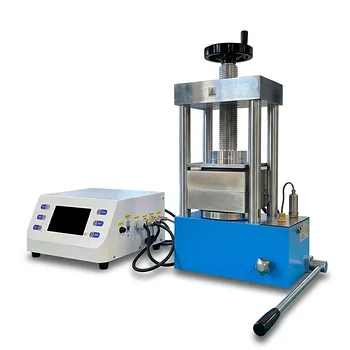
The primary role of a laboratory hydraulic press in manufacturing Diamond/Copper composites is to mechanically stabilize the internal architecture of the preform before sintering. By applying significant force, the press pre-compacts the copper powder surrounding the diamond rods, effectively locking the rods into a fixed vertical position. This prevents the rods from shifting due to powder flow during subsequent handling or the initial phases of vacuum hot pressing, thereby preserving the parallel alignment essential for the material's thermal performance.
The pre-pressing stage acts as a structural anchor for the composite. It transforms loose copper powder and diamond rods into a cohesive "green body," ensuring that the critical parallel arrangement of the diamond components remains intact during the transition from assembly to final sintering.
Ensuring Structural Integrity
Fixing Component Alignment
The most critical function of the hydraulic press in this application is positional fixation. In a Diamond/Copper composite, the diamond rods act as the primary heat-conducting pathways.
If these rods shift or tilt during processing, the thermal conductivity of the final product is compromised. The hydraulic press densifies the copper powder in the gaps between the rods, creating a rigid matrix that holds the diamonds in precise parallel alignment.
Increasing Initial Density
The press applies sufficient force to achieve a specific relative density (often around 75%) in the green compact.
This mechanical compression forces the copper particles to rearrange and pack more tightly. A higher initial density reduces the amount of shrinkage required during the sintering phase and contributes to a more uniform final microstructure.
Process Optimization and Handling
Facilitating Material Transfer
Loose powder combined with inserted rods is extremely fragile and difficult to move.
The hydraulic press transforms these loose components into a solid green compact with sufficient structural strength. This allows operators to safely transfer the preform from the metal forming mold into the graphite mold used for high-temperature sintering without the assembly collapsing or deforming.
Air Expulsion and Particle Contact
The application of hydraulic pressure helps expel the majority of the air trapped between the powder particles.
Removing these air voids promotes better contact between the copper particles and the diamond surface. This intimate contact is a prerequisite for successful sintering and ensures the final composite achieves high dimensional accuracy and structural solidity.
Critical Considerations and Trade-offs
The Balance of Pressure
While high pressure is necessary for density, it must be carefully calibrated.
The goal is to achieve a "green body" strong enough to handle, but the pressure must not damage the brittle diamond rods. The hydraulic press provides the control needed to reach the target density without exceeding the mechanical limits of the diamond inserts.
Green Strength vs. Sintered Strength
It is important to distinguish that the preform created by the hydraulic press has low mechanical strength compared to the final product.
It relies on mechanical interlocking rather than metallurgical bonding. The pre-pressing stage is strictly a preparatory step to facilitate the vacuum hot pressing process, not a replacement for thermal sintering.
Making the Right Choice for Your Goal
To maximize the effectiveness of the pre-pressing stage, consider your primary manufacturing objective:
- If your primary focus is Thermal Conductivity: Prioritize pressure uniformity to ensure the diamond rods remain perfectly parallel, as any deviation here will permanently degrade heat transfer.
- If your primary focus is Dimensional Accuracy: Focus on achieving a consistent and high initial relative density to minimize unpredictable shrinkage during the sintering phase.
By utilizing a laboratory hydraulic press to lock in component geometry, you ensure that the delicate internal structure of the composite survives the manufacturing process intact.
Summary Table:
| Stage | Function of Hydraulic Press | Impact on Final Composite |
|---|---|---|
| Component Fixation | Locks diamond rods in parallel alignment | Ensures maximum thermal conductivity |
| Densification | Compacts copper powder to ~75% relative density | Reduces shrinkage and improves microstructure |
| Structural Integrity | Creates a cohesive "green body" | Allows safe handling and transfer to sintering molds |
| Air Expulsion | Removes air voids between particles | Promotes intimate particle contact for sintering |
Elevate Your Material Research with KINTEK Precision Solutions
Achieving the perfect "green body" density and component alignment is critical for high-performance Diamond/Copper composites. KINTEK specializes in advanced laboratory equipment designed to meet the rigorous demands of material science.
Our comprehensive range of hydraulic presses, including pellet, hot, and isostatic models, provides the precise force control necessary to stabilize delicate architectures without damaging brittle inserts. Beyond pressing, KINTEK offers a full suite of research tools including:
- High-temperature furnaces (Vacuum, CVD, and Muffle) for flawless sintering.
- Crushing, milling, and sieving systems for powder preparation.
- High-temperature high-pressure reactors and autoclaves.
- Specialized consumables like PTFE products, ceramics, and crucibles.
Ready to optimize your composite manufacturing process? Contact our technical experts today to find the ideal equipment for your laboratory.
Related Products
- Laboratory Hydraulic Press Split Electric Lab Pellet Press
- Laboratory Hydraulic Press Lab Pellet Press Machine for Glove Box
- 24T 30T 60T Heated Hydraulic Press Machine with Heated Plates for Laboratory Hot Press
- Automatic Laboratory Hydraulic Press for XRF & KBR Pellet Press
- Automatic Laboratory Hydraulic Pellet Press Machine for Lab Use
People Also Ask
- What role does a laboratory hydraulic press play in platinum recovery research? Enhancing Sample Precision
- What are the specific applications of a lab hydraulic press in biochar evaluation? Optimize density and data accuracy.
- What are the roles of a laboratory hydraulic press and stainless steel molds in the preparation of graphite samples?
- What is the role of a laboratory hydraulic press in electrode prep? Maximize Energy Density & Sealing Precision
- Why must a laboratory hydraulic press equipped with cylindrical molds be used when preparing BZY green bodies? High Density