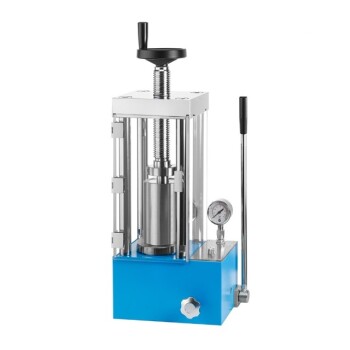
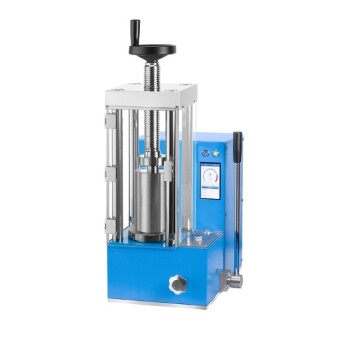
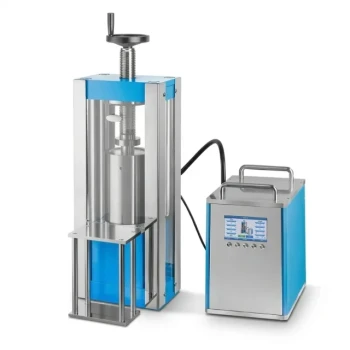
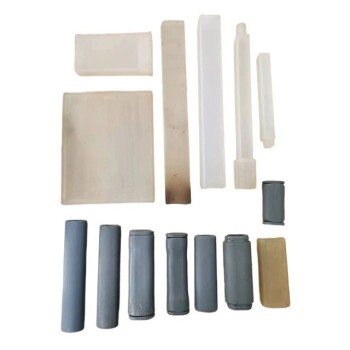
The use of a laboratory hydraulic press in conjunction with rubber tubing facilitates a process known as Cold Isostatic Pressing (CIP) for NdAlGe powder. This method converts the uniaxial force of the press into hydrostatic pressure, which compresses the loose powder uniformly from all directions. By doing so, it creates a "green body" with consistent density and high mechanical strength, which is essential for the material to survive the intense thermal stresses of subsequent high-temperature melting.
This configuration serves as a specialized method for eliminating internal density gradients and air gaps that would otherwise cause the NdAlGe feed rod to crack or collapse. It ensures the powder is transformed into a stable, high-density cylindrical form suitable for advanced crystal growth techniques.
The Mechanics of Isostatic Compression
Converting Uniaxial Force to Hydrostatic Pressure
A standard hydraulic press typically applies uniaxial pressure, meaning the force moves in a single direction. By placing the NdAlGe powder inside rubber tubing, the tubing acts as a flexible membrane that translates this downward force into hydrostatic pressure (up to 40 MPa).
Eliminating Density Gradients
Unlike rigid molds, which can cause friction and uneven packing, the flexible tubing ensures that pressure is distributed equally across the entire surface of the powder. This eliminates "soft spots" or density gradients within the rod, resulting in a homogeneous internal structure that is critical for repeatable experimental results.
The Removal of Internal Voids
The high pressure applied by the hydraulic press drives particle rearrangement and expels air trapped between the powder grains. This mechanical compression forces the NdAlGe particles into tight contact, creating a high-density green compact with defined geometric stability.
Ensuring Integrity for Downstream Processing
Preparation for Floating Zone Melting
NdAlGe powder is often prepared for the floating zone melting process, a technique used for crystal growth that involves extreme temperatures. If the initial feed rod contains air gaps or uneven density, it will likely fracture or undergo localized collapse when subjected to the thermal gradients of the melting zone.
Achieving Necessary Mechanical Strength
The "green body" produced by this pressing method must have sufficient initial mechanical strength to be handled and mounted in a furnace. Without the structural integrity provided by the hydraulic press, the rod would be too brittle to maintain its shape during the transition from loose powder to a solid crystalline structure.
Preventing Cracks and Deformations
Consistent density is the primary defense against cracks and deformations caused by thermal expansion and contraction. By ensuring the contact points between particles are uniform, the material can better distribute heat, preventing the internal stresses that lead to structural failure.
Understanding the Trade-offs
Pressure Limits and Material Constraints
While this method is highly effective for laboratory-scale research, it is limited by the elasticity and durability of the rubber tubing. If the pressure exceeds the tubing's limit, the mold may rupture, leading to powder contamination or an unevenly shaped green body.
Geometric Limitations
Isostatic pressing with rubber tubing is ideal for cylindrical forms but becomes increasingly difficult for complex geometries. Researchers must ensure the powder is packed evenly within the tube before pressing to avoid "waisting" or bending of the rod under high pressure.
Manual vs. Automated Systems
This setup is a cost-effective way to achieve isostatic results using a standard laboratory press, but it requires precise manual control. Small errors in the alignment of the press or the sealing of the tubing can result in a compact that lacks the necessary density for successful melting.
How to Apply This to Your Project
Making the Right Choice for Your Goal
To achieve the best results with NdAlGe or similar metal powders, consider your primary objective:
- If your primary focus is uniform density: Ensure the rubber tubing is completely submerged in a fluid medium or perfectly aligned to allow the hydraulic press to distribute pressure evenly around the circumference of the rod.
- If your primary focus is preventing rod fracture: Focus on maximizing the pressure (up to the recommended 40 MPa) to ensure the green body has the highest possible initial packing density.
- If your primary focus is experimental repeatability: Carefully document the axial pressure applied by the hydraulic press to ensure consistent heat exchange data during the subsequent melting kinetics phase.
The combination of controlled hydraulic pressure and flexible encapsulation is the most reliable way to transform sensitive powders into the high-integrity structures required for advanced material science.
Summary Table:
| Feature/Component | Role in the Pressing Process | Benefit for NdAlGe Powder |
|---|---|---|
| Laboratory Hydraulic Press | Provides controlled uniaxial force | Ensures repeatable mechanical compression levels |
| Rubber Tubing | Acts as a flexible hydrostatic membrane | Translates force into equal pressure from all directions |
| Isostatic Pressure | Eliminates internal density gradients | Prevents rod fracture during high-temperature melting |
| High-Density Compact | Removes air gaps and voids | Creates a stable "green body" for crystal growth |
Elevate Your Material Research with KINTEK
Achieving perfect structural integrity for sensitive materials like NdAlGe requires precision and the right tools. KINTEK specializes in high-performance laboratory equipment designed for the most demanding research environments.
Whether you need robust hydraulic presses (pellet, hot, isostatic) to create high-density green bodies or high-temperature furnaces (muffle, vacuum, CVD) for advanced crystal growth, our portfolio is built to ensure your experimental repeatability. We also offer a full range of crushing and milling systems, PTFE and ceramic consumables, and cooling solutions to support every stage of your workflow.
Don't let density gradients or material fractures compromise your results. Contact KINTEK today to find the ideal equipment configuration for your lab and experience the reliability that leading researchers trust.
References
- Naoki Kikugawa, Shinya Uji. Bulk Physical Properties of a Magnetic Weyl Semimetal Candidate NdAlGe Grown by a Laser Floating-Zone Method. DOI: 10.3390/inorganics11010020
This article is also based on technical information from Kintek Solution Knowledge Base .
Related Products
- Warm Isostatic Press for Solid State Battery Research
- Automatic Lab Cold Isostatic Press CIP Machine Cold Isostatic Pressing
- Manual Cold Isostatic Pressing Machine CIP Pellet Press
- Electric Lab Cold Isostatic Press CIP Machine for Cold Isostatic Pressing
- Electric Split Lab Cold Isostatic Press CIP Machine for Cold Isostatic Pressing
People Also Ask
- What is the temperature of a warm isostatic press? Achieve Optimal Densification for Your Materials
- What is the function of a Warm Isostatic Press (WIP) in all-solid-state pouch cells? Optimize Battery Density
- Why are Warm Isostatic Presses (WIP) necessary for solid-state batteries? Achieve Atomic-Level Contact
- What advantages does a warm isostatic press offer over a traditional uniaxial press for Li6PS5Cl electrolyte sheets?
- How do warm isostatic presses improve dry electrode performance? Enhance ASSB Conductivity with Heat & Pressure