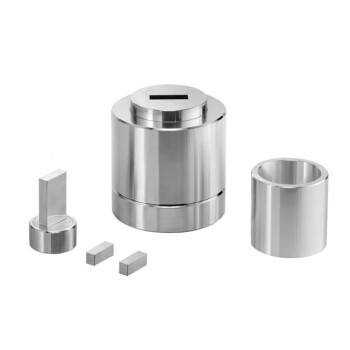
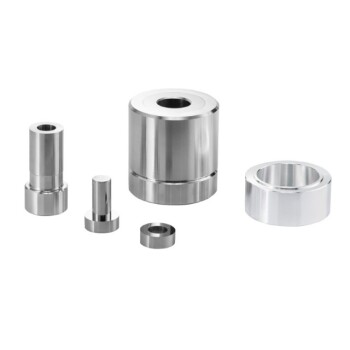
To ensure the viability of sulfide electrolytes, applying a manufacturing pressure of 510 MPa is a critical requirement for achieving specific relative density targets—90% for Li3PS4 and 81% for Na3PS4. This high-pressure cold-pressing technique mechanically forces powder particles together to create a dense, cohesive pellet. By reaching these density thresholds, researchers can secure necessary ionic conductivity and mechanical strength without subjecting the volatile sulfide materials to high-temperature sintering.
Core Takeaway High-pressure densification at 510 MPa is the primary mechanism for transforming loose Li3PS4 and Na3PS4 powders into functional solid-state electrolytes. It serves as a direct substitute for thermal sintering, maximizing ionic conductivity by physically eliminating porosity and creating continuous transport channels.
The Critical Role of Relative Density
Meeting the 90% Threshold for Li3PS4
For Li3PS4 electrolytes, the target performance metrics are inextricably linked to the physical density of the pellet. When processed at 510 MPa, these materials achieve a relative density of 90%.
Compacting Na3PS4 Effectively
Similarly, Na3PS4 requires this substantial pressure to reach a relative density of 81%. Without this specific level of compaction, the material remains too porous to function effectively as a solid-state electrolyte.
Overcoming Particle Friction
At lower pressures, friction between sulfide particles prevents them from packing tightly. The application of 510 MPa overcomes this inter-particle friction, forcing the powder to rearrange and deform into a solid mass.
Enhancing Ionic Performance
Establishing Continuous Ion Channels
The primary goal of densification is to create a pathway for ions to move freely. High manufacturing pressure eliminates the voids and gaps between particles that typically block ion flow.
Maximizing Conductivity
By reducing porosity, the hydraulic press ensures that the internal structure of the pellet consists of continuous, contacting material. This structural continuity is a prerequisite for high ionic conductivity in solid-state batteries.
Improving Contact Area
The compaction process maximizes the contact area between individual powder grains. This increased surface contact reduces grain boundary resistance, which is often the bottleneck in electrolyte performance.
Eliminating Thermal Processing
The Advantage of Cold-Pressing
Unlike oxide-based ceramics that often require high heat to sinter, sulfide electrolytes like Li3PS4 and Na3PS4 can be processed at room temperature using high pressure. This preserves the chemical composition of the sulfides, which can be sensitive to thermal degradation.
Mechanical Integrity Without Sintering
The pressure of 510 MPa provides sufficient mechanical interlocking to hold the pellet together. This yields a "green body" with enough structural integrity to withstand handling and testing without the need for a firing step.
Understanding the Trade-offs
Elastic Recovery Issues
While high pressure is necessary, sulfide particles exhibit elasticity. After the pressure is released, the material may attempt to spring back to its original shape, potentially causing micro-cracks or lamination if the pressure release is not controlled.
Diminishing Returns
There is a limit to how much density can be achieved solely through pressure. While 510 MPa achieves high density (90% for Li3PS4), pushing significantly beyond this may stress laboratory equipment without yielding proportional gains in conductivity.
Equipment Constraints
Generating 510 MPa requires specialized, high-tonnage hydraulic presses. Standard laboratory presses designed for softer materials may not be capable of safely maintaining this pressure, necessitating robust, purpose-built tooling.
Making the Right Choice for Your Goal
When preparing solid-state electrolytes, your processing parameters must align with your specific material constraints.
- If your primary focus is maximizing ionic conductivity: Prioritize pressures near 510 MPa to minimize porosity and ensure continuous ion transport channels are fully established.
- If your primary focus is material stability: Rely on this high-pressure cold-pressing method to avoid the chemical degradation risks associated with high-temperature sintering.
By utilizing precise high-pressure environments, you ensure the creation of an electrolyte pellet that is both mechanically robust and electrochemically efficient.
Summary Table:
| Electrolyte Material | Applied Pressure | Target Relative Density | Primary Benefit |
|---|---|---|---|
| Li3PS4 | 510 MPa | 90% | Maximum ionic conductivity and porosity elimination |
| Na3PS4 | 510 MPa | 81% | Enhanced mechanical integrity and ion transport |
| General Sulfides | 510 MPa | High | Cold-pressing alternative to high-temp sintering |
Elevate Your Battery Research with Precision Engineering
To achieve the 510 MPa thresholds required for high-performance Li3PS4 and Na3PS4 electrolyte pellets, your lab needs equipment that delivers consistent, high-tonnage force. KINTEK specializes in advanced laboratory hydraulic presses (pellet, hot, and isostatic) and crushing systems designed to meet the rigorous demands of solid-state battery development.
From high-temperature reactors to specialized battery research tools and consumables, we provide the end-to-end solutions necessary to eliminate porosity and maximize ionic conductivity in your materials. Ensure the mechanical and electrochemical integrity of your samples with our robust, purpose-built laboratory equipment.
Ready to optimize your densification process? Contact KINTEK today to find the perfect hydraulic press for your research!
Related Products
- Automatic Laboratory Hydraulic Pellet Press Machine for Lab Use
- Laboratory Manual Hydraulic Pellet Press for Lab Use
- Laboratory Hydraulic Press Split Electric Lab Pellet Press
- Laboratory Manual Hydraulic Pellet Press for Lab Use
- Automatic Laboratory Hydraulic Press for XRF & KBR Pellet Press
People Also Ask
- What is the role of a laboratory hydraulic pellet press and stainless steel molds in the fabrication of RuO2/NbC anodes?
- What role does a laboratory pellet press play in the enhancement of biomass energy products? Optimize Fuel Efficiency
- What is the purpose of using a laboratory pellet press when evaluating the electronic conductivity of carbon powders? Guide
- How does a laboratory hydraulic pellet press contribute to SiCw/2024 aluminum composite preforms? Optimize Densification
- What is the significance of applying 200 MPa of pressure with a laboratory hydraulic pellet press for composite ceramics?