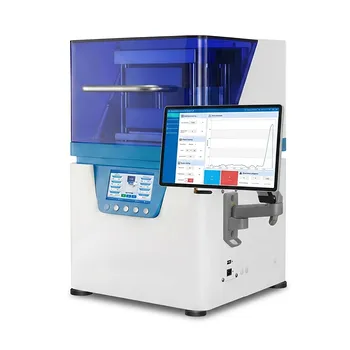
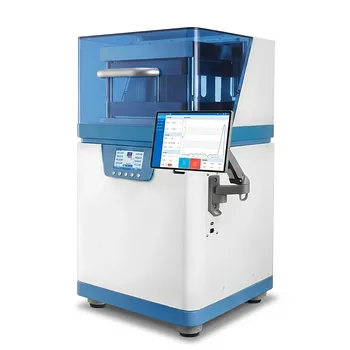
The primary reason a laboratory hydraulic press is used for nickel-aluminum and alumina samples is to transform loose powders into a high-density "green body" with specific geometric dimensions. By applying controlled, uniaxial pressure, the press forces powder particles to rearrange and deform, creating a structurally sound compact. This process is essential for establishing the particle-to-particle contact required for successful high-temperature sintering and mechanical testing.
The laboratory hydraulic press serves as the bridge between raw powder and a solid material, using high-precision pressure to maximize initial density and mechanical strength. This ensures that the samples can withstand handling and undergo uniform densification during the sintering process.
Enhancing the Structural Foundation of Green Bodies
Maximizing Initial Packing Density
A hydraulic press applies significant force—often ranging from 20 MPa to 300 MPa—to significantly increase the density of the powder mixture. High pressure forces particles into a closer arrangement, reducing the volume of empty space between them. This high initial density is a critical prerequisite for achieving a final product with high average density and minimal porosity.
Mechanical Interlocking and Plastic Deformation
At high pressures, the powder particles undergo plastic deformation and physical displacement. This causes the particles to interlock and "hook" into one another at room temperature. This interlocking provides the green strength necessary for the sample to maintain its shape during handling and placement into a sintering furnace.
Ensuring Precision and Reproducibility
Air Expulsion and Void Management
The application of constant, high pressure effectively expels trapped air from within the powder mixture. Removing air pockets reduces the risk of cracking and internal flaws during the subsequent heating stages. This controlled environment allows researchers to create samples with highly uniform internal structures.
Dimensional Accuracy and Shape Retention
Using a hydraulic press with high-precision molds ensures that every sample has consistent dimensions, such as specific diameters and thicknesses. This accuracy is vital for comparative experiments where standardized specimens are required for mechanical or thermal testing. Precise control over the hydraulic system allows for the creation of repeatable data benchmarks, eliminating the errors associated with manual forming.
Facilitating the Sintering Process
Increasing Particle Contact Area
Sintering relies on atomic diffusion between particles, which only occurs at contact points. The press increases the contact area between nickel-aluminum or alumina particles, creating the physical foundation for effective material bonding at high temperatures. This increased contact significantly reduces shrinkage and deformation during the final firing process.
Enhancing Thermal and Chemical Efficiency
By pre-shaping powders into dense ingots or pellets, the heat conduction efficiency is improved during thermal treatments. A well-compacted green body ensures that heat is distributed more evenly through the material. This consistency is crucial for achieving the desired refractory properties or alloy characteristics in nickel-aluminum and alumina ceramics.
Understanding the Trade-offs
Internal Friction and Density Gradients
While high pressure increases density, internal friction between powder particles and the mold walls can create density gradients. This means the center of a sample may be less dense than the edges. If not managed with proper lubrication or mold design, these gradients can lead to uneven shrinkage or warping during sintering.
The Risk of Over-Pressing
Applying excessive pressure can lead to a phenomenon known as "spring-back," where the material expands slightly when removed from the mold. In brittle materials like alumina, this expansion can cause micro-cracking or "lamination" (layering). It is essential to find the specific pressure threshold that maximizes density without compromising the structural integrity of the green body.
How to Apply This to Your Project
When preparing your samples, the pressure settings should be tailored to your specific material properties and desired outcomes.
- If your primary focus is high-strength ceramics: Utilize higher pressures (up to 300 MPa) to ensure maximum particle deformation and the highest possible green density.
- If your primary focus is studying porosity or thermal conductivity: Use the press’s manual control to apply specific low pressures, intentionally retaining a calculated volume of voids.
- If your primary focus is dimensional stability: Ensure the use of high-precision stainless steel molds and consistent pressure dwell times to minimize sample-to-sample variation.
The strategic use of a laboratory hydraulic press ensures that your material synthesis begins with a structurally sound, high-density foundation, which is the single most important factor for predictable sintering results.
Summary Table:
| Key Function | Impact on Ni-Al & Alumina Samples | Critical Metric/Outcome |
|---|---|---|
| Densification | Maximizes initial packing & minimizes porosity | 20 MPa to 300 MPa pressure |
| Green Strength | Enables mechanical interlocking for safe handling | Structural integrity post-pressing |
| Void Removal | Expels trapped air to prevent internal cracking | Uniform internal structure |
| Dimensional Control | Ensures repeatable geometry for comparative tests | High-precision mold accuracy |
| Sintering Prep | Increases particle contact area for diffusion | Reduced shrinkage & deformation |
Elevate Your Material Research with KINTEK Precision
Achieving a flawless green body is the critical first step in advanced material synthesis. KINTEK specializes in high-performance laboratory solutions designed to give you total control over your sample preparation. Whether you are developing nickel-aluminum alloys or alumina ceramics, our comprehensive range of laboratory hydraulic presses (pellet, hot, and isostatic) and high-precision molds ensures maximum density and structural integrity every time.
Beyond pressing, KINTEK supports your entire workflow with:
- Thermal Processing: Muffle, tube, vacuum, and atmosphere furnaces for perfect sintering.
- Sample Preparation: Crushing, milling, and sieving systems to achieve the ideal powder consistency.
- Specialized Tools: High-pressure reactors, electrolytic cells, and battery research consumables.
- Essential Labware: High-quality PTFE products, ceramics, and crucibles.
Ready to optimize your lab's efficiency and sample quality?
Contact our specialists today to find the perfect equipment for your project!
References
- C Rakesh, Amandeep Nagpal. RETRACTED: Multiscale Characterization of Microstructural Evolution in Powder Metallurgy and Ceramic Forming Processes. DOI: 10.1051/e3sconf/202343001128
This article is also based on technical information from Kintek Solution Knowledge Base .
Related Products
- Laboratory Hydraulic Press Split Electric Lab Pellet Press
- Laboratory Hydraulic Press Lab Pellet Press Machine for Glove Box
- Laboratory Hydraulic Press Lab Pellet Press for Button Battery
- Automatic Laboratory Hydraulic Pellet Press Machine for Lab Use
- Fully Automatic Heated Hydraulic Lab Press for Materials Sintering and Sample Preparation
People Also Ask
- What are the roles of a laboratory hydraulic press and stainless steel molds in the preparation of graphite samples?
- What is the role of a laboratory hydraulic press in electrode prep? Maximize Energy Density & Sealing Precision
- How does a laboratory hydraulic press ensure the quality of alumina-forming alloy green bodies? Optimize CSP Research
- How is a laboratory hydraulic press used to evaluate the mechanical performance of nano-modified concrete? Expert Guide
- Why is a laboratory hydraulic press used for ASSB assembly? Achieving 392 MPa for Optimal Solid-State Battery Density