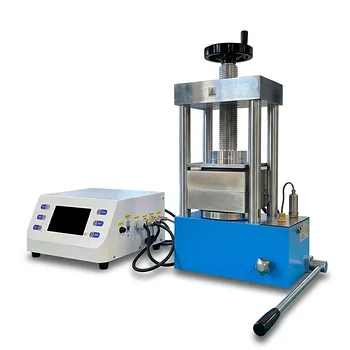
The application of high uniaxial pressure is the fundamental step in establishing the structural integrity of LLZTO electrolytes. A laboratory hydraulic press is used to subject synthesized LLZTO powder to significant force, typically around 300 MPa, to compress it into a dense "green" pellet. This mechanical compression drastically reduces the empty space between particles, serving as the critical prerequisite for achieving a high-performance ceramic.
Core Takeaway The hydraulic press does not just shape the powder; it determines the material's potential for densification. By maximizing the initial density and minimizing porosity in the green state, high-pressure treatment ensures the material can reach over 90 percent of its theoretical density and achieve strong grain bonding during the subsequent sintering process.
The Mechanics of Densification
Reducing Inter-Particle Porosity
Synthesized LLZTO powder naturally contains significant voids and air gaps between individual particles. If these voids are not removed prior to heating, they often remain as defects in the final product.
The hydraulic press applies uniaxial force to physically crush these voids. This significantly increases the packing density of the green pellet, ensuring that the volume is occupied by active material rather than air.
Enhancing Particle Contact
For a solid-state electrolyte to function, ions must move seamlessly from one grain to another. The high pressure forces loose powder particles into intimate physical contact.
This increased contact area is vital for the next stage of manufacturing. It shortens the diffusion distance between particles, facilitating the atomic movement required to fuse the grains together.
The Link to Sintering Success
Enabling High Final Density
The quality of the final sintered ceramic is directly dependent on the quality of the green pellet. A low-density green pellet generally results in a porous final product with poor performance.
By using high pressure (approx. 300 MPa) to create a dense green compact, you set the stage for the material to achieve a relative density of over 90 percent after sintering. This high density is non-negotiable for achieving the ionic conductivity required for battery applications.
Promoting Grain Bonding
Sintering is a thermal process where particles bond and densify. However, heat alone is often insufficient if the particles are not already tightly packed.
The initial compaction provided by the hydraulic press ensures that the particles are close enough to undergo strong grain bonding. Without this initial mechanical densification, the material would likely suffer from weak structural integrity and disconnected ion pathways.
Understanding the Trade-offs
The Necessity of Specific Pressure
Applying pressure is not a case of "more is always better," but rather applying the correct amount of force.
The primary reference indicates that roughly 300 MPa is the target for LLZTO. Pressure significantly lower than this may result in a "soft" green pellet that crumbles or fails to densify during sintering.
Conversely, while not explicitly detailed in the primary text, standard ceramic processing dictates that excessive pressure can lead to elastic recovery issues, where the pellet expands and cracks upon ejection from the die. Adhering to the specific pressure requirements of the material is essential for balancing density with structural stability.
Making the Right Choice for Your Goal
To optimize your LLZTO preparation, tailor your pressing parameters to your specific outcome:
- If your primary focus is High Ionic Conductivity: Ensure your press is capable of delivering at least 300 MPa to guarantee the green density required for >90% final relative density.
- If your primary focus is Mechanical Strength: Prioritize the reduction of inter-particle porosity during the pressing stage to prevent micro-cracks and weak grain boundaries in the final ceramic.
- If your primary focus is Process Consistency: Use a hydraulic press that allows for precise, repeatable pressure control to ensure every batch starts with the exact same initial density.
Ultimately, the hydraulic press bridges the gap between loose powder and a solid, conductive electrolyte by mechanically enforcing the particle proximity required for successful sintering.
Summary Table:
| Parameter | Influence on LLZTO Pellets | Benefit for Sintering |
|---|---|---|
| Uniaxial Pressure | Typically 300 MPa | Establishes critical green density |
| Inter-particle Porosity | Crushes air voids & gaps | Prevents defects in the final ceramic |
| Particle Contact | Maximizes surface-to-surface contact | Shortens atomic diffusion distance |
| Target Density | >90% of theoretical density | Ensures high ionic conductivity |
| Grain Bonding | Mechanically forces particles together | Promotes strong structural integrity |
Elevate Your Battery Research with KINTEK Precision
Achieving the perfect LLZTO electrolyte requires more than just powder—it requires precise, repeatable mechanical densification. KINTEK specializes in high-performance laboratory hydraulic presses (pellet, hot, and isostatic) designed to deliver the exact uniaxial force needed for superior green pellet integrity.
From high-temperature furnaces and crushing systems to specialized battery research tools and consumables, we provide the end-to-end solutions necessary for advanced material science. Contact KINTEK today to discover how our equipment can enhance your lab's efficiency and ensure your ceramics meet the highest standards of conductivity and strength.
Related Products
- Laboratory Hydraulic Press Split Electric Lab Pellet Press
- Automatic Laboratory Hydraulic Pellet Press Machine for Lab Use
- Manual Lab Heat Press
- Laboratory Hydraulic Pellet Press for XRF KBR FTIR Lab Applications
- Laboratory Hydraulic Press Lab Pellet Press Machine for Glove Box
People Also Ask
- What role does a laboratory hydraulic press play in platinum recovery research? Enhancing Sample Precision
- What are the specific applications of a lab hydraulic press in biochar evaluation? Optimize density and data accuracy.
- What are the roles of a laboratory hydraulic press and stainless steel molds in the preparation of graphite samples?
- What is the role of a laboratory hydraulic press in electrode prep? Maximize Energy Density & Sealing Precision
- Why must a laboratory hydraulic press equipped with cylindrical molds be used when preparing BZY green bodies? High Density