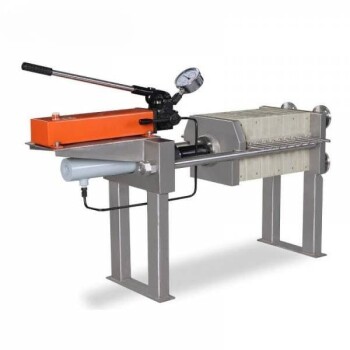
A laboratory hydraulic press serves as the definitive mechanism for bonding active materials to current collectors. It is utilized to forcefully compress a specific mixture of graphene, acetylene black, and a PTFE binder onto one side of a 3D nickel foam substrate. By applying high, controlled pressure, the press transforms loose components into a robust, integrated electrode structure.
The application of precise pressure, such as 1000 kg/cm², is essential to maximize electrical contact and mechanical adhesion. Without this compression, the bio-anode would suffer from high internal resistance and structural failure when exposed to wastewater environments.
Optimizing Electrochemical Efficiency
Reducing Interfacial Resistance
The primary technical challenge in fabricating graphene-enhanced anodes is ensuring a conductive path for electrons.
A hydraulic press forces the graphene and acetylene black mixture into intimate contact with the nickel foam. This tight packing significantly reduces interfacial resistance between the active material and the conductive substrate.
Ensuring Efficient Charge Transfer
Bio-batteries rely on the seamless movement of charge carriers.
By eliminating microscopic gaps through compression, the press ensures efficient charge transfer. This allows the anode to perform effectively as an electron acceptor in biological fuel cells.
Achieving Structural Integrity
Mechanical Adhesion
Bio-anodes often operate in challenging physical environments, such as flowing wastewater.
The hydraulic press activates the binding properties of the PTFE and locks the carbon-based mixture onto the 3D nickel foam. This creates strong mechanical adhesion, preventing the active material from sloughing off during operation.
Uniform Density Distribution
Consistency across the electrode surface is vital for reliable performance.
Much like in ceramic powder compaction, the hydraulic press ensures the particles are tightly arranged without density gradients. This prevents weak spots that could lead to localized failure or uneven current distribution.
Operational Considerations and Trade-offs
The Balance of Pressure
While high pressure is necessary for conductivity, it must be carefully calibrated.
Insufficient pressure leads to poor adhesion and high resistance. Conversely, excessive force could crush the porous structure of the 3D nickel foam, reducing the surface area available for biological reactions. The target pressure of 1000 kg/cm² represents a specific optimization for this material set.
Making the Right Choice for Your Goal
When configuring a molding process for bio-anodes, your pressure parameters should align with your specific performance targets.
- If your primary focus is Electrical Conductivity: Prioritize higher pressures within the substrate's tolerance to minimize contact resistance and maximize electron flow.
- If your primary focus is Mechanical Durability: Focus on the consistency of the pressure application to ensure the binder (PTFE) effectively locks the material into a unified mass that resists erosion.
Precision compression is the bridge between a loose mixture of chemicals and a high-performance, functionally stable bio-anode.
Summary Table:
| Feature | Impact on Bio-Anode Performance | Key Mechanism |
|---|---|---|
| High Pressure (1000 kg/cm²) | Maximizes electrical contact and mechanical bonding | Particle compaction onto 3D nickel foam |
| Interfacial Resistance | Significantly reduced for better electron flow | Elimination of microscopic gaps between materials |
| PTFE Binder Activation | Enhances structural integrity in wastewater | Pressure-induced locking of carbon-based mixtures |
| Uniform Density | Prevents localized failure and uneven current | Consistent particle arrangement across electrode |
Elevate Your Battery Research with KINTEK Precision
To achieve superior electrochemical efficiency, your materials require the precise application of force. KINTEK specializes in advanced laboratory solutions, offering a robust range of hydraulic presses (pellet, hot, and isostatic) engineered for high-performance electrode fabrication.
Whether you are developing graphene-enhanced bio-anodes or advanced solid-state batteries, our equipment ensures optimal density distribution and structural integrity for your research. Beyond pressing, KINTEK provides a comprehensive ecosystem of tools, including high-temperature furnaces, high-pressure reactors, and specialized battery research consumables.
Ready to minimize resistance and maximize your lab's output? Contact KINTEK today to find the perfect hydraulic press and laboratory equipment for your specific application requirements.
References
- Sambhu Sapkota, Venkataramana Gadhamshetty. Graphene-Infused Hybrid Biobattery–Supercapacitor Powered by Wastewater for Sustainable Energy Innovation. DOI: 10.3390/inorganics12030084
This article is also based on technical information from Kintek Solution Knowledge Base .
Related Products
- Laboratory Hydraulic Press Lab Pellet Press Machine for Glove Box
- Laboratory Hydraulic Press Split Electric Lab Pellet Press
- Laboratory Hydraulic Press Lab Pellet Press for Button Battery
- Automatic Laboratory Hydraulic Press for XRF & KBR Pellet Press
- Automatic Laboratory Hydraulic Pellet Press Machine for Lab Use
People Also Ask
- What is the function of a laboratory hydraulic press in W-Cu composites? Control Porosity and Material Ratio
- What is the role of a laboratory hydraulic press in the initial stages of Li6PS5Cl preparation? Key to Green Pellets
- What role does a laboratory hydraulic press play in triboelectric testing? Achieve Precision Alloy Sample Prep
- How can a laboratory hydraulic press be applied to chitosan for wastewater treatment? Optimize Pores & Strength
- How do a precision laboratory hydraulic press and specialized molds contribute to the fabrication of spherical ceramic samples? Achieving High-Density Material Precision