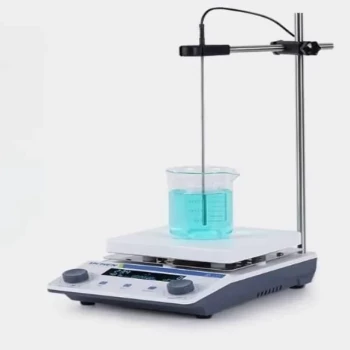
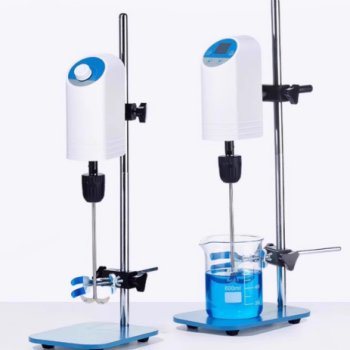
During the flocculation stage following electrocoagulation, a magnetic stirrer is utilized at specific, low rotation speeds to create a precise hydrodynamic environment.
While high-speed mixing is used for chemical reactions, flocculation requires a gentle, controlled velocity gradient (often around 40 rpm). This specific speed encourages microscopic particles generated during electrolysis to collide and stick to pollutants, forming larger aggregates (flocs), without generating turbulence strong enough to tear these fragile formations apart.
The effectiveness of flocculation relies on a delicate balance of forces: the agitation must be sufficient to induce particle collisions, yet gentle enough to prevent shear forces from shattering the newly formed flocs.
The Physics of Particle Aggregation
Promoting Essential Collisions
Electrocoagulation releases microscopic coagulant particles into the water. For these particles to clean the water, they must physically contact the pollutants.
Overcoming Distance
Without external energy, these particles would remain suspended and separate. The magnetic stirrer introduces kinetic energy, forcing the particles to travel and collide with one another.
Formation of Settlable Flocs
As these collisions occur, the particles aggregate into larger clusters known as flocs. Increasing the size of these flocs is the primary goal, as larger masses settle faster and are easier to separate from the clean water.
The Critical Role of Controlled Speed
The Velocity Gradient (G-Value)
The technical purpose of the stirrer is to provide a specific "velocity gradient," often referred to as the G-value. This value represents the intensity of mixing relative to the volume of fluid.
Why Specific Speeds Matter
Specific speeds, such as 40 rpm, are chosen to optimize this G-value. This speed provides just enough fluid motion to maximize the probability of particles bumping into each other.
Contrast with Reaction Mixing
It is important to distinguish this stage from general chemical mixing. While a laboratory stirrer might run at 1000 rpm to eliminate concentration gradients and accelerate reactions during the initial mixing phase, such speeds are destructive during flocculation.
Understanding the Trade-offs: Shear vs. Growth
The Danger of Shear Forces
If the rotation speed is too high, the stirrer acts as a blender rather than an aggregator. High speeds create intense shear forces in the liquid.
Shear-Induced Breakage
These shear forces can strip particles away from the growing flocs. If the shear force exceeds the strength of the bond holding the floc together, the aggregate will break apart.
Impact on Sedimentation
Once flocs are broken by over-mixing, they revert to smaller sizes that do not settle effectively. This directly reduces the efficiency of the subsequent sedimentation process, leaving pollutants suspended in the water.
The Risk of Under-Mixing
Conversely, if the speed is too low, the particles will not collide frequently enough. The flocs will never grow large enough to settle out of the solution efficiently.
Optimizing Your Process Strategy
To maximize the efficiency of your water treatment process, you must adjust the stirring intensity based on the specific stage of treatment.
- If your primary focus is initial chemical reaction: Utilize high speeds (e.g., 1000 rpm) to ensure uniform mixing and eliminate thermal or concentration gradients.
- If your primary focus is floc growth and separation: Reduce speed significantly (e.g., 40 rpm) to promote aggregation while avoiding shear-induced breakage.
By treating rotation speed as a precise variable rather than a binary setting, you ensure the physical stability required for effective pollutant separation.
Summary Table:
| Mixing Stage | Typical Speed (RPM) | Primary Objective | Physical Outcome |
|---|---|---|---|
| Electrocoagulation | High (800 - 1000+) | Chemical Reaction | Uniform distribution of coagulants |
| Flocculation | Low (20 - 40) | Particle Aggregation | Formation of large, settlable flocs |
| Excessive Speed | > 100 RPM | High Shear | Floc breakage & poor sedimentation |
| Inadequate Speed | < 10 RPM | Low Collision Rate | Minimal growth of aggregates |
Maximize Your Lab’s Precision with KINTEK
Precise control over hydrodynamic environments is essential for successful electrocoagulation and flocculation. At KINTEK, we specialize in providing high-performance laboratory equipment designed for the most demanding research applications.
Whether you need advanced magnetic stirrers for delicate flocculation, high-temperature furnaces, electrolytic cells, or hydraulic presses for material synthesis, our comprehensive portfolio is engineered for accuracy and durability. From battery research tools to specialized ceramics and crucibles, KINTEK supports your entire workflow.
Ready to optimize your separation efficiency? Contact our technical experts today to discover how our premium laboratory solutions can enhance your research outcomes.
References
- Emily K. Maher, Patrick J. McNamara. Removal of Estrogenic Compounds from Water Via Energy Efficient Sequential Electrocoagulation-Electrooxidation. DOI: 10.1089/ees.2019.0335
This article is also based on technical information from Kintek Solution Knowledge Base .
Related Products
- Laboratory Small Constant Temperature Heated Magnetic Stirrer Heater and Stirrer
- Custom PTFE Teflon Parts Manufacturer for Magnetic Stirring Bar
- High Performance Laboratory Stirrers for Diverse Applications
- Three-dimensional electromagnetic sieving instrument
- Custom PTFE Teflon Parts Manufacturer for PTFE Stirring Bar Recovery Rod
People Also Ask
- What role does a magnetic stirrer with heating play in ZnO nanoparticle synthesis? Precision Control for Quality Results
- What role does a constant temperature heating magnetic stirrer play in MFC-HAp synthesis? Achieve Material Homogeneity
- What is the function of a laboratory magnetic stirrer in Ni–Cr–P electrodeposition? Optimize Ion Transport & Coating
- Why is a laboratory magnetic stirrer required for benzoic acid esters? Boost Reaction Speed & Yield with High RPM
- What role does a laboratory magnetic stirrer play in TiO2 and TiO2-Ag sol preparation? Master Chemical Kinetics