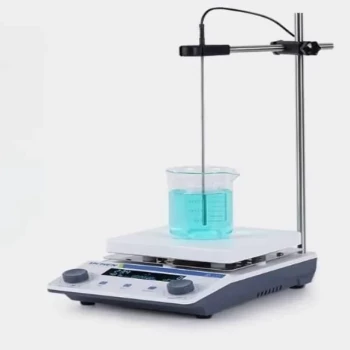
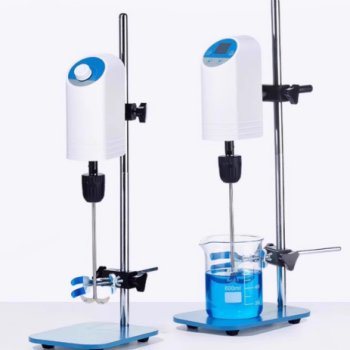
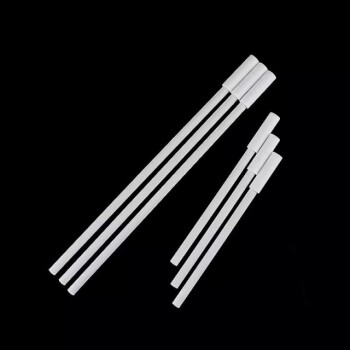
The primary function of a magnetic stirrer in the MWCNTs/TiO2 sol-gel process is to generate continuous and uniform shear forces within the mixture. This mechanical action ensures that titanium precursors, such as titanium isopropoxide, achieve thorough contact with the Multi-Walled Carbon Nanotubes (MWCNTs).
The magnetic stirrer acts as the critical stabilizing agent during synthesis, bridging the gap between raw precursors and a cohesive material. It facilitates essential chemical reactions while preventing component separation, ensuring the final composite is structurally uniform.
The Mechanics of Interaction
Generating Shear Forces
The magnetic stirrer provides constant mechanical energy to the solution.
This creates continuous shear forces that physically force the liquid components to interact.
Without this active agitation, the components would likely remain static, preventing the necessary molecular interactions.
Facilitating Precursor Contact
For the composite to form correctly, the titanium source must coat or interact with the carbon nanotubes.
The stirring action ensures thorough contact between the titanium isopropoxide and the MWCNTs.
This contact is the prerequisite for the chemical integration of the two distinct materials.
Driving Chemical Reactions
The sol-gel process relies on specific chemical transformations, primarily hydrolysis and polycondensation.
Magnetic stirring facilitates these reactions by constantly refreshing the interface between reactants.
This ensures the chemical conversion proceeds efficiently across the entire volume of the solution, rather than just in localized pockets.
Ensuring Colloidal Stability
Maintaining System Equilibrium
A sol-gel mixture is a colloidal system that requires delicate balance.
By precisely controlling the stirring speed, you maintain the stability of this colloidal system.
This control prevents the mixture from destabilizing, which could lead to inconsistent material properties.
Preventing Agglomeration
Nanotubes and precipitating particles have a natural tendency to clump together or settle.
The continuous motion prevents localized agglomeration of components.
This ensures the MWCNTs remain dispersed rather than forming clusters that would weaken the final composite.
Achieving Component Uniformity
The ultimate goal of the stirring process is homogeneity.
The result is a primary composite sol with a highly uniform distribution of both titanium dioxide and carbon nanotubes.
This uniformity in the liquid phase translates directly to the structural integrity of the final solid material.
Understanding the Trade-offs
The Necessity of Precision
While stirring is essential, the speed cannot be arbitrary.
The process requires precise speed control to match the viscosity and reaction kinetics of the specific sol.
Inadequate stirring leads to separation, while excessive or erratic stirring could disrupt the delicate formation of the gel network.
Making the Right Choice for Your Goal
To optimize your sol-gel synthesis, align your stirring parameters with your specific objectives:
- If your primary focus is Structural Integrity: Ensure the stirring speed is sufficient to prevent MWCNT agglomeration, guaranteeing a uniform internal structure.
- If your primary focus is Chemical Conversion: Focus on continuous, steady agitation to maximize the contact time between titanium isopropoxide and the nanotubes for complete hydrolysis.
Uniform shear force is the key to transforming raw precursors into a stable, high-performance nanocomposite.
Summary Table:
| Key Function | Role in Sol-Gel Process | Impact on MWCNTs/TiO2 Composite |
|---|---|---|
| Shear Force Generation | Provides continuous mechanical energy | Forces liquid components to interact at molecular levels |
| Precursor Contact | Ensures thorough mixing of titanium isopropoxide | Facilitates coating of TiO2 onto the carbon nanotube surfaces |
| Reaction Driving | Promotes hydrolysis and polycondensation | Refreshes reactant interfaces for efficient chemical conversion |
| Agglomeration Control | Prevents clumping and settling of nanotubes | Maintains high dispersion and structural integrity of the gel |
| Colloidal Stability | Balances system equilibrium via speed control | Ensures a homogenous sol with consistent material properties |
Elevate Your Nanotechnology Research with KINTEK
Achieving the perfect MWCNTs/TiO2 composite requires more than just chemistry; it requires precision equipment. KINTEK specializes in high-performance laboratory solutions designed to optimize your sol-gel synthesis and material characterization.
Our extensive portfolio includes:
- Advanced Magnetic Stirrers & Homogenizers: For precise speed control and uniform shear forces.
- High-Temperature Furnaces: Including muffle, tube, and vacuum furnaces for post-synthesis calcination.
- Crushing & Milling Systems: To prepare your raw materials with exact grain sizes.
- Crucibles & Ceramics: Durable consumables for high-temperature material processing.
Whether you are focusing on structural integrity or chemical conversion, KINTEK provides the reliability and precision your lab demands. Contact us today to discover our comprehensive range of equipment and consumables and see how we can enhance your research efficiency.
References
- Diana S. Raie, Ákos T. Kovács. Effect of Novel Quercetin Titanium Dioxide-Decorated Multi-Walled Carbon Nanotubes Nanocomposite on Bacillus subtilis Biofilm Development. DOI: 10.3390/ma11010157
This article is also based on technical information from Kintek Solution Knowledge Base .
Related Products
- Laboratory Small Constant Temperature Heated Magnetic Stirrer Heater and Stirrer
- Custom PTFE Teflon Parts Manufacturer for Magnetic Stirring Bar
- High Performance Laboratory Stirrers for Diverse Applications
- Three-dimensional electromagnetic sieving instrument
- Custom PTFE Teflon Parts Manufacturer for PTFE Stirring Bar Recovery Rod
People Also Ask
- What role does a magnetic stirrer with heating play in ZnO nanoparticle synthesis? Precision Control for Quality Results
- What role does a constant temperature heating magnetic stirrer play in MFC-HAp synthesis? Achieve Material Homogeneity
- What is the function of a laboratory magnetic stirrer in Ni–Cr–P electrodeposition? Optimize Ion Transport & Coating
- Why is a laboratory magnetic stirrer required for benzoic acid esters? Boost Reaction Speed & Yield with High RPM
- What role does a laboratory magnetic stirrer play in TiO2 and TiO2-Ag sol preparation? Master Chemical Kinetics