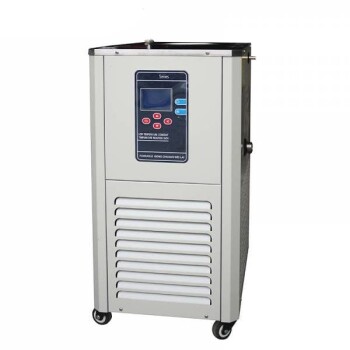
A Quencher is the critical bridge between the chaotic environment of a reactor and the precision required for analysis. It is vital because it utilizes a circulating oil cooling system to rapidly drop the temperature of reactants to approximately 473 K, instantly terminating secondary reactions and preventing physical blockages. Without this rapid stabilization, the data collected by your online analysis system would be inaccurate and your sampling lines would likely foul.
A reaction does not end simply because it leaves the heated zone. The Quencher acts as a "chemical freeze frame," ensuring that the product mix you analyze is identical to the mix that was created, rather than an artifact of slow cooling.
The Mechanics of Chemical Stabilization
Halting Secondary Reactions
In high-temperature experiments, the gas leaving the reactor is often rich in reactive species. Specifically, secondary free-radical reactions can continue to occur even after the mixture leaves the main reaction zone.
If these are not stopped immediately, the chemical composition changes while the sample travels to the analyzer. The Quencher solves this by rapidly cooling the stream to 473 K, effectively quenching these reactions instantly.
Preserving True Distribution
The goal of any experiment is to understand what happened inside the reactor.
By stabilizing the product mix immediately, the Quencher ensures the gas composition entering the analysis system represents the true distribution at the reactor outlet. This eliminates data skewing caused by post-reactor chemistry.
Ensuring Physical System Integrity
Managing Heavy Components
Many high-temperature reactions produce high-boiling-point heavy components.
If the temperature drops naturally (slowly) or uncontrolled, these heavy components can liquefy unpredictably. The Quencher uses its circulating oil system to manage this temperature drop precisely, preventing premature liquefaction.
Preventing System Clogs
A major practical risk in these experiments is the fouling of sampling lines.
When heavy components liquefy in the wrong place, they form condensate that can block narrow sampling tubes. The Quencher prevents this, protecting the online analysis system from physical damage and downtime caused by clogging.
Operational Considerations and Trade-offs
Temperature Specificity
The Quencher is designed to target a specific temperature of approximately 473 K.
While this is effective for many high-boiling components and free radicals, it is not a "cold" trap. Operators must understand that the gas is still significantly hot, and downstream analyzers must be rated to handle or further condition samples at this temperature.
Reliance on Active Systems
Unlike passive air cooling, this method relies on a circulating oil cooling system.
This introduces mechanical variables into the experiment. If the oil circulation fails or fluctuates, the cooling rate changes, potentially re-introducing the secondary reactions or condensation issues the system is meant to prevent.
Making the Right Choice for Your Goal
To ensure your data is valid, consider how the Quencher supports your specific objectives:
- If your primary focus is Chemical Kinetics: You must rely on the Quencher to stop free-radical reactions instantly, or your rate data will be corrupted by post-reactor changes.
- If your primary focus is Operational Uptime: You need the Quencher to prevent heavy condensates from liquefying and clogging your delicate sampling lines.
Ultimately, the Quencher is not merely a cooling accessory; it is the primary safeguard for both your data integrity and your equipment's longevity.
Summary Table:
| Feature | Role of the Quencher | Impact on Analysis |
|---|---|---|
| Secondary Reactions | Instantly halts free-radical reactions | Ensures chemical composition remains unchanged |
| Thermal Management | Rapidly drops temperature to ~473 K | Prevents data skewing from post-reactor cooling |
| Heavy Components | Manages liquefaction of high-boiling species | Protects sampling lines from blockages and fouling |
| Data Accuracy | Freezes the product mix at the reactor outlet | Provides a true distribution of the reaction products |
| System Integrity | Prevents condensate formation in tubes | Reduces downtime and prevents equipment damage |
Secure Your Experimental Precision with KINTEK
Don't let post-reactor changes or system clogs compromise your research. KINTEK specializes in advanced laboratory solutions, including high-temperature reactors and precision cooling systems designed for the most demanding environments. Whether you are conducting battery research, chemical kinetics, or material synthesis, our comprehensive range of high-temperature furnaces, reactors, and cooling solutions—including ULT freezers and cold traps—ensures your data remains accurate and your equipment lasts.
Ready to optimize your high-temperature reaction system? Contact KINTEK today for expert guidance and high-performance equipment!
References
- Stamatis A. Sarris, Kevin M. Van Geem. Effect of Long-Term High Temperature Oxidation on the Coking Behavior of Ni-Cr Superalloys. DOI: 10.3390/ma11101899
This article is also based on technical information from Kintek Solution Knowledge Base .
Related Products
People Also Ask
- What is the necessity of a circulating water bath in chlorate production? Optimize Yield & Purity with Precision
- What function does a circulating cooling chiller perform during the gas adsorption isotherm testing of nanoporous carbon?
- What is the role of low-temperature cooling baths in bio-oil collection? Maximize Yield Through Rapid Quenching
- For which types of substances are water baths and chillers considered ideal? Essential Care for Sensitive Samples
- Why is a circulating water chiller required for Prussian Blue nanoparticles? Ensure Stability & Batch Reproducibility